Latest News
Faced With Starlink Competition, Ground Segment Leaders Turn to Orchestration, Specialization
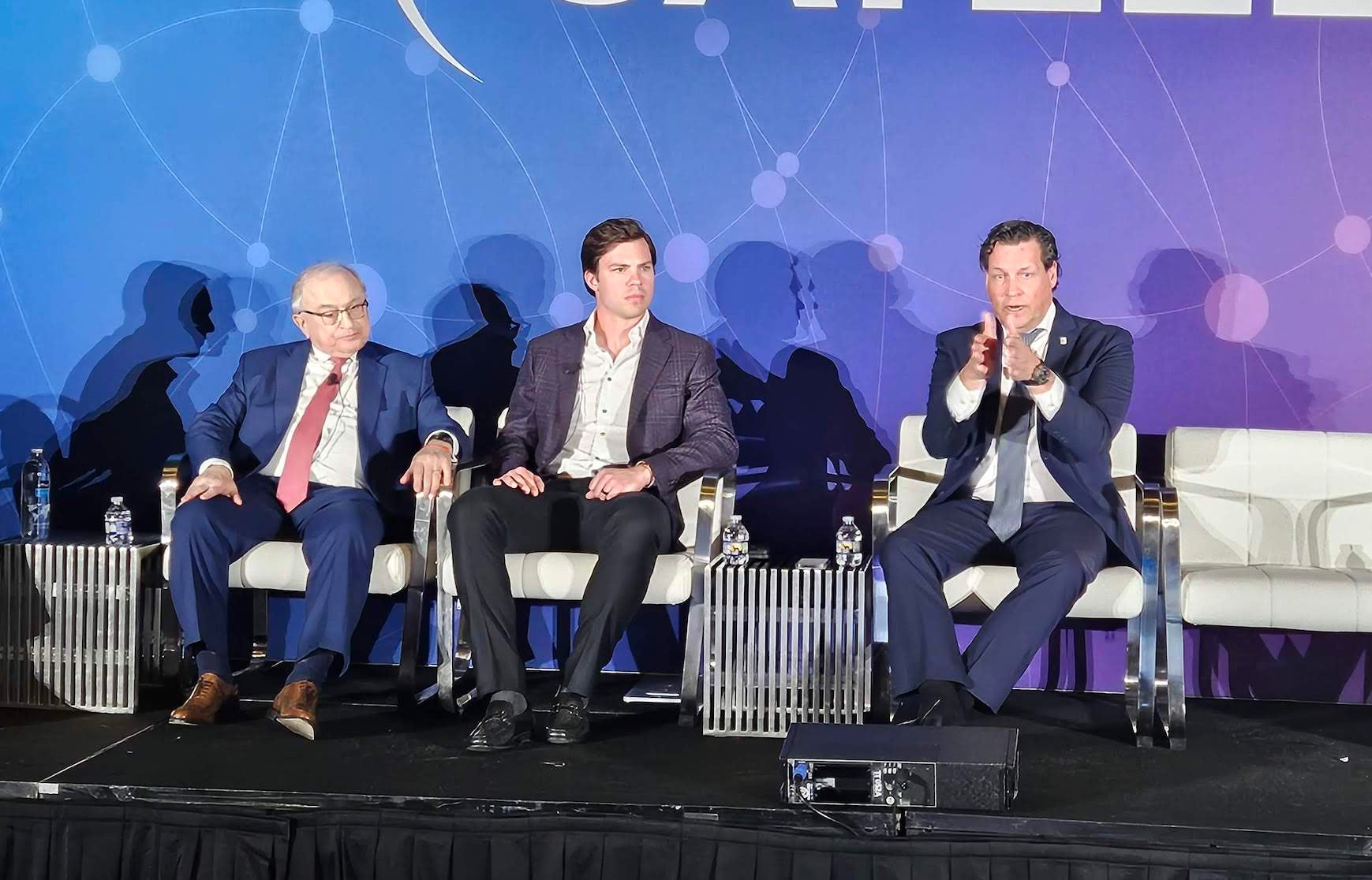
From left: SpaceBridge CEO David Gelerman, Comtech of Comtech Satellite & Space Communications Segment President Daniel GIzinski, and Ovzon CEO Per Noren. Photo: Shaun Waterman for Via Satellite
Faced with the game-changing advent of vertically integrated Low-Earth Orbit (LEO) megaconstellations like Starlink and Amazon Leo, ground segment hardware and service providers are having to rethink both their technology and their business model, a panel of ground segment CEOs told SATShow last week.
“We’ve never been in a more exciting time, honestly, in terms of dollars invested in capabilities in space,” said Per Norén, the CEO of Ovzon, which started out making user terminals but now provides high-end Geostationary Earth Orbit (GEO) satcom-as-a-service capabilities to national security and defense customers.
With investment capital pouring into the space sector writ large, Norén is optimistic. “It’s a fantastic time to be here, right now,” he said.
Calling the new LEO constellations “a formidable capability for general connectivity,” he said they have changed the game.
But Norén added there is still “room for GEO, absolutely,” because of its unique characteristics, though more driven by defense, national security, and public safety customers, for whom a system which you can rely on “almost all the time” just isn’t good enough. “Almost is not a good thing for mission critical,” said Norén.
David Gelerman, CEO of SpaceBridge, which designs, manufactures, and supplies advanced satellite ground networking equipment, was more blunt about the impact of Starlink, which he pointed out had vertically integrated to make their own user terminals and employed massive economies of scale. “They have reduced costs to a bare minimum and passed the savings to the consumer,” he said, “But where it leaves us [ground segment companies] is, it takes us out of the equation.”
Starlink manufactures and sells its own user terminals and operates its own ground stations.
Gelerman agreed that there was a market for GEO, but argued that GEO and other traditional providers — including ground tech purveyors — have basically been evicted from the price-sensitive consumer market segment.
“Geostationary business is far from dead, but it’s geopolitically driven now. If you look at consumer, it’s all gone. There are no broadband customers left. It’s economy of scale again: Starlink kills everybody with prices and performance too. Look what happened to Intelsat and SES. We cannot survive anymore.”
Norén pushed back against that idea, saying the ground segment will still have customers, even among the more price sensitive enterprises, because they are able to offer multi-orbit, multi-frequency devices and services and put them together to build capabilities that users wanted.
End users need to know “What is your use case? What are you going to use it for? And what are your requirements for that? We need to work with the customer side to find the right solution, right for their technology, for their use cases,” Norén said.
Nowadays, that means choosing between orbits, but Ovzon isn’t “obsessed with orbits,” it’s just another choice customers have to make.
“I think we should be more obsessed about how you actually build capabilities and how you do orchestration of all these things. Service orchestration will be the core [of ground segment business] for the future,” Norén said.
Orchestration is “a very hard problem to solve,” he added. “It’s hard for a government to have all of that in house, [because] it needs to come from where the technology evolves, where the integration capabilities are developed,” he pointed out, predicting the emergence of specialist systems and service orchestrators. “Some of us already do it today because the customers want that,” Norén concluded.
The exhibit floor at SATShow was a good illustration of how the industry was changing, said Daniel Gizinski, president of Comtech’s Satellite & Space Communications Segment.
“There’s a lot of new faces relative to who was here six or seven years ago,” he said, adding, “There’s a lot of innovation, and that’s the right thing that we need.”
Ground segment companies needed to find their niche in the new multi-orbit world, he said.
“What makes a business successful is understanding who your customer is, understanding the problem that they have to solve, and then running relentlessly to go solve that,” Gizinski said.
Historically, the ground segment had focused on consumer-grade, direct-to-home connections, because that was the largest market, “But the average value per user is much lower than some of the other markets,” he pointed out.
“The companies that are successful in the future are not going to be the ones that look at the market as one single thing, one size fits all. It’s the folks that understand this is my niche. This is my segment,” that will flourish by solving problems for their slice of the marketplace better than anyone else, Gizinski predicted.
“One of the great benefits of not having to serve that large, consumer grade market is you’re able to run very fast and very focused for special customers,” he said.
The coming direct-to-device revolution is another new market, like LEO, where ground providers would be shut out of the mass market user equipment segment by economies of scale, Gizinski said. Mobile phone manufacturers are already offering 5G handsets with non-terrestrial network (NTN) connectivity “that cost less than a legacy satellite ground station manufacturer could probably ship an empty box for. And I think that’s a reality that we have to face as an industry.”
But there are openings, niches, for ground segment providers, Gizinski argued. “There will be cases for high end user terminals in the direct-to-device world,” he predicted. More importantly, the backend connection between the satellite and the ground station, “That’s very high throughput, typically a higher frequency band, very broad band processing. That’s an area that we excel. That’s something that we’ve done for a long time. That’s our real market,” he said.
Stay connected and get ahead with the leading source of industry intel!
Subscribe Now