Latest News
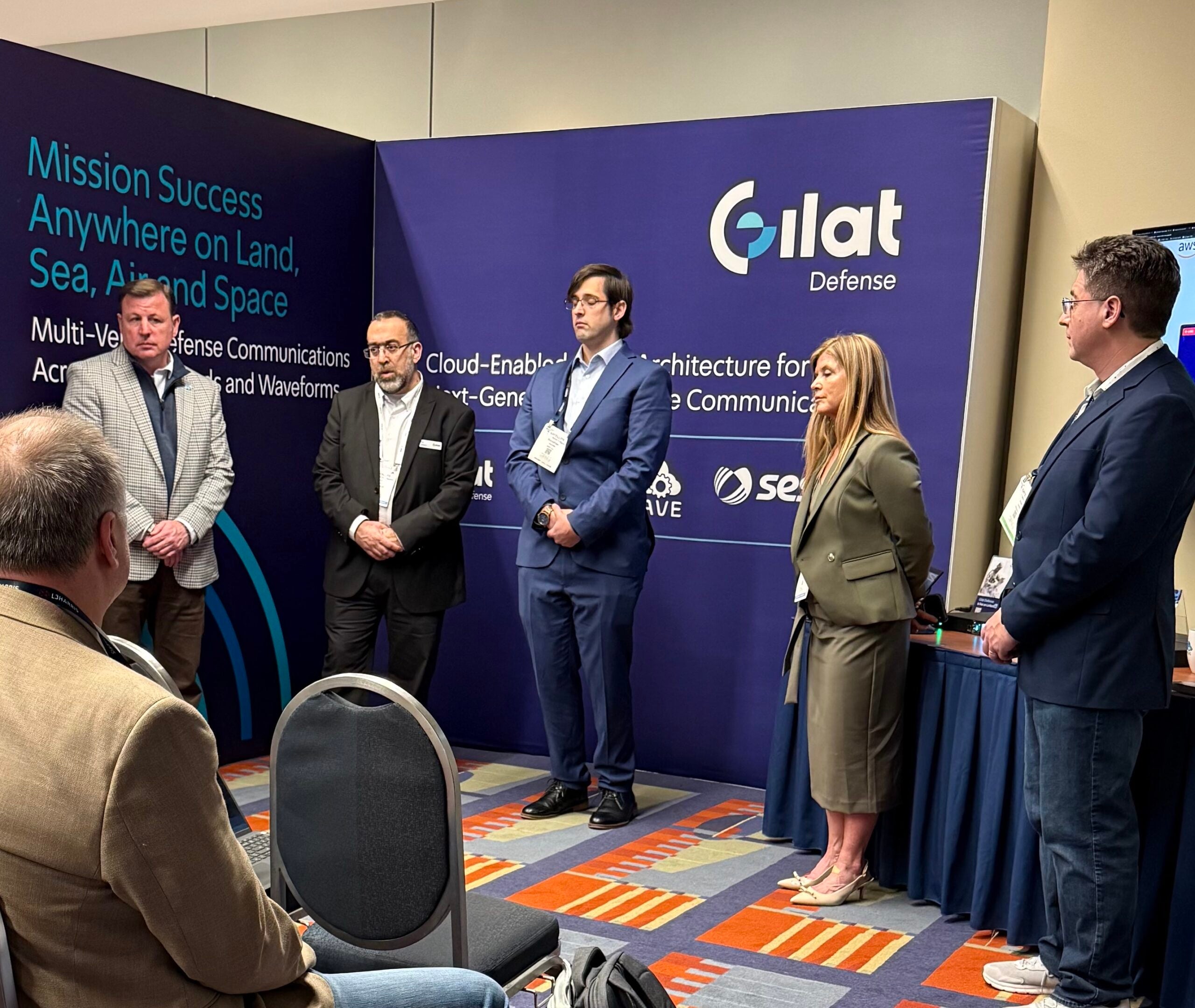
WAVE Consortium members conducted live demonstrations during SATShow Week. Photo: Leandra Bernstein for Via Satellite
Members of the Waveform Architecture for Virtualized Ecosystems (WAVE) Consortium, an IEEE standards body, achieved the first instance of standardized waveform virtualization using field-programmable gate array (FPGA) acceleration in the cloud during SATShow last week.
WAVE members AWS, Gilat, and SES accomplished multiple firsts during a SATShow demonstration, said WAVE Executive Director Juan Deaton. “The biggest one is being able to connect a virtualized cloud platform to an SES gateway, which is something that has not been done before using digital IF.”
The demonstration also marked a milestone for AWS, which used generative AI to provide real-time human-language analysis of RF signals. Finally, the group debuted WAVE’s new specification 1.0, scheduled for public release.
WAVE members took a 10 Mbps video stream from a local laptop and routed it through a Gilat Aquarius Pro modem running the DVBS-2X waveform. Using a satellite emulator, the stream was connected to a digitizer installed at the SES gateway in Hagerstown, Maryland. The digitizer converted the RF signal into a standardized digital IF (DIFI) stream, which was then piped into the AWS cloud over a dedicated 1 Gbps Direct Connect terrestrial link. Once in the cloud, a Gilat virtual modem ran two separate FPGA instances, one to receive and demodulate the stream back into video and another to generate a carrier signal to return traffic through the SES gateway to the physical modem. The two instances were meant to show the feasibility of two-way transmit and receive traffic.
“This has been the holy grail of the industry,” Gilat Chief Technology Officer Dubi Lever told Via Satellite, saying a digital, standards-based approach will unlock interoperability, so users can access multiple waveforms from different service providers on one common architecture. “This was all under the umbrella of WAVE, together with DIFI using a standards-based solution,” he added.
In addition to providing cloud resources, AWS ran a generative AI layer over the top of the process, loading images of IQ Constellation Graphs and analyzing them for anomalies and signal interference.
“One of the things that you tend to do in this industry is analyze the RF signals,” said Donathan Ratcliffe, solutions architect at AWS for Aerospace and Satellites. “That requires someone with knowledge of RF analytics.”
AWS taught a traditional SageMaker AI/ML model to understand complex IQ Constellation scatter plots and deliver human-language analysis of anomalies, noise detection and interference. By automating this process, AWS achieved anomaly detection speeds in the range of sub-100 milliseconds, according to Ratcliffe.
“This is only the beginning of where we’re going, but it’s a necessary place that we have to go,” said Michael Geist, vice president of product management for SES Space and Defense. “This is what our future gateway architectures will look like.”
Geist said SES plans to roll out virtualized infrastructure within its gateways to serve the meoSphere constellation, scheduled to be operational by 2030. SES will also work with the WAVE consortium to incorporate other waveforms, such 5G NTN, Digital Sequence Spread Spectrum (DSSS), 6G and others. WAVE selected the DVB-S2X waveform for the initial demo due to its widespread use across commercial and defense applications.
The ultimate goal is “multi-tenancy,” Lever said, meaning a single gateway or remote can support multiple, independent customers, operators or service providers with minimal proprietary hardware.
WAVE members estimate it will take between 9 to 12 months of “solid engineering effort” to move the virtualization capability from demonstration to a commercial product. Gilat emphasized that it is able to move “at the speed of need” to accelerate the timeline to meet customer demand, such as the need for interoperability with multiple orbits and multiple networks or other use cases.
“This is a proof of concept, showing we can do it,” said Deaton, explaining the demo showed how to deploy standards-based solutions, while maturing the WAVE specification. “It’s about demonstrating the capability to the DoD [Department of Defense] user and commercial satcom.”
According to Deaton, language about waveform virtualization and standards-based digitization has begun to enter DOD requirements, which he says will incentivize scalability and a faster path to deployment. The DOD Chief Information Office, Air Force Research Lab and PEO C3T are currently members of WAVE, representing three of the largest U.S. milsatcom acquisition authorities.
Other vendors have successfully demonstrated cloud-native satcom architectures using software and CPUs. According to Gil Elizov, vice president of Product and Solution at Gilat, those configurations require more power and compute resources than FPGA acceleration, which he says “allows you to do more with less.”
Multiple vendors acknowledged on background that cloud introduces a greater cost than traditional hardware for single carrier links but said cloud-native architectures provide flexibility and resilience that cannot be accomplished with hardware.
The WAVE Consortium kicked off in 2024, with the aim to transform the satcom industry toward a fully interoperable ecosystem by using open and virtualized networks and providing standardized architectures and specifications.
Stay connected and get ahead with the leading source of industry intel!
Subscribe Now