Latest News
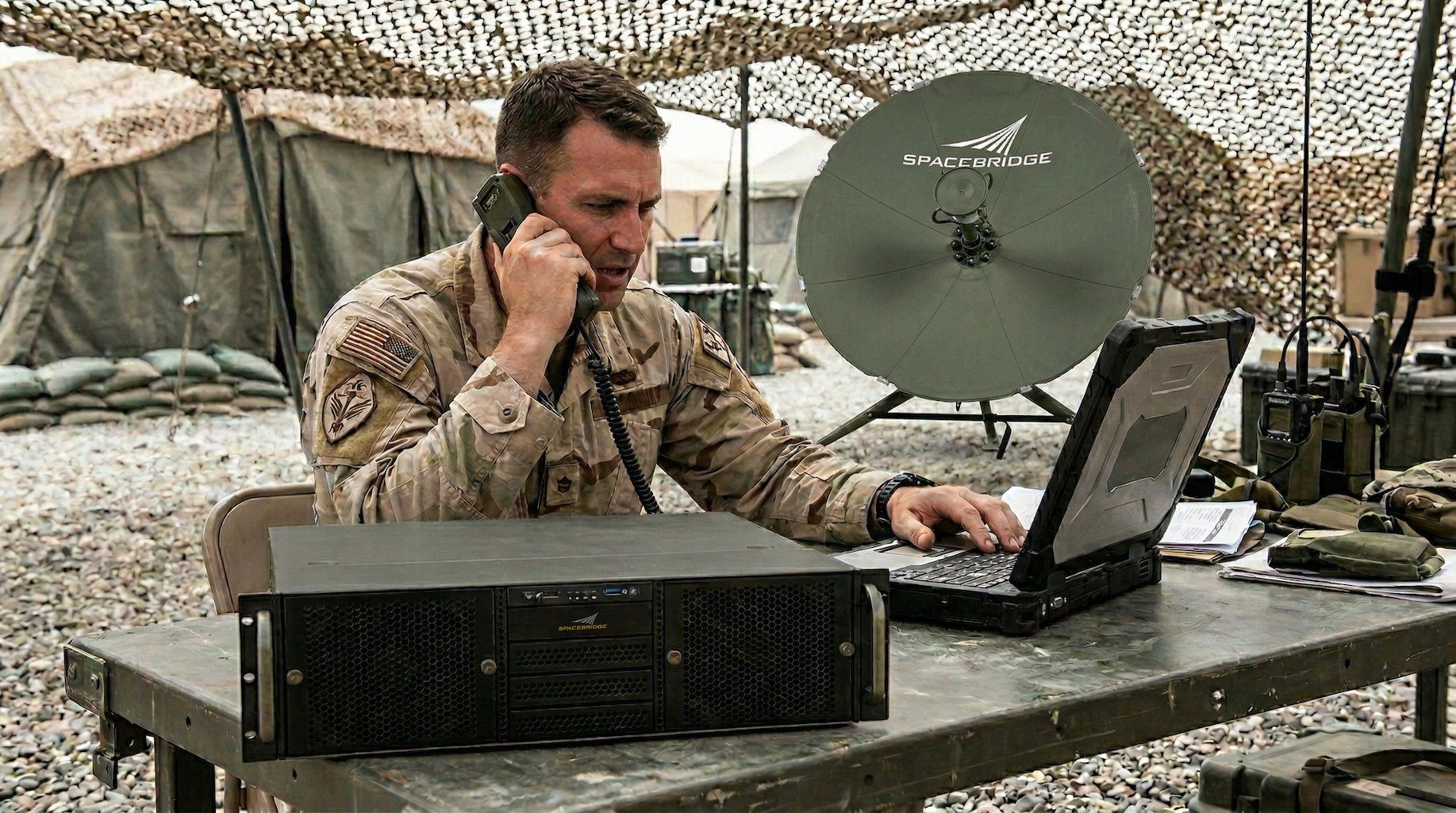
Representation of a deployed UniHub. Photo: SpaceBridge
SpaceBridge is going to launch a new technology solution during SATShow 2026, the UniHub. This is a key launch for the company as UniHub aims to offer a more dynamic, flexible, deployable, modular, software-defined VSAT hub to customers.
SpaceBridge CEO David Gelerman calls the launch a “pivotal” one for the company, as it will enable the company to address new markets. SpaceBridge hopes to have success across both government and commercial markets with UniHub and is expecting a strong dealflow, once the product is launched. In this interview with Via Satellite, Gelerman shares the background behind the launch and ultimately why it could make a huge difference to customers.
VIA SATELLITE: 2026 is shaping up to be a big year with the launch of UniHub. Why is this pivotal?
Gelerman: SATELLITE 2026 marks a defining milestone for SpaceBridge because the UniHub VSAT platform represents a structural evolution in how we deliver satellite ground infrastructure. It is not simply a new product, it reflects a strategic shift toward an integrated, SWaP-optimized, cost-effective, modular, rapidly deployable, software-defined VSAT Hub.
The market today demands greater agility, sovereign capability, simplified installation, reduced deployment timelines, and lower ongoing maintenance requirements. UniHub directly addresses all of these objectives. It consolidates multiple ground segment functions into a unified, compact 3RU enclosure that dramatically simplifies field integration, set-up, and deployment. For SpaceBridge, this launch is pivotal because it expands our addressable market while reinforcing our leadership in advanced satellite network infrastructure.
SpaceBridge CEO David Gelerman
VIA SATELLITE: What are the key new features of UniHub? Are these new to customers?
Gelerman: UniHub introduces several significant advancements. Firstly, it brings true all-in-one integration of VSAT Hub baseband functionality and network management within a compact 3RU form factor. It will also bring enhanced portability, enabling rapid field deployment in minutes rather than days, particularly critical for tactical deployments. Other features include cloud-native orchestration compatibility for hybrid and distributed architectures. UniHub will also have a scalable modular design allowing capacity expansion without network redesign. Secondly, it has a software-defined architecture enabling faster upgrades and feature deployment.
While SpaceBridge has long delivered high-performance satellite ground systems, UniHub integrates these capabilities into a far more compact, agile, and deployment-ready solution. Everything that Estella-Core provides in terms of innovation and superior physical layer efficiency, UniHub offers as well, although, on the reduced capacity and number of terminals simultaneously supported.
Importantly, UniHub delivers substantial SWaP reduction and up to a five-fold performance increase compared to the previous ASAT-II Hub architecture, representing a significant technological leap for our customers.
VIA SATELLITE: What do you expect the dealflow to be in the first 12 months?
Gelerman: We anticipate strong interest across both government and commercial sectors. In the first 12 months, we expect particular momentum in sovereign national network deployments, as well as defense and secure mobility applications. Emerging operators seeking cost-effective rapid market entry for the large, telco grade VSAT platforms are another target customer base. Given current geopolitical dynamics and procurement trends, we expect accelerated evaluation and deployment cycles compared to traditional hub infrastructure. UniHub’s simplified integration and rapid installation significantly reduce both cost and procurement friction.
VIA SATELLITE: Is UniHub targeted more at government or commercial markets?
Gelerman: UniHub is designed to serve both markets. However, its portability and sovereignty-friendly architecture make it particularly compelling for government and defense customers. At the same time, commercial operators, especially in mobility, disaster recovery, private networks, and emerging markets, benefit from its rapid deployment, lower infrastructure footprint, and reduced operational expenditure. UniHub is cross-market by design, enabling SpaceBridge to address multiple high-growth verticals simultaneously.
VIA SATELLITE: How will SpaceBridge tap into sovereign government markets with UniHub?
Gelerman: Sovereign capability has become central to satellite infrastructure strategy worldwide, particularly among Geostationary Orbit (GEO) operators and national governments. Governments increasingly require full in-country control of ground infrastructure, and they have a reduced reliance on foreign-hosted systems. There is also a need for rapid
deployment for contingency and emergency operations. Localization, including knowledge transfer and potential local manufacturing or support is also an important factor and need. UniHub enables exactly that. Its compact and cost-effective architecture allows governments to deploy national hubs quickly, maintain operational autonomy, and scale as required. At events such as SATELLITE, we will emphasize how UniHub supports secure, independent, and rapidly deployable sovereign networks, aligning directly with today’s procurement priorities.
VIA SATELLITE: How is UniHub an evolution from Estella? Is it part of Estella or something new?
Gelerman: UniHub builds upon the technological foundation established by the Estella platform, which introduced advanced digital processing, flexible architecture, and our machine learning-based scheduler. The Estella Scheduler dynamically transitions error free between 3D-TDMA (MF-TDMA) and dSCPC (WaveSwitch) modes in real time, optimizing bandwidth efficiency based on demand and service level agreement (SLA) requirements.
UniHub leverages this core intelligence but packages it into a next-generation, highly integrated, portable deployment model. It is not a replacement for Estella: it is an evolution and expansion, particularly optimized for networks with a lower number of terminals (of up to 1000 user terminals) where cost and deployment agility and maintenance are paramount.
Estella provided the advanced digital backbone. UniHub delivers that intelligence in a compact, all-in-one architecture optimized for modern operational requirements.
VIA SATELLITE: Why is portability important? Does it open new markets?
Gelerman: Portability is increasingly critical because customers require a number of different things now. These include, for example, rapid response capability, as well as expeditionary deployments supporting global defense operations. Government customers need disaster recovery readiness and tactical military applications. Given the pace of change, there is a desire to have cost-effective infrastructure rollouts in emerging markets. Traditional hub deployments are complex and time-intensive. UniHub dramatically reduces deployment time and logistical burden.
This portability opens opportunities in a number of different fields. UniHub could play a key role in defense and field operations, for example. Other use cases could include humanitarian missions, remote industrial and energy sites, enterprise and private networks, and also IIOT. Portability, combined with cost efficiency, significantly expands our accessible market segments.
VIA SATELLITE: Why is an all-in-one solution important?
Gelerman: Historically, satellite ground systems have relied on multi-rack, multi-vendor, integration-heavy architectures. This approach is not the most efficient way of doing things. For example, it can increase things such as deployment time and power consumption. There are bigger space requirements. There is also an integration risk, and the total cost of ownership is much higher.
An all-in-one architecture will simplify the entire operational model. It will deliver things such as worry-free operation. It will enable customers to generate revenues faster. It will also mean a lower operational overhead. It will also provide a reduced integration complexity and cost. Significantly, there will also be a smaller footprint and a significantly reduced power consumption. For new entrants and sovereign programs in particular, this represents a genuine step change in how ground infrastructure can be deployed and managed.
VIA SATELLITE: What does the future hold for other Estella-based solutions?
Gelerman: Estella remains a core technology platform for SpaceBridge. Looking ahead, we expect to implement and deliver a continued feature expansion through software upgrades. We will also enhance cloud-native and virtualization capabilities. There will also be an expanded integration with emerging satellite constellations
hybrid interoperability for GEO, Medium-Earth Orbit (MEO), and Low-Earth Orbit (LEO). UniHub does not replace Estella, it extends its reach. Our broader roadmap continues to build on Estella’s digital processing and intelligent network control capabilities.
VIA SATELLITE: With NATO nations ramping up defense spending, how does this impact the industry? Is defense now the biggest market?
Gelerman: Increased defense spending among NATO nations has significantly accelerated demand for secure, resilient satellite infrastructure. For example, we are seeing a greater emphasis on geographical redundancy/disaster recovery and network resilience. Other important trends include seeing a stronger investment in sovereign ground infrastructure, and faster procurement cycles for deployable systems.
Defense is certainly one of the fastest-growing segments. However, commercial markets particularly mobility, enterprise connectivity, and private networks remain strategically important. For SpaceBridge, the defense growth trend reinforces demand for solutions like UniHub, but we continue to maintain a balanced and diversified portfolio across sectors.
VIA SATELLITE: Beyond UniHub and Estella, what is next on SpaceBridge’s technology roadmap?
Gelerman: While we cannot disclose proprietary details, SpaceBridge is actively investing in areas such as advanced software-defined networking enhancements. We are also looking at greater automation and AI-assisted network optimization. We are also focused on cloud-native management platforms, as well as, multi-channel mesh infrastructure. Given the multi-orbit nature of the satellite market right now, we are also looking at multi-orbit interoperability across GEO, MEO, and LEO. Our broader vision is to ensure that ground infrastructure evolves in parallel with increasingly dynamic and distributed space architectures.
VIA SATELLITE: How will SpaceBridge stay ahead in a competitive satellite market?
Gelerman: We differentiate ourselves through technology leadership. We can implement advanced physical layer and digital processing and scalable architectures. Operational agility is also important to us. We can provide customers with faster deployment and simplified integration compared to legacy competitors. Intelligent resource management is also at the heart of our approach. Our scheduler dynamically reallocates frequency bands on-the-fly based on demand and SLA requirements, eliminating the need for rigid pre-set frequency planning.
We are very focused on the customer and we look at providing customer-centric engineering, so tailored solutions rather than rigid product models. We have a strategic alignment with sovereignty and portability trends. The satellite ground segment is evolving rapidly. Staying ahead requires continuous innovation, investment and responsiveness to geopolitical and market shifts, delivering practical solutions that reduce complexity for operators. UniHub embodies that strategy.
Stay connected and get ahead with the leading source of industry intel!
Subscribe Now