Latest News
Space Force and Industry Partners Push Speed and Hybrid Architectures to Maintain Space Superiority
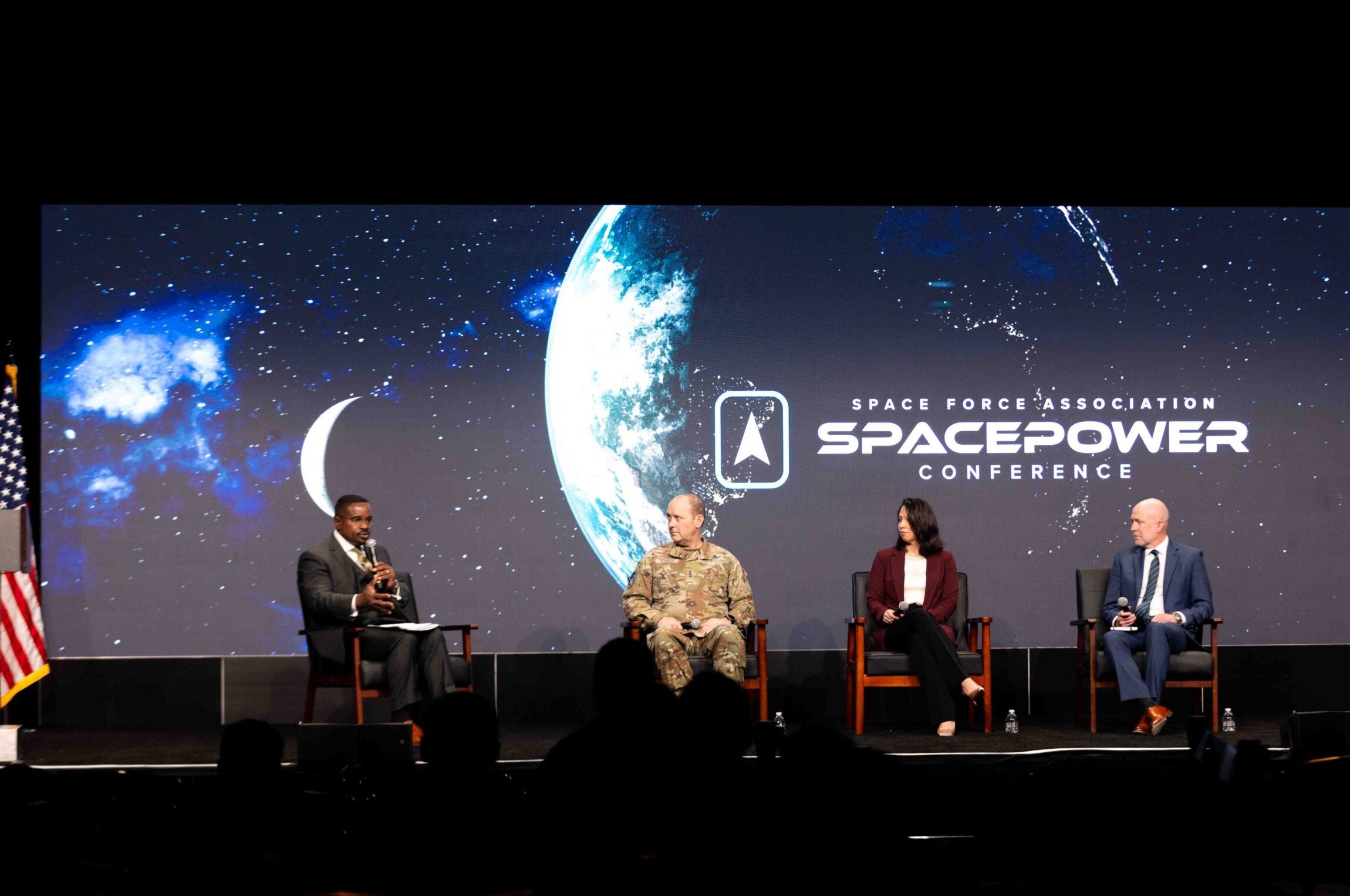
Amazon Leo for Government President Rick Freeman moderates a discussion on missile warning and missile defense at Spacepower with Lt. Gen. Douglas A. Schiess, Dr. Jes Kalmanson of Peraton, and Jeff McCall of Raytheon. Photo: Space Force Association
As space is no longer a supporting domain, but recognized as a decisive, warfighting one, U.S. Space Force leaders, defense primes, and commercial partners are working to ensure the U.S. maintains space superiority, while working through the challenges of embracing speed and resilient hybrid commercial-government architectures.
Space and cyberspace are increasingly where conflicts will be decided, said Amazon Leo for Government President Rick Freeman during the recent Spacepower event in Orlando, hosted by the Space Force Association.
“The modern warfighter faces an unprecedented challenge accessing critical data at the speed of relevance in contested environments where traditional communications can be jammed and compromised or unavailable. As such, speed and resilience will be critical to the future of the warfighter,” Freeman said.
He identified the key question that both the Space Force and industry partners are focused on — How do we ensure America maintains superiority in this most contested environment?
Freeman commended Space Force General B. Chance Saltzman, Chief of Space Operations, for championing a commercial space strategy that recognizes that the “the future of space operations is hybrid by design.”
“General Saltzman gets something fundamental. In my opinion, America’s advantage in space doesn’t come from building fortress constellations that take 15 years to field — it comes from speed, from resilience, and from treating commercial capabilities as force multipliers rather than afterthoughts.”
Saltzman spoke to the Space Force’s journey from concept to readiness over the past six years. That journey has taken the Space Force from a service in establishment to a “purpose-built combat-credible, warfighting force.” December marked the Space Force’s sixth birthday as it was officially created in December 2019.
“Over the past year, we’ve seen the complex national security environment evolving almost daily. We also saw sweeping calls to reform departments’ acquisition practices. If we expect to win tomorrow’s fight in space, the air, on land or at sea, Guardians and their weapon systems must meet and defeat highly capable threat arrays that are being fielded today,” Saltzman said during his December 11 address at Spacepower.
Saltzman said the Space Force has embraced the Pentagon’s call to reform acquisition. For the Space Force, this will include a more agile requirements process, reorganized acquisition authorities, a new organization focused on clearly defining operational concepts and objective force, Saltzman said.
He spoke to the critical nature of the Space Force’s partners.
“Space is the ultimate team sport,” Saltzman said. “We simply cannot succeed without our industry teams, without our collaboration with academia and our international allies and partners.”
That “team sport” nature was a key part of discussions during Spacepower, as partners work through challenges to build a collaborative ecosystem focused on maintaining U.S. space superiority.
These hard conversations between governments, commercial providers and primes are a mark of progress — with governments rethinking acquisition timelines and primes integrating commercial capabilities, Freeman said while accepting the Innovation Award during the Spacepower Excellence Awards.
“We’ve learned that the most impactful innovations come from creating an environment where our partners thrive, from small defense contractors to major systems integrators,” Freeman said. “By providing the technological infrastructure and tools that empower these partnerships, we’ve seen remarkable solutions emerge that directly enhance military readiness and capabilities.”
Freeman said this type of collaborative approach has brought about solutions that wouldn’t have come about otherwise.
“The future is not winner take all,” Freeman said. Instead, success is built on partnering to give commanders options instead of “locking them into a single dependency. We want options,” he added.
“The work ahead is about building an ecosystem where American innovation can move at speed, where allies can interoperate without friction, and where commanders have the tools they need when threats evolve faster than the procurement cycles can handle,” Freeman said.
Missile warning and missile defense is one area where speed and the power of partnership is crucial.
Lt. Gen. Douglas A. Schiess, Deputy Chief of Space Operations for Operations, U.S. Space Force, described a new threat environment where the Space Force has to consider threats like hypersonics, fractional orbital vehicles, and direct ascent anti-satellite weapons. This evolved threat environment requires more resilient defenses.
“We can’t just rely on one orbital regime anymore. We’ve got to go to other regimes to be able to get after what provides us resiliency, so it isn’t that big, juicy target,” Schiess said during a discussion on missile defense. “We’ve got to have multi-faceted orbits. We have to have more satellites and we have to have resilience in different ways.”
Schiess said a space data network is a critical layer to missile defense capabilities — to take all of the data collected on the threats to the warfighter at the speed of relevance.
Commercial solutions will likely play a role in data transport for missile defense architectures, Jeff McCall, Vice President, Mission Solutions & Payloads at Raytheon Air & Space Defense Systems, said during the discussion.
“There have to be parts that are going to be government-[owned], but we have to leverage the commercial providers. We have to leverage that proliferated orbit, that data network to be able to get that information. We’re working with our partners,” McCall said.
Freeman echoed the importance of this data transport, and the role proliferated Low-Earth Orbit will play here.
Dr. Jes Kalmanson, Peraton CTO for Space and Intelligence (S&I), spoke to the importance of integration. The environment with government constellations, commercial sensing and allied capabilities is only growing more complex.
“Integration is where capability manifests — but I’d like to take it one step further — integration is where missions fail or succeed,” Kalmanson said.
In this more complex environment for integration, modernizing existing systems comes with the challenge of maintaining 24/7 mission availability, while upgrading the infrastructure underneath, she added.
She described resiliency as a design philosophy, built in from the beginning.
“It is not if you lose nodes — it’s when you use nodes. How will your system react? Will it degrade gracefully, or will it catastrophically? And now we have to think of these dynamic re-routing around failures and making sure the operators know when it’s working and when it’s degraded,” Kalmanson said.
The future vision is a battle space where every sensor, platform, and operator are connected through resilient, high-throughput networks distributed across multiple satellites, Freeman said in a discussion on how space is an enabler of multi-domain operations.
“Space is fundamentally transforming multi-domain military operations through next-generation networking capabilities.” Freeman said. “The traditional silos that have been limiting joint operations are breaking down, enabling commanders to coordinate and execute multi-domain operations with unprecedented speed and effectiveness.”
Robert Lightfoot, President of Lockheed Martin Space, spoke to the importance of open system architectures. When capabilities were developed in the past, the idea that systems would have to interoperate with each other wasn’t in consideration. Now, systems must be designed to be updated more like software, Lightfoot said.
Partners agreed that winning in space depends on how fast systems can evolve, recover, and deliver information — not how long they take to build.
The defense industry has to move to faster speeds, even though it introduces risk into the system. “We may fly something that doesn’t work because we went fast. But I’d rather have something up there that I can maybe save than have it sitting on the ground,” Lightfoot said in terms of how Lockheed Martin Space has changed its approach.
Lightfoot called it a “Sputnik moment” every time China launches new capabilities to space.
“The two oceans don’t protect us anymore,” he cautioned. “I’m not trying to scare everybody to death — but we need people to understand the reality of the situation that we’re in. The old way of doing business isn’t going to work going forward.”
During his acceptance speech, Freeman said there’s been concern that commercial providers would take over from traditional defense primes, but that’s not the case. In this contested environment, everyone needs to come to the table to build an ecosystem of innovation, he argued.
“What we are seeing is partnership. The government needs the scale and innovation cycle that commercial brings. And commercial needs the mission expertise and operational rigor that primes and the government labs bring,” Freeman said. “The space domain is increasingly contested, and these challenges will increasingly require collective solutions to achieve our national security objectives. I believe that the team we have assembled is up to the challenge.”
Stay connected and get ahead with the leading source of industry intel!
Subscribe Now