Latest News
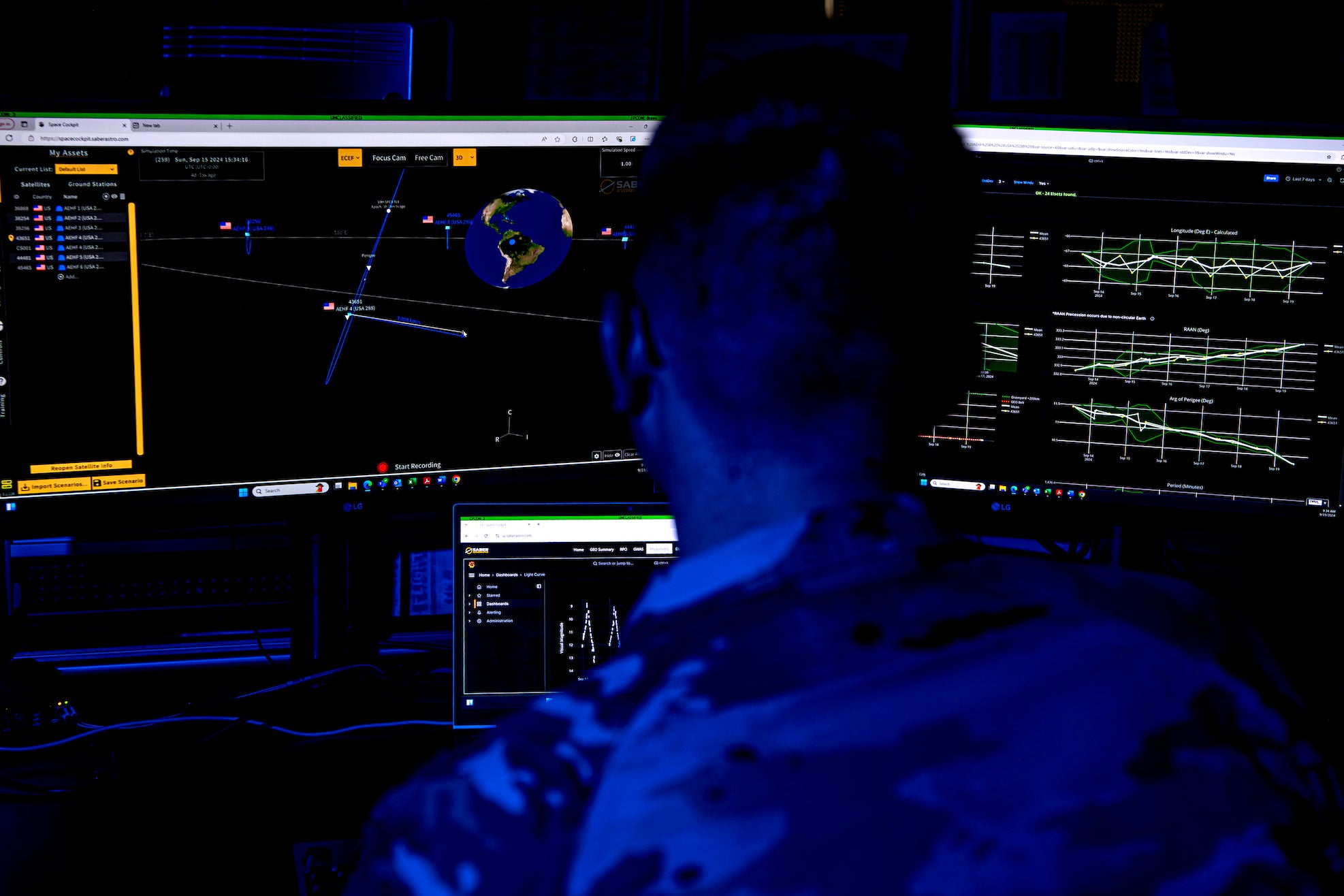
A 4th Space Operations Squadron tactician conducts analysis of possible satellite maneuver detection at Schriever Space Force Base, Colo. Photo: U.S. Space Force
“The Space Force was established … in recognition of one key fact: space is a warfighting domain,” Gen. B. Chance Saltzman, chief of space operations, recently testified. He added that “it is highly likely that satellites will be some of the first casualties of any conflict between the U.S. and China.”
He’s absolutely correct. Beyond kinetic anti-satellite attacks, U.S. satellites face the prospect of electromagnetic interference, collisions, close-proximity manipulation, and other gray-zone actions that can disable or displace critical systems.
These threats aren’t speculative; they’re observable today. Ambiguous satellite maneuvers, unexpected repositioning of high-value assets, and deliberate gray-zone activities are not hypotheticals – they are routine features of the current space environment. Space is already contested, and in ways that demand more than passive awareness.
Nowhere is this stark reality better articulated than in “Contested Space: Ensuring Effective U.S. National Security Space Capabilities in an Increasingly Contested Environment,” edited by defense and intelligence space experts Christopher A. Williams and James J. Frelk.
The book includes chapters on timely national security space topics as well as actionable recommendations for Washington to increase U.S. space dominance in the face of increasingly sophisticated threats to critical space systems.
Who is Doing What in Space and Why?
As Saltzman has emphasized, securing the domain and surviving threats are now core missions of the Space Force. In contested space, “securing the domain” starts with persistent awareness of who is doing what where and, critically, why. It’s more than episodic coverage of an adversary’s activity or forensic reconstruction of something that happened days ago. Rather, securing the domain demands a sustained ability to observe and interpret activity as it unfolds. This is true space domain awareness (SDA) and a nonnegotiable prerequisite for U.S. dominance in space.
“Contested Space” cites deterrence as another pillar of dominance: “Deterrence in space must be based on resilience, survivability, denial of benefit, and attribution.” This last piece, “attribution,” means conclusively identifying the actor behind an action and their intent. Since many space activities involve dual-use technologies – assets that are useful for civil, commercial, and military purposes – intent can be hard to pin down.
That’s why attribution is too often treated as a policy problem. But in practice, it’s a tempo problem.
If attribution is slow, adversaries learn they can act and reset before their activity is identified. They learn their opponents lack the fidelity to call them out without ambiguity. This ambiguity becomes their sanctuary.
Why is This Russian Satellite Following Us?
Russia’s LUCH (OLYMP) satellites exemplify this challenge. The original LUCH (OLYMP), launched in 2014, spent years maneuvering near high-value commercial satellites, particularly those operated by communications giant Intelsat, maintaining uncoordinated formations as close as 10 kilometers.
These prolonged behaviors weren’t acknowledged by Russia and were not benign. They raised alarms across the commercial space community and among allied governments.
A decade later, in August 2024, the original LUCH (OLYMP) closed to within 2 kilometers of Intelsat-37E. LUCH (OLYMP) 2 launched in March 2023 and employed an identical maneuver with Intelsat 1002, coming within 3 kilometers.
These are not fleeting encounters. They are deliberate, prolonged formations that raise the prospect of surveillance, signals collection, or prepositioning for counterspace missions. These actions lie squarely in the gray zone: operationally ambiguous, politically deniable, and technically difficult to characterize without persistent, high-accuracy SDA.
We Need Better SDA
In written testimony to Congress, Gen. Stephen N. Whiting argued that achieving and maintaining space superiority in a contested domain is a core responsibility of U.S. Space Command. As he put it, “This critical task requires more accurate, robust, resilient, and timely Space Domain Awareness.”
“Contested Space” extends that declaration by emphasizing that strategic advantage flows from the ability to decide faster and more confidently than the adversary. That doesn’t just mean knowing where hundreds of thousands of space objects are. It means understanding what they’re doing, what they’ve done, and what might happen next.
We’ve seen that when awareness is sustained and responsive, decision-makers can operate with tempo. They can respond to maneuvers within hours – not days. They can characterize intent, not just location.
When decisions are informed by persistent, real-time, and reliable data, the fog begins to lift. Strategic ambiguity gives way to operational clarity. That’s how you generate decision advantage, by staying inside the adversary’s OODA (observe, orient, decide, act) loop and forcing them to operate at a tempo they can’t match.
In October of 2024, Intelsat 33E suffered a catastrophic on-orbit anomaly in Geostationary Orbit (GEO). Previous GEO events – AMC9, TELKOM1, and Intelsat 29E – produced debris, but IS33E was different. It released hundreds of trackable fragments – an unprecedented scale of debris for a single satellite in GEO.
Resolving the full scope of the debris field required coordinated multi-site observations, fused tracking data, and days of sustained analysis to confirm object separations and safeguard nearby assets. We knew what was happening. No ambiguity.
And in this case, we confirmed there was no adversary involvement, which is important to know. As “Contested Space” says, “In the absence of verifiable attribution, escalation risks rise.” The ability to maintain persistent, credible observation isn’t academic – it’s a shield against misjudgment.
Commercial Innovation and Operational Consequence
In “Contested Space,” John Paul “JP” Parker examines why commercial innovation often struggles to penetrate the defense acquisition system. Drawing on decades of experience, Parker argues that despite policy rhetoric encouraging commercial integration, many officials remain dependent on cleared defense contractors and wary of nontraditional firms.
That cultural friction has operational consequences. If decision advantage in contested space depends on persistent, real-time space domain awareness, then failing to adopt the fastest and most capable commercial capabilities is not merely a procurement inefficiency — it is a strategic vulnerability. Eliminating strategic ambiguity requires not only better sensors, but faster integration of the best available tools.
If the next war starts in space, events such as IS33E foreshadow what those opening moments might look like – and why we must be ready to interpret them before the world reacts.
The “Contested Space” chapter by Scott Pace, director of the George Washington University Space Policy Institute, reminds us that international law still governs space, and that escalation control depends on distinguishing hostile intent from incidental behavior.
But that distinction only exists if you can prove it. Norms only stabilize behavior when violations are visible.
Legitimacy restrains escalation only when attribution is credible. In this sense, SDA isn’t just a military tool; it’s a strategic stabilizer. SDA enables both deterrence and diplomacy.
The strategic picture in “Contested Space” is clear. Its diagnosis is urgent. What’s needed now is the operational continuity to carry that urgency forward – through integration, readiness, and persistent awareness.
From the operator’s perspective, contested space is not an emerging condition. It is the daily baseline. The behaviors described in the book – RPOs (rendezvous and proximity operations), gray-zone activity, capability signaling through maneuver – aren’t future threats. They’re recent events.
And robust SDA is not an accessory to space power. It is what allows freedom of action to exist at all. So, as the space environment continues to evolve (often in quiet, subtle ways), our ability to detect, interpret, and respond without ambiguity will determine not only what we can do in orbit, but whether we can act at all.
Certainty will be our sanctuary.
 Clinton Clark serves as chief growth officer and vice president of first impressions at ExoAnalytic Solutions, a leader in space domain awareness for defense and commercial organizations. Exo fields the world’s largest commercial telescope network. On March 10, Anduril Industries announced it is acquiring ExoAnalytic Solutions.
Stay connected and get ahead with the leading source of industry intel!
Subscribe Now