Secure satellite communications form the invisible backbone of modern defense operations, quietly enabling missions and connecting forces across the globe. Yet these systems are facing mounting challenges. From cyberattacks and jamming to eavesdropping and the complexities of hybrid warfare, the threats are growing more sophisticated and persistent.
In today’s climate of geopolitical instability, Europe’s need for sovereign, secure, and resilient communications has never been more urgent. The continent can no longer afford to rely heavily on external providers for such a critical capability.
The Strategic Imperative for Secure Connectivity
Threats to satellite communications are growing in both sophistication and scale, ranging from cyberattacks that corrupt or hijack data flows to jamming that disrupts signal continuity and eavesdropping that exposes sensitive information. These risks are further compounded by hybrid warfare tactics, which blend digital intrusions with physical and political pressure to destabilise opponents.
For Europe, ensuring operational resilience requires more than an incremental upgrade and calls for a complete rethink of sovereignty in defense communications. Reducing reliance on external providers and embedding security into the very fabric of communications systems has become a strategic imperative.
This is the driving force behind the European Protected Waveform (EPW), a program created to ensure secure communications even under the most contested conditions while reinforcing Europe’s ability to operate independently of external technologies or political constraints. In this context, EPW emerges not only as a technological breakthrough but as a strategic shift in the future of European defense communications.
Born from the European Union’s strategic vision and enabled through the European Defence Fund (EDF), this transformative multi-year program represents the EU’s commitment to fostering European defense industrial cooperation while strengthening technological sovereignty. The program is built around the triple helix between industry, the EU Commission and the ministry of defense of 13 EU member states.
Phase one of the program established the technical foundation, defining the baseline requirements for resilience against cyber and electronic threats, embedding “security by design” into the architecture. It involved expertise from 22 partners from 12 Member States, spanning ministries of defense, industry leaders, and academic institutions. The result was a roadmap for a European waveform designed to resist disruption in even the most hostile environments.
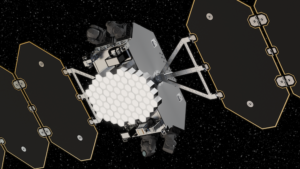
Phase two, now underway, shifts from design to deployment. Prototypes are moving from the lab into real-world testing, with integration planned into flagship EU programs such as IRIS², Europe’s next-generation secure satellite constellation, and GovSatCom, which provides secure services for governmental and military missions. With this evolution, EPW is becoming more than a project. It is set to become the secure communications standard for European defense.
The Multi-Orbit Paradigm
No single satellite orbit can meet Europe’s defensive needs. Geostationary (GEO) satellites offer global coverage but suffer from latency, whereas Low-Earth Orbit (LEO) satellites deliver high-speed, low-latency links but lack persistence. Medium-Earth Orbit (MEO) and Highly Elliptical Orbit (HEO) provide unique coverage advantages, particularly for polar and Arctic regions.
Therefore, a multi-orbit architecture is essential. By combining orbits, Europe gains the flexibility to adapt to mission requirements, redundancy to withstand attacks or disruptions, and assurance that communications persist even under duress.
EPW sits at the heart of this ecosystem, acting as the secure binding layer that ensures seamless operation across orbits and domains. It supports advanced techniques such as latency mitigation for GEO-based users, best-path routing and satellite switching algorithms that enable transitions to HEO for extended Arctic coverage, and integration with terrestrial 5G and non-terrestrial networks.
Preparations are already underway for seamless roaming between satellite and terrestrial networks, ensuring uninterrupted connectivity across every operational environment. For military users, this means that whether they are operating at sea, in the air, on land, or in space, communications remain secure, resilient, and uninterrupted.
Sovereignty, Security, and Interoperability
The promise of EPW extends far beyond technology. At its core, the initiative addresses Europe’s strategic dependence on external actors.
By establishing a European-designed, European-owned secure waveform, the continent achieves true sovereignty in defense communications. Reliance on non-EU providers for critical links is reduced, while a single standardised waveform across Member States ensures seamless interoperability, simplifying joint operations and making them smoother, faster, and more effective. Built-in resilience also guarantees continuity under duress, keeping communication links intact even in cyber-contested or electromagnetic warfare environments.
This is particularly vital as Europe scales up collective operations, where multinational forces must coordinate seamlessly without fear of compromised links. The initiative strengthens not just the technical layer of communication but the very foundation of Europe’s ability to act as a unified defense actor.
While EPW is fundamentally a defense initiative, its applications extend to other critical areas. Secure, resilient communications are equally vital for emergency response in natural disasters, for the protection of critical infrastructure such as energy grids and transportation systems, and for civil security operations including border management and maritime surveillance.
As Phase two progresses, EPW is poised to deliver demonstrable, integrated prototypes capable of real-world evaluation. These will feed directly into operational readiness planning, preparing the ground for deployment across European defense networks. With its integration into IRIS² and GovSatCom, EPW is set to become the missing puzzle piece in Europe’s layered communications architecture, binding together multi-orbit satellites and terrestrial systems into one coherent, resilient ecosystem.
The forward trajectory is unmistakable. EPW is not simply another technological upgrade but a cornerstone of Europe’s sovereignty. The waveform’s role as a common standard across Member States will enhance interoperability, streamline joint missions, and strengthen deterrence by guaranteeing secure connectivity even under attack.
In an age defined by cyber threats, contested domains, and unpredictable geopolitics, EPW represents the backbone of a future-ready Europe. It is not only a secure waveform but a strategic revolution, ensuring that Europe remains resilient, autonomous, and united in the face of modern hybrid warfare. More than just technology, EPW is the foundation of Europe’s future defense networks, and, ultimately, of its sovereignty.
 Koen Willems is the vice president of EU Programmes and Government Relations at ST Engineering iDirect Europe.
The European Protected Waveform (Phase 2) is funded by the European Union. Views and opinions expressed are however those of ST Engineering iDirect Europe only and do not necessarily reflect those of the European Union or the European Commission. Neither the European Union nor the granting authority can be held responsible for them.