Non-terrestrial networks (NTNs) are poised to play an increasingly vital role in next-generation networks, with applications in 5G and 6G, as well as mission-critical communications and defense. Comprising base stations aboard interconnected satellites, high-altitude platforms (HAPs), and uncrewed aerial vehicles (UAVs), these networks can extend high-speed connectivity to remote, rural, and underserved areas, and to provide critical coverage during disasters.
An NTN can comprise any combination of aerial or space stations and a gateway that connects the non-terrestrial access network to the core network. In a similar way to terrestrial cellular networks, a service link connects the terrestrial terminals to the access network, and a feeder link connects the satellite access network to the gateway.
The diversity of platforms enables multi-layered coverage, with UAVs at altitudes of a few hundred meters, HAPs operating in the stratosphere at about 20 km, and satellites in Low-Earth Orbit (LEO), Medium-Earth Orbit (MEO), and Geostationary Orbit (GEO) orbits. This architecture facilitates several important use cases that have proved challenging or impractical to realize with conventional terrestrial cellular networks. These include delivering 5/6G broadband services to rural areas and other remote locations, including at sea. In addition, the flexibility to launch UAVs on demand can provide sophisticated communication services to support disaster relief and emergency connectivity.
Moreover, NTNs enable cost-effective delivery of mobile broadband to hotspots or areas of high demand, avoiding the costs associated with installing fixed infrastructure, and can be used to boost service delivery to users at cell edges. NTNs can also provide global continuity of service for IoT applications.
Among numerous enabling technologies that are critical for realizing these networks, major recent advancements include ubiquitous and affordable UAVs, as well as commercial access to micro- and pico-satellites and private launch services driven by the emergence of the new space market. These have helped significantly drive down the cost of setting up a satellite-based network. In addition, software-defined networking as well as advancements in directional antennas, which permit broadband service delivery within a limited radio frequency (RF) link budget, have made NTN deployment more feasible and flexible. These innovations allow for efficient service delivery and the rapid expansion or reinforcement of networks.
Implementing NTNs
Despite their promise, NTNs bring significant technical and operational challenges. The dynamic movement and diversity of airborne and space stations complicate network orchestration. Constellations of satellites are needed to ensure continuity and, similarly, UAVs can be deployed in swarms, calling for advanced constellation management with seamless handovers and effective load balancing. Whereas terrestrial networks are characterized by a fixed infrastructure, the rapidly moving platforms represent a reversal that introduces issues such as large Doppler shifts, rapid link changes, and the need for advanced synchronization algorithms.
Latency and propagation delays also pose serious concerns for NTNs, as signals in NTNs experience much longer round-trip times (RTT) compared to terrestrial networks. These can exceed the limits defined in standard protocols such as TCP, requiring special acceleration and adaptation techniques to maintain high data throughput.
Moreover, as 5G and 6G access networks, including terrestrial networks, utilize mmWave frequency bands to support broadband services, operating at these frequencies in space brings severe challenges such as range limitations, atmospheric attenuation, and interference. Maintaining reliable, high-capacity connections with mmWave frequencies demands precise beam alignment, which is possible using directional antennas but at the same time is made difficult because the satellites move at high speeds. Loss of beam alignment can disrupt data exchanges unless compensated by sophisticated tracking and error correction methods.
Interoperability and coexistence are, of course, crucial. The different types of NTN elements and terrestrial systems must work seamlessly together, especially for handovers, timing, and network management. NTNs must also coexist with pre-existing satellite systems, such as weather satellites, operating in similar mmWave frequency bands.
Environmental factors must also be tackled, such as fading due to multipath propagation, shadowing from terrain or obstructions, and atmospheric phenomena like rain fade and ionospheric scintillation. These are far more pronounced in NTNs than in terrestrial networks.
Clearly, NTNs offer transformative potential for global connectivity. On the other hand, implementing these networks depends on overcoming numerous technical, operational, and environmental challenges and demands rigorous system validation.
Test Challenges
New approaches and platforms are needed for testing and validation that effectively address the dynamic and complex nature of NTNs. Because opportunities for real-world testing are limited, and mistakes are expensive, equipment developers need to assess the overall network reliability, stability and performance accurately before installing equipment and launching vehicles, particularly HAPs and satellites. Despite today’s relatively easy and affordable access to commercial launch services, the expense and risks associated with putting a satellite into any orbit remain relatively high.
Equipment developers therefore need a test platform capable of evaluating end-to-end network performance, including emulating satellite and UE mobility under realistic conditions including terrain, weather, and Doppler effects. Testing satellite payloads and link budgets, ground stations, and 5G core components is also needed, to support full-stack validation of NTN systems.
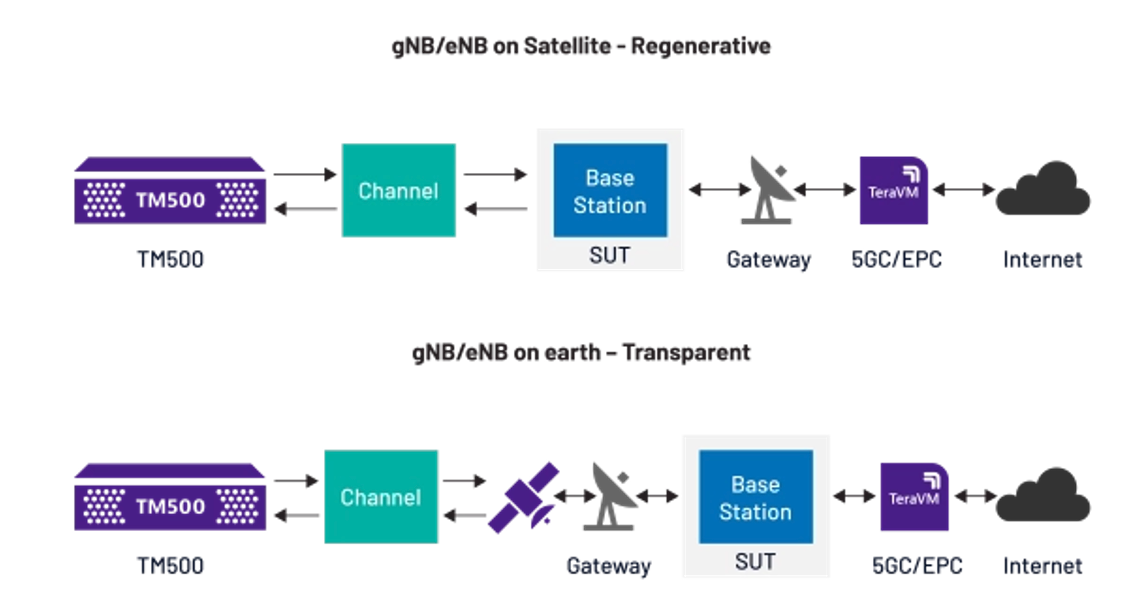
In addition to assessing individual component performance, testing in controlled conditions can check the integration of network components and verify application performance. Further important checks including testing the service and feeder links under simulated high-load conditions and with high UE mobility, as well as testing across GEO, MEO, LEO, and HAPS orbits. In addition, by generating realistic RAN scenarios, developers can explore interactions between the NTN and the 5G core and ensure compliance with 3GPP standards.
Also, by using a signaling and network tester in conjunction, engineers can apply digital twin approaches across LEO, MEO, and GEO satellites. It should also be stated that digital twin strategies are especially powerful for NTN testing, enabling users to create accurate replicas of the network components and multi-orbit operating environments to simulate aspects such as orbital dynamics, signal propagation, and handovers between satellites. Not only do they identify problems before launch, but after deployment, the digital twin can support further experimentation and predictive maintenance by using real-time telemetry data to update the virtual model. There is also scope for testing beyond the lab, incorporating PNT solutions, optical filters – which allow the implementation of inter-satellite links, which enables satellite to satellite communication across large constellations – mission-critical monitoring, and test-as-a-service (TaaS) for complex NTN environments.
NTNs have a critical role in the future of 5G and 6G services, bringing the ability to provide global coverage, rapid response in emergencies, equitable access to all regions and users at cell edges, and global support for IoT applications. Key challenges to overcome include mobility management, long propagation delays, signal attenuation, and severe environmental effects. In addition, ensuring interoperability and coexistence with terrestrial and existing satellite systems is crucial, as well as addressing complex handovers and precise beam alignment.
Proper testing, using tools that incorporate digital twins and provide end-to-end validation and simulation of various operational scenarios, can help ensure reliable deployment and performance of future NTN systems.
 Obilor Nwamadi is a senior product manager of NTN, VIAVI