
I was told early in my journalism education that it’s easier to teach a writer about a topic then to teach a subject-matter expert how to write to a broad audience on a relatable level. I’ve leaned pretty heavily on that advice during my career, especially when I made the jump from sportswriter to aerospace reporter. I think I was the typical “space enthusiast” when I entered the aerospace and satellite sector. I have always been amazed by the technological accomplishments required to build rockets and place satellites into orbit and then move information around the globe. And like many outside of the sector, I was lulled into a false sense of “this must be easy, because the people within the sector make it seem routine.”
Now I certainly know better. While the people behind the space sector have made it seem easy or routine to the casual observer, this is rocket science. Every launch is both exciting and nerve-wracking at the same time. And to this day, I still wonder why some people applaud after a rocket has cleared the tower when there is still so much to do before the launch can be declared a success, and even more time and effort involved before the satellite can be declared operational.
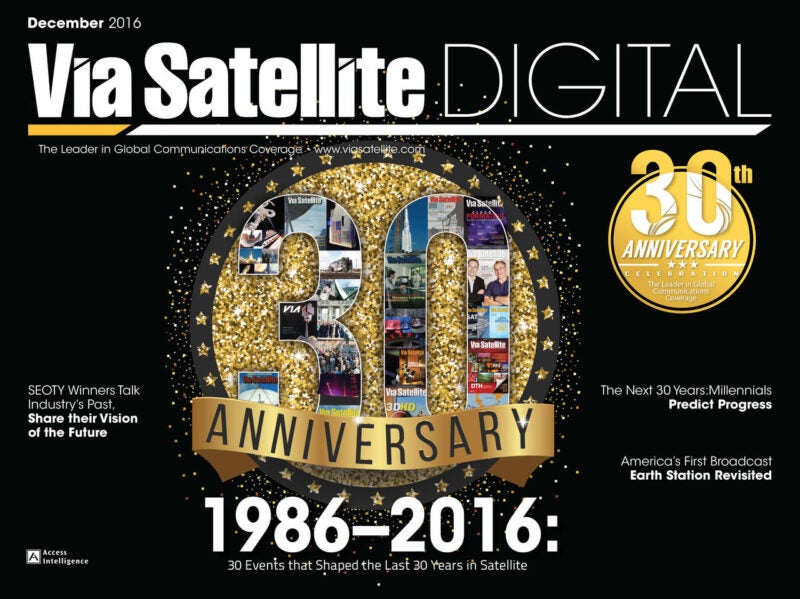
Explore the 30th Anniversary Edition Issue
Check out more from this issue and find your next story to read.
While I’ve certainly learned a lot about the satellite world over the past two decades, the learning curve was steep from day one — and remains steep to this day. But exposure to the thousands of smart men and women that I have had the pleasure to work around, with and talk to has both given me the ability to relate complicated technology to audiences, and given me an even larger appreciation for how much has been accomplished.
Beyond making the incredibly difficult task of building and launching satellites look routine and then using that in-orbit hardware to connect the world in so many different ways, I also remember witnessing some of the ingenuity present in the satellite sector that is borne out of necessity.
For example, I remember the launch of PAS-22 (then AsiaSat3) in 1997. The satellite was left in an unusable orbit due to an upper stage failure and was declared a total failure. But a group of people were able to place the spacecraft into geosynchronous orbit by flying it around the moon. These operation consumed most of the satellite’s propellant; with the remaining fuel, the satellite could be controlled as a geosynchronous satellite.
I also remember the wave of self-funded launch vehicles and Low-Earth Orbit (LEO) satellite constellations envisioned in the late 1990s and early 2000s — all of which basically went nowhere beyond a large collection of PowerPoint presentations and creative videos. But today, we have a new generation of rockets in various stages of operations and new fleets of LEO constellations that are much closer to fruition — because an industry powered by smart people has figured out how to accomplish these feats given the advances in technology that have taken place sine the original efforts.
Satellite-enabled services have been present in the daily life of millions of people around the globe for a long time, from broadcasting to enterprise networks, from maritime communications to disaster recovery. And while the majority of people around the globe have little idea how much satellite is involved in their daily lives, there remains a perception for some that satellite is a slow, expensive and complicated technology, and that many of the functions provided from orbit today could more easily and more efficiently be delivered by terrestrial or atmospheric technology. The truth lies somewhere in the middle, in that no single technology will provide all the answers. This means the satellite sector will work more closely with a vast array of communications technologies to solve the communications challenges facing the globe today. And this brings me back to the people that power the satellite sector. Satellite has made tremendous strides over the past two decades. And I have no doubt that the satellite sector will continue to evolve and lead the communications of the future, as the people driving satellite forward continue to innovate and push technology into new and better directions. VS