Latest News
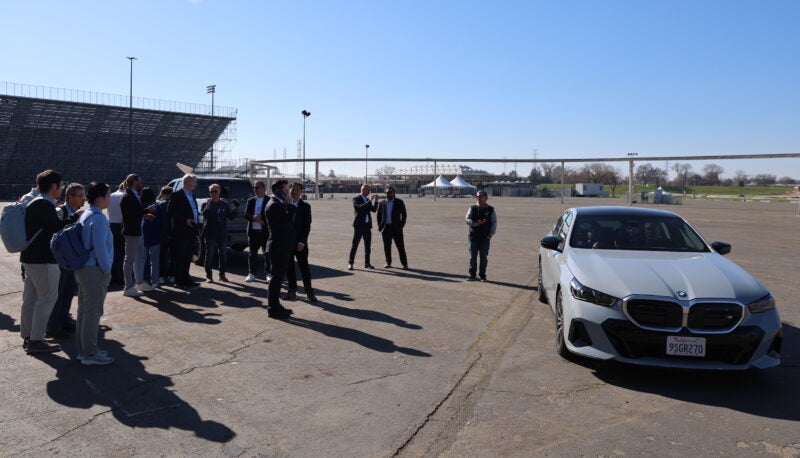
Viasat demonstrates a voice call over satellite from a connected vehicle at a 5GAA event in February 2026. Photo: Viasat
Last week, Viasat demonstrated a bi-directional voice call from a connected vehicle over satellite, to show how satellite can be used in emergency situations for vehicles.
In a demonstration for the 5G Automotive Association (5GAA), a BMW i4 equipped with an antenna and Qualcomm modem made a live, bi-directional voice call using a Viasat voice application, sending data over satellite.
Kevin Cohen, vice president of Viasat Direct-to-Device, explained to Via Satellite the demonstration used a Fraunhofer codec to compress the data in order to transmit in narrowband IoT, low data rate over Viasat’s mobile satellite service (MSS) network. The vehicle was equipped with the standard Qualcomm chipset that includes non-terrestrial network (NTN) compatibility.
The demonstration took place in Sacramento, California last week at a 5GAA event
“A lot of people think that this is never going to be commercially available or this is impossible — We demonstrated that it is possible,” Cohen said. “This is a commercially viable technology that will save lives and improve peace of mind for drivers when they’re outside of cellular coverage.”
Viasat demonstrated the vehicle was able to make a voice call over satellite, which could come into play in emergency situations outside of cellular networks.
“What happens when you’re driving outside of cell service and your car breaks down, you get in an accident, run out of gas, or the car catches on fire? There’s the ability to save lives if you can [communicate] with satellite,” Cohen said.
While some people on the roads today have cell phones equipped with direct-to-device technology, Cohen notes that’s not always an option in a car accident. A satellite-equipped car adds another layer of safety.
Viasat is working across the industry, working with automotive suppliers to enable this feature commercially, working with companies that develop telematics control units, and chipset vendors.
“It’s really on the automotive OEMs to say, ‘Yes, I want this feature,’ and bake that into their next model of cars or all across the fleet. You can imagine different automakers might start with one brand or one model, maybe some models that go off-road or out of cellular coverage often, maybe some brands are more safety conscious.”
Cohen says future-proofing a connectivity solution for cars is important to 5GAA and auto manufacturers, citing that many older cars lost automatic crash notifications with the sunsetting of 3G networks.
Viasat’s ambitions in the connected car landscape tie in to its work with Equatys, the joint venture company that treats satellites like shared infrastructure of cell towers. Equatys is expected to launch a satellite constellation but hasn’t announced more specifics. That constellation will operate in 5G New Radio (NR) standards, which are designed to be future-proof.
Cohen expects this type of connectivity in cars to follow an adoption trajectory to be widespread in the 2030s, with seamless roaming between terrestrial and non-terrestrial connectivity that’s not evident to the user.
“I think we’re going to get to the point where there’s a peace of mind that wherever you drive, you’re connected,” he says. “You won’t have to worry about not having someone be able to rescue you if you get into an accident or your car breaks down. And the pain points of dropped service are going to go away eventually.”
Stay connected and get ahead with the leading source of industry intel!
Subscribe Now