Latest News
Boeing Space Missions VP Michelle Parker on the Outlook for Government, Commercial Satellite Manufacturing
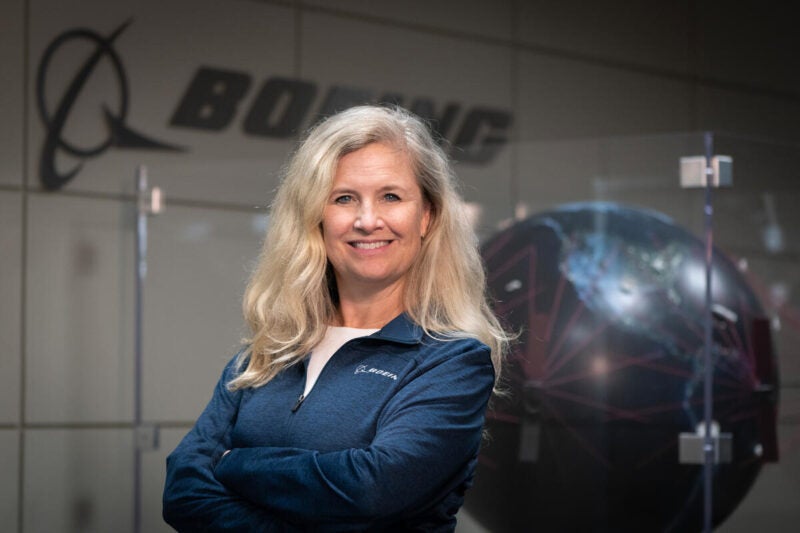
Michelle Parker, vice president Boeing Space Mission Systems. Photo: Boeing
There are a number of evolutions underway in satellite manufacturing: software-defined satellites, more satellites in Low-Earth Orbit and Medium-Earth Orbit, fewer orders in Geostationary Orbit, and increasing demand from both U.S. and international governments. Michelle Parker, vice president Boeing Space Mission Systems, shared her outlook on demand for satellite manufacturing in a recent conversation with Via Satellite.
The Space Mission Systems portfolio includes commercial and government satellites, Spectrolab subsidiary, and Millennium Space Systems, all in one organization. Parker says she is seeing more demand on the government side, and the investments Boeing has made to ramp up and automate production lines.
VIA SATELLITE: What are some of the key focus areas for the Boeing Space Missions System business now that it has been a few years since the satellite programs were unified into one business?
Parker: In those two years we’ve come a long way, and we’ve realized some of the advantages that we were hoping to. This year we have a lot of production going on. We have WGS-11 [Wideband Global Satcom] and O3b mPOWER satellites working their way through the factory. We have a full Millennium factory, which is great to see. We recently received the WGS-12 contract and are beginning procurements for that satellite. The SDA FOO Fighter which was really a big deal as the first SDA award for us. We’re excited to be a part of it and that is based on a sensor we developed internally.
There’s a lot going on across the portfolio, and we continue to invest in research and development in key areas in photonics, quantum, AI, the sensor that I mentioned. We’re also investing in our production capabilities within Millennium, within our larger satellite factor, and within our subsidiary Spectrolab that does solar cells. We’re looking to production harden our factories so that we have hot production lines and can deliver at pace to our customers. We have done a lot of the things we said we were going to do and the future is looking really good. Space remains core to our business.
VIA SATELLITE: How do you see the opportunity for the Boeing platform used for the O3b mPOWER satellite for other customers other than SES?
Parker: I think there’s a lot of opportunity. The great thing about our integrated payload array (IPA) that is fully software defined is that it’s applicable to a lot of different missions. All of the underlying technology and the software defined aspects of it with beamforming and switching of coverage areas work and have worked from the beginning. It’s a major technological feat for software-defined [capabilities].
That’s what we were looking for — a product that would be applicable, agile, and redefinable, to bring to other customers. We’ve also taken that underlying technology and hardened it for military use. The WGS satellites are also underpinned by the IPA technology, with added anti-jam and protected comm augmentation for the military. It also underpins our ESS [Evolved Strategic Satcom] and PTS [Protected Tactical Satcom] offerings.
The interesting thing about the IPA was the development of how we produce those technologies. [We have] a fully automated production facility dedicated to the IPA. You bring in a blank board and pop out the full payload, pretty much all automated, maybe four hand steps. That line runs all of the programs that I just mentioned. As we get more and more opportunities we can replicate that line and increase our capacity.
VIA SATELLITE: Do you expect there will be more commercial customers for the platform?
Parker: I think there could be, it definitely has application. There are definitely areas where the agility of the payload definition is really beneficial. We’re also looking at whether we can augment the payload with photonics, which gives us the ability to expand the frequency bands and speed.
VIA SATELLITE: How do you see the outlook for big Geostationary Orbit (GEO) orders?
Parker: If you go back a few years ago, the question was either/or. Everything going LEO [Low-Earth Orbit] or staying in GEO. I don’t think that’s the conversation anymore. The conversation is really about “and” — putting the right mission in the right place. GEO still seems to be a sweet spot for broadcasting, constant coverage, things where latency is not all that important. Streaming is a good example. You can cover broad areas. I think there will remain a market for GEO. I also think LEO and MEO [Medium-Earth Orbit] will continue to expand. That is one of the reasons we brought Millennium into the family, and one of the reasons we have the MEO bus for O3b. You can pick the orbit and the architecture that’s best for the mission that you’re trying to solve.
VIA SATELLITE: What is the balance of demand for satellite orders in terms of commercial versus government, and international?
Parker: The biggest demand is from the U.S. government right now. There are a lot of evolving architectures, and the switch from bespoke to constellations and rapid evolution. More missions are going to space that used to be ground or air-based. There’s a lot of discussion and demand around that, and bringing new capabilities to bear in that area.
[There is] still demand in commercial customers. We really appreciate the partnership that we’ve had with SES and Viasat. They’re going through the same inflection point — what does the next generation look like? We’re happy to be a part of those conversations and help in the overall architecture definition. At the moment, there is more demand from government, but I think the industry has always been cyclical that way.
From an international standpoint, there is a lot of discussion around sovereignty. Whether that means [nations] operating their own satellites or having the production facilities for space assets. We are actively in discussions with multiple countries about that. That could look like their own sovereign capability, it could look like ‘allied by design’ — an infrastructure that is interoperable with the U.S. As the space ecosystem expands, more international folks want to put assets in space. One interesting thing about international, it’s not just about the satellite, it’s about the ground system and the operations. We’ve had discussions about the overall infrastructure that it takes to have your own software capabilities.
VIA SATELLITE: What about opportunities for Boeing in missile defense capabilities, like the Golden Dome architecture?
Parker: I think it’s a really exciting discussion. From a Boeing standpoint, it’s the multi-domain capacity. You can talk multiple orbits and multiple domains with space assets, air assets, ground assets — all of the system architecture. That’s fascinating. There’s a lot that Boeing brings to the table for that kind of integrated architecture. We’re definitely working closely to understand the Golden Dome. There are a lot of areas within that context of missile track where our offerings in space and air and ground can be brought into that system architecture to make it very effective.
VIA SATELLITE: How have you maintained the Millennium Space niche as a smaller disruptor within the Boeing family, and now under the new leadership of Tony Gingiss?
Parker: Things with Millennium are going really, really well. We’ve been very deliberate to make sure that Millennium can keep their “Millennium panache.” When we acquired them in 2018, they were about 200 people and they were doing prototype national security space — one to two-off a year delivery, but doing really amazing things.
Seven years later, they are going to cross 1,000 employees with a roughly 100 satellite backlog, delivering more than 10 satellites this year. We’re seeing the fruits of that plan to keep their identity but allow them to rate up production levels. We always said that the increase in production would be a crawl, walk, run. We have the crawl and walk this year. We are actually increasing their factory floor space for FOO Fighter, and you’ll start to see those production rates continue to increase.
To talk about the leadership change, I love what Tony has brought into the company with an understanding of what it takes to ramp up production. There are a lot of things that go into production — supply chain, engineering complete, work instructions, shifting people strategy. He brings all of that experience in and we’re seeing the benefits of that.
VIA SATELLITE: How do you decide whether something will be a Millennium mission versus a Boeing mission?
Parker: We have those discussions at the Space Mission Systems level. The niche for Millennium is typically national security space, smaller buses, maybe lower mission life. But all of that evolves and changes as they become more mature. We’ve also looked at combinations where the heritage Boeing satellites have a great communications payload, but can we combine the Millennium bus with a payload, and that gives us some really great opportunities as well.
VIA SATELLITE: Boeing’s Defense and Space segment has had some issues with cost margins over the past few years. What are your goals to ensure the satellite manufacturing business is sustainable in the long term?
Parker: One of our big focuses for this year is on production hardening — both in the big satellite factory and at Millennium. The market historically was one-off, craft build, bespoke satellites. The change we are making is on production lines and repetitive, robust production to meet the demands of the customer. That’s a great change because you can evolve the payloads while the production lines produce the buses and have continual cadence on deliveries and launches. All along the way you’re producing, evolving, developing. A lot of industries go through that maturation and that’s the inflection point that we’re in now in the satellite market.
VIA SATELLITE: There’s a lot of talk about AI, but sometimes it seems to be used as a buzzword. How is AI playing a role in Boeing’s manufacturing or on-orbit operations?
Parker: AI can operate on large data sets and that’s an advantage. Satellites are great at generating a lot of data. Being able to use AI to cull through that data, whether it’s from an in-orbit sensor, or spacecraft data, to all of the test data we have generated through years of manufacturing — AI can help more rapidly streamline and get through that data to identify areas of interest or conclusions.
We are also using AI in our production to streamline our documentation. Work planning things that are a little repetitive, they can be generated using AI and then touched up. AI can also look at data coming from a satellite under test and look for discrepancies and be able to identify them much more quickly. Those are interesting and practical applications of AI. There are a ton of areas that I think could be useful in, but it’s about being able to take it from a buzzword to practical applications.
VIA SATELLITE: What are you personally excited about in the next year for space?
Parker: There’s just so much going on in space, the ecosystem is continuing to expand. New space entrants and ideas make the environment really dynamic and exciting. I’m excited about the growth of Millennium, and I’m excited about the whole vision of Space Mission Systems as an overall portfolio that can span all orbits, many mission areas, and many size vehicles. The customer can pick and choose in those orbits or size regimes. Making that strong throughout the portfolio and being able to deliver with production lines. It was something we talked about two years ago and I’m seeing that come to fruition now.
Stay connected and get ahead with the leading source of industry intel!
Subscribe Now