
The transformation of battlespace communications involves working with advancements in technology to enhance situational awareness and operate with clear battlefield advantage. But as the development process gets underway, experts have other concerns, particularly about cyber security and interoperability between commercial operations that come about because of the different needs of the military.
Rich Pang, vice president of Corporate Development for Telesat Government Solutions has worked on both the commercial and government side, and sees the intersection of the two blurring.
Explore the Show Daily 2023 Day 4 Issue
Check out more from this issue and find your next story to read.
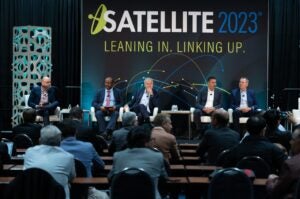
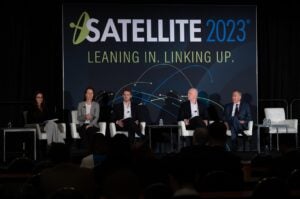
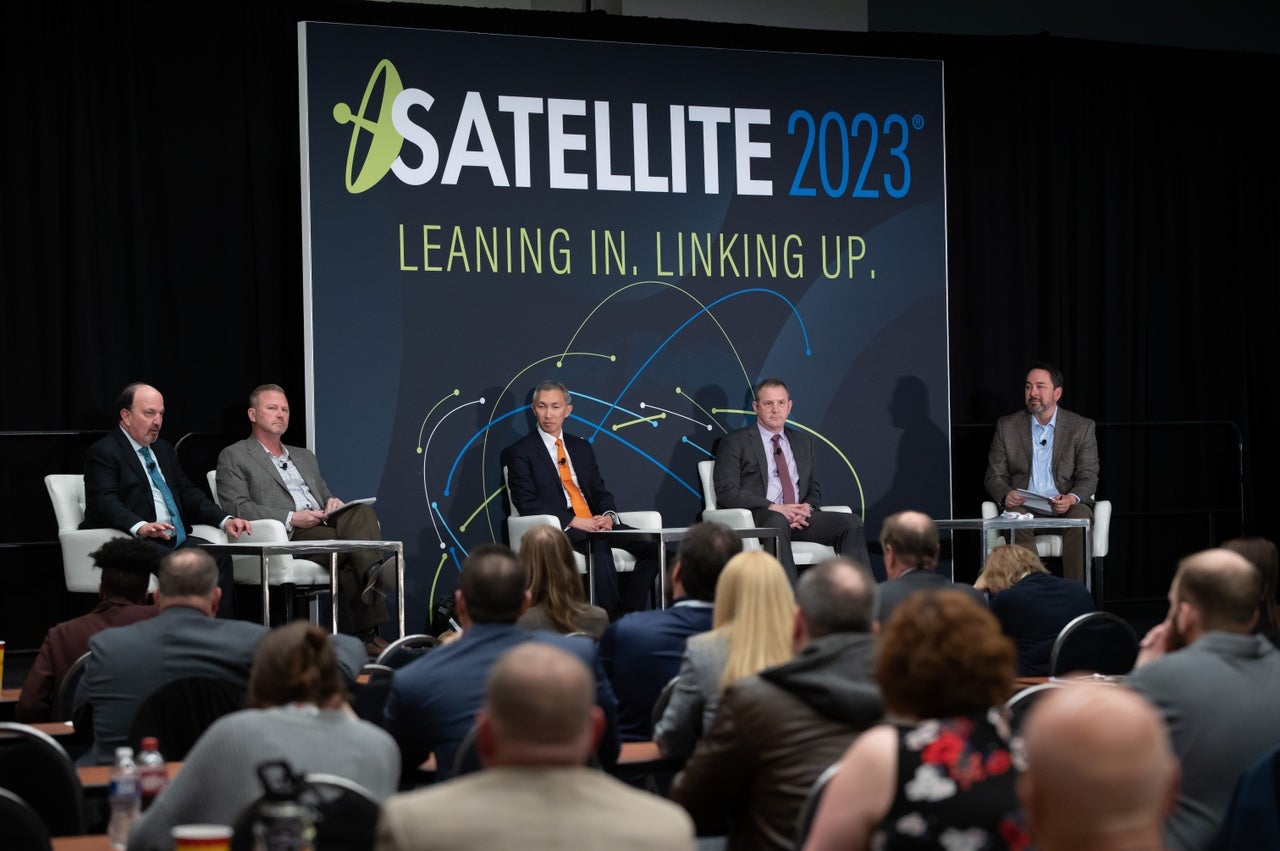
“Unfortunately, most of what we use in the commercial world was never designed specifically for government customers, and we’re forced to stitch together solutions with capabilities that were developed for the commercial world,” Pang said Tuesday at the SATELLITE 2023 conference in the panel “Transforming Battlespace Communications.”
He thinks they are seeing changes in the acquisition process that is allowing the government to communicate their requirements more clearly early on, even while systems are being built.
But we are still in the early stages of getting this technology into the hands of users, according to Dr. Frank Turner, technical director of the Space Development Agency (SDA). “If we’re depending on commercial technologies, then the technologies are there. And what we need to do is get capability in the hands of the user, whether that user be commercial or military.”
Mining down on that thought, Mike Dean, U.S. Department of Defense (DoD) Satcom Chief, said that he thinks it’s important for commercial companies to find out where they can have a business case that applies on both the commercial side and the military side, in order to make the most investment that they can go to the greatest utility.
He said the DoD has a partnership with Qualcomm for the new Snapdragon chips, for example. “We’ve got a relationship now with Qualcomm for Snapdragon chips direct-into-device. That is something that’s going to require a huge investment. But it bears fruit on both sides of our business case. There are times when the military application is significantly different. And perhaps some of those investments aren’t as applicable. But when you can find those ones like our Qualcomm relationship, those are the ones that you look for.”
Turner said he is almost always asked if a new acquisition process is needed.
“The perception is that SDA is doing something dramatically different,” Turner said. “And the reality is we’re not. In fact, the first acquisition we did was identical to the acquisitions that I did as a lieutenant a long, long time ago. But if you take a group of people, and you empower them, and you remove some of the roadblocks, and you put the decision making really close to them, and you make them accountable, and you get out of their way, they can do amazing things.”
Pang followed up in full agreement with Turner. “The process itself is not bad. It’s in the implementation where we get ourselves into trouble, whether it be the oversight side, or just spending all our effort on the last 10 percent of the problem,” he said. “We find a problem, we get stuck on that problem, we can’t get past it. And if you have processes in place that empowers people to make decisions at the lowest possible level, I think it is exactly how you punch through those efforts.”
It’s the process. But as Pang said, it’s also the capabilities of the people in the process. On this point, Dean offered different insight based on what he has witnessed. “It’s not so much that we’re not able to rapidly pull in capabilities. I think we can do that, and we have many ways to do that. I think our challenge right now is to look at the enterprise across all segments, because we don’t do that well right now,” he said.
Turner said that there’s never enough intelligence and surveillance reconnaissance for a commander to say that he wants to be able to blind the enemy, or see the enemy, or kill the enemy. “In order to do that, you need all the data that you can possibly have turned into excellent information to yield decision superiority. And if you’ve got that decision superiority, regardless of how you built it, with what elements, what building blocks, those building blocks are commercial, those building blocks are tactical, those building blocks are strategic. All of it comes together into a picture that gives the United States significant overmatch over its adversaries. That’s what we’re trying to achieve.”
Cybersecurity is an ongoing issue, since commercial systems don’t necessarily have the same need for rigorous defense against attack that a military operation would. “I think that some of the threats that may be posed or will be equally felt on both the DoD side and the commercial side because there is no discrimination between commercial birds and military birds,” said David Robinson, director of Government Programs for Iridium. “So there happens to be things that you need to worry about on both the commercial side, at least for the space segment.”
Some commercial operations worry that they may become a target if they work with the military, but Pang downplayed the potential threat. “Certainly, there’s something behind that,” he said. “But I would say, you’re one of many, right?” VS