
While space gets more and more crowded with an increasing number of satellites being launched, issues such as a crowded Low-Earth Orbit (LEO), space debris, and satellite collisions have become more than a concern for the companies putting these satellites in space. It’s also an issue for all space-faring governments because unpredictable events in space can have wide-ranging global repercussions.
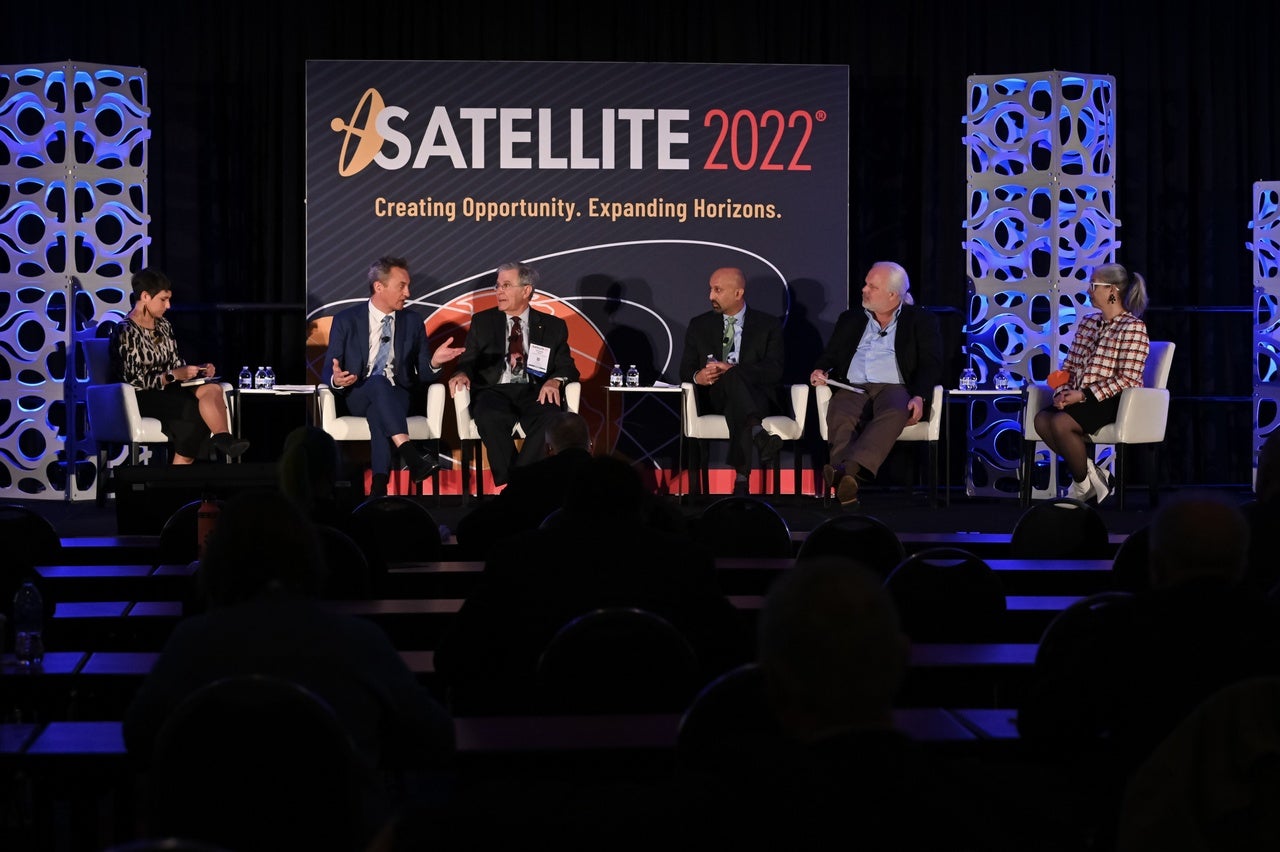
But for now, space sustainability and management does not seem top of the agenda for the U.S., and for other space commerce countries represented at the United Nations. What needs to happen was part of the discussion of sustainability on March 23 during the SATELLITE 2022 show featuring representatives from government regulatory affairs and government relations organizations.

Explore the Show Daily 2022 Wrap Up Issue
Check out more from this issue and find your next story to read.
Patrick Chatard Moulin, deputy head of the Space Task Force for the European External Action Service (EEAS), said that he hasn’t seen anything happen regarding sustainability and regulation through the United Nations in two years, saying that climate change has been a much greater focus. “It’s now about what we can do individually [for space sustainability]. The one thing that I think we need to be very careful about in the next few years is space safety and security,” he said.
Ruth Pritchard-Kelly, senior advisor of Regulatory and Space Policy for OneWeb, agreed with Moulin that it’s going to take time for governments to step up and address sustainability issues in space.
“I think Patrick is right in that regulators can’t respond in two years. It is the industry that needs to be responsible,” she said. “What we launch should have been responsible by design. We should have chosen an orbit where we think we are not going to interfere with other objects. We should have tested our objects on the ground as best we can. We should have used a reliable vehicle. That’s the burden on the industry. Don’t launch whatever and just say, if it doesn’t work, ‘Oh, it’s okay. It’ll eventually decay.’ That’s not responsible.”
John Janka, chief officer of Global Government Affairs and Regulatory for Viasat, agreed that industry should be responsible. “That’s a critical thing, but I don’t think that’s enough,” he said. “I think that on top of that, it’s really important for regulators to start to act on these matters. They should be looking at constellations and the level of risk and the level of responsiveness and evaluate that when they’re giving licenses or market access. They do it in all types of other contexts,” he said.
Kalpak Gude, head of Domestic Regulatory Affairs for Project Kuiper at Amazon, added to Janka’s comment. “We get a little bit concerned about governments moving too quickly to regulation. We really do think government has an enormous role to help drive getting the answers to these questions about sustainability in space. And it should be done through public private partnerships, or through government being a convener driving for the creation of better standards and best practices, those types of approaches right now,” he said. “Sustainability issues are not restricted to one government or to one country. It is something that really would deliver tremendous value across the board.”
Most satellite manufacturers are aware of the issues of a more crowded Low-Earth Orbit, that satellite collisions and debris accumulation in space will likely get worse. But there have been some unintended consequences because of the proliferation of satellites in LEO, according to panelist Richard Green, assistant director for Government Relations at the University of Arizona.
NASA is charged with finding all the potential hazards that will come across the Earth’s path, such as an errant asteroid. “If the Low-Earth Orbit satellite build-out continues on its current curve, what’s not known is how many potential hazardous asteroids do you miss because of this new source blocking the information?” Green said.
Pritchard-Kelly pointed to the seriousness of debris that is already in space from prior activities.
“It’s easy for operational constellations to talk to each other and to control their satellites and objects and not to have collisions,” Pritchard-Kelly said. “But what about the 50 years of garbage that’s out there from 50 years of other activities? Who’s going to clean that up? No one’s going out and picking up somebody else’s dog poop. That’s not happening. But it has to happen. And governments have got to step in and encourage a prize or some way for this to become affordable and interesting.”
Gude said that, from an operations perspective, active collision avoidance is critical but it requires information sharing. “We think that is another key component to operating safely,” he said. “It may not be shared publicly, but at least maybe shared responsibly with other operators in your environment. But share as much as you can. Because everybody should understand not just where you are and where you’re going, but where you might go based on your own decisions to maneuver your satellite. You don’t want to create new problems for others.”
There are other areas of space sustainability that people talk about, but not much happens, according to Janka. One of those areas is lethal, non-trackable debris. “We know it can be devastating, but for reasons that escape me, at least in the U.S. licensing process, that risk isn’t added. There’s a lot of debate about it, but nobody’s putting data down. We should talk about how we’re going to mitigate the risks. Right? There are brilliant engineers and scientists who can put numbers on this. We owe it to ourselves to do that type of quantification.”
Sophisticated collision avoidance techniques, Janka said, are terrific. But they should be considered and evaluated. “We’re still dealing with some folks who are arguing that ‘Well, I have an autonomous collision avoidance system. Therefore, nothing can go wrong.’ We need to evaluate those things.” VS