
Just how crowded is Low-Earth Orbit [LEO], and how can the satellite industry do more to prevent collision and manage traffic?
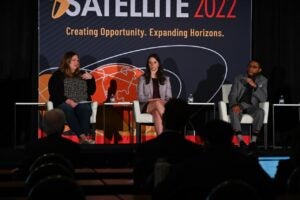
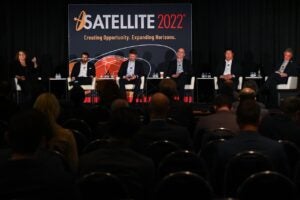
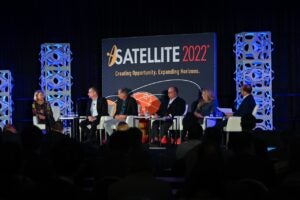
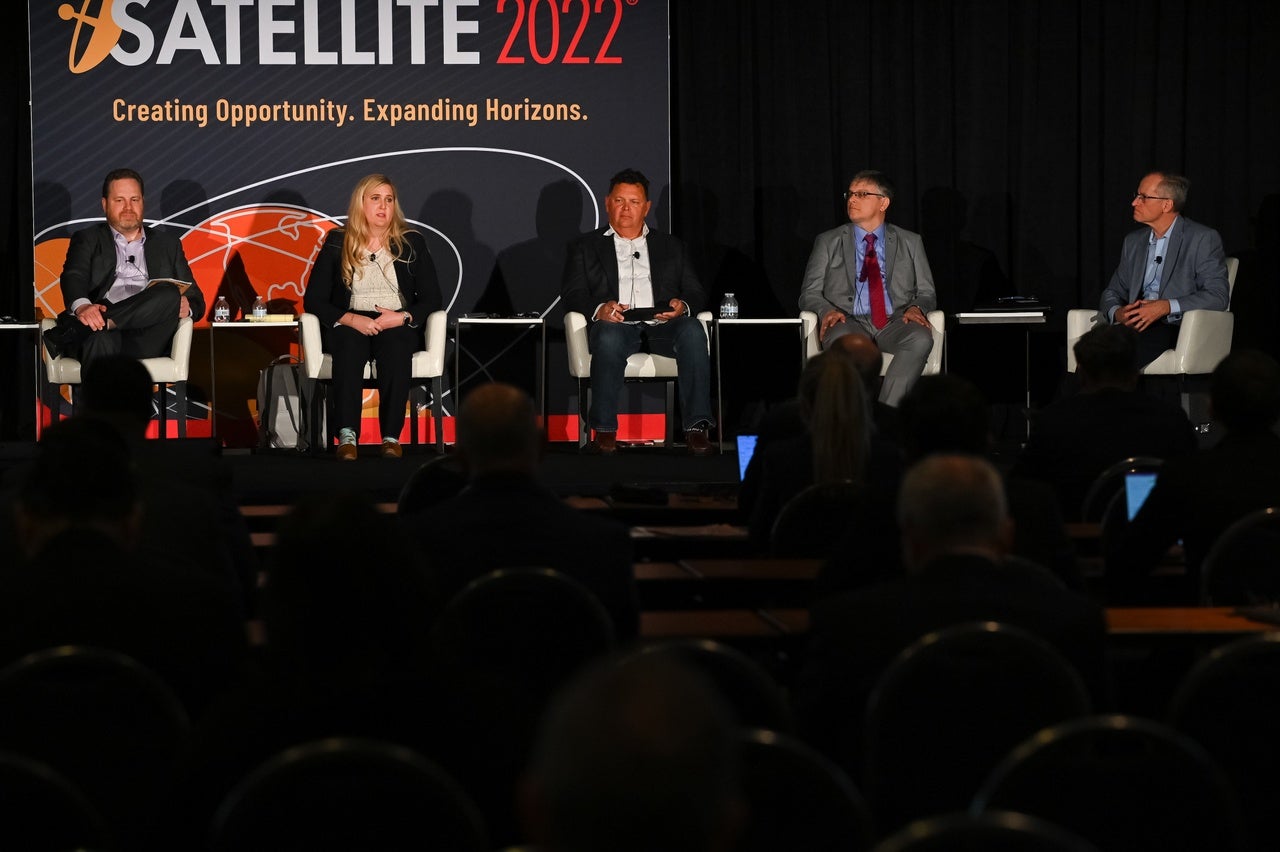
These questions, which continue to perplex satellite industry stakeholders, dominated the SATELLITE 2022 Tuesday afternoon session, “The Great LEO Congestion Debate: What Does it Mean to Be Crowded in Space?” which brought together experts in space science, law, and business. The session was less of a debate about whether crowding exists, and more of a discussion on what space stakeholders must do to prevent collision and catastrophe.

Explore the Show Daily 2022 Day 4 Issue
Check out more from this issue and find your next story to read.
And the timing for such a discussion could not be more urgent. An estimated 6,000 tons of space debris are circulating in Low-Earth Orbit (LEO), while many of the international laws governing de-orbiting spacecraft are outdated.
Moderator Dr. Brian Weeden, director of program planning for Secure World Foundation and executive director of CONFERS Secure World Foundation, said that the evidence is clear that real solutions in satellite asset management and debris mitigation are needed.
“Active satellites jumped from about 2,000 to 5,000 over the last five years,” he said, noting that both the commercial and government sectors plan to launch tens of thousands of additional satellites over the next few years into LEO, raising the likelihood of catastrophic collisions not unlike the scene that played out in the 2013 blockbuster “Gravity.”
And while the industry is making progress, for example, by designing more efficient, self-maneuvering satellites that can move out of harm’s way, a confluence of challenges, from the difficulty of updating international guidelines, to the inability to rein in small, lethal non trackable debris, could put a dent into any progress.
“Everybody wants to focus on constellations,” said Darren McKnight, senior technical fellow for LeoLabs, a six-year-old, venture-funded spinout of SRI International which leverages radar technologies and predictive analytics to monitor orbital debris and assess the risk of collision. “Constellations are agile operating halos and many people think they’re the problem. I’m going to say they’re the victim.”
McKnight — who is also a member of the International Academy of Astronautics’ Space Debris Committee — led session attendees through a series of slides with pie charts that indicated how much spatial density is occupied by rocket body, fragments, and payloads. Other slides highlighted the presence of clusters, which LeoLabs defined as “uncontrolled derelicts [that] are sources for future debris clouds.”
“Three satellites are more than 50 percent of the fragments,” McKnight continued, referring to major collision incidents including the 2009 collision between Russian satellite Cosmo 2251 and Iridium 33, which produced almost 2,000 pieces of debris measuring at least 10 centimeters in diameter, as well as thousands of smaller pieces — debris that’s still circulating in space, more than a decade later.
Samuel Peterson, director of Strategy and Innovation, Swedish Space Corporation (SSC), framed the challenge of debris by showing audience members photos of a Copernicus Sentinel-1A spacecraft before and after a non-catastrophic collision in August 2016. It only took a piece of debris just one millimeter in size to damage a solar panel.
“When the impact happened, what we saw from ESA was a drop in power,” said Peterson, suggesting that the stakeholders were lucky the debris didn’t render the satellite inoperable.
Tobias Nassif, director of the Space Data Association, noted that the space industry could do more to refine and update guidelines to reflect advances in technology and the commercialization of LEO.
“Most satellite operators are in compliance with the guidelines but those guidelines aren’t going to help with putting up satellites, and replenishing satellites,” he said. “At the SDA, we’re satellite operators, providing service for satellite operators, and we try to encourage communications so we can better work together and maneuver debris. Where we could use help is identifying non-trackable objects. We’ve had space objects… how do we track those [less than 10 centimeter] items [of debris] so they don’t become lethal?”
But while enacting change internationally is hard, and can be contentious, some progress has been made, albeit slowly.
“It’s not the wild, wild west,” said Jessica Noble, general counsel of NanoRacks LLC. “There is an established framework for the rules for conducting the activities in space, such as UN treaties governing activities in space, including Article 1 of the Outer Space Treaty,” which, she added, indicates that all activities conducted in space should be for the benefit and interest of all countries.
However, she said, coming up with a plan for communication and coordination at the state level is very difficult, especially right now.
From Peterson’s experience, collaboration among satellite operators is usually more amenable even when nations aren’t friendly bedfellows.
“I’ve been involved with satellite operators in several different countries. I’ve found that even when nations don’t talk with one another, satellite operators are really amiable and can find ways within the ITU [International Telecommunications Union] process to make it work,” said Peterson.
From McKnight’s perspective, the industry needs less talking and more action. “It’s up to the point where these lethal non-trackable objects are going to become the bane of our existence,” he said. “The [approach of] study, wait and hope is for the ‘90s. We need to Monitor, characterize and track.”
And as the satellite industry rolls out new technology, we need to think beyond how satellites affect other satellites.
“So much of the conversation [is] about satellites and how they will affect other satellites,” said Noble. “There are companies who want to build their own private stations. We’re also looking at companies and looking at more people living in space. The [risk] calculus needs to include human life.” VS