
The 2020s have ushered in global challenges that in many ways eclipsed those of the previous decade — yet for the space industry, the opportunities, too, have also been unprecedented, between the commercialization of Low-Earth Orbit (LEO) and exploratory missions to Mars.
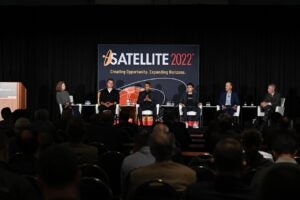
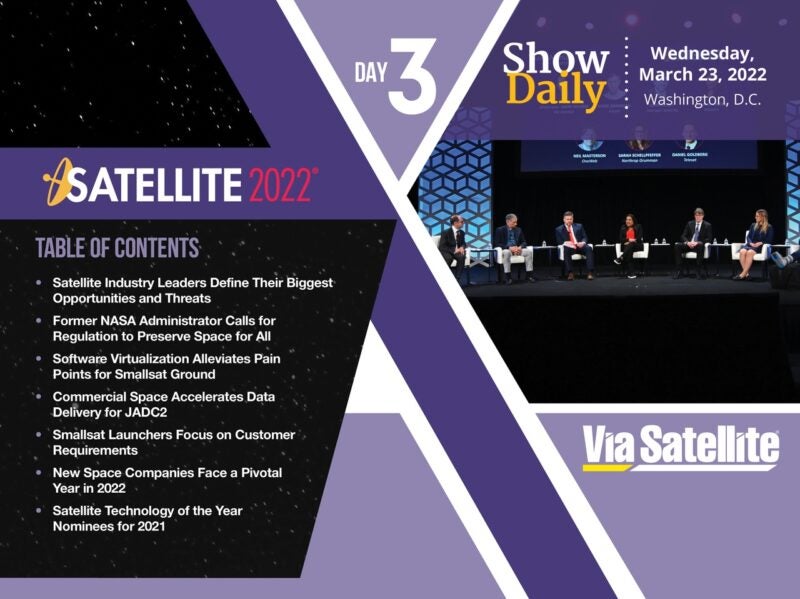
Throughout Tuesday’s opening general session, “A Defining Era for the Satellite Industry” at SATELLITE 2022, industry leaders acknowledged these positive developments, while elaborating on how their organizations and partners are responding to international needs — for affordable broadband, better cybersecurity, and broader connectivity. The war in Ukraine was top of mind, and a constant theme throughout conversation, moderated by Via Satellite Editorial Director Mark Holmes.

Explore the Show Daily 2022 Day 3 Issue
Check out more from this issue and find your next story to read.
“Our thoughts are with the people of the Ukraine,” said panelist Neil Masterson, CEO of OneWeb, referring to Monday’s announcement that the operator had signed a deal with SpaceX to resume launches after its after its Soyuz launch campaign at the Baikonur Cosmodrome was stymied by Russian space agency Roscosmos. “We were forced to make a choice and we did. We remain absolutely determined to ensure the deployment of our constellation.”
Masterson also observed that the changing of the global geopolitical balance in space has made businesses eager for more international regulations.
“It feels to me as if the Cold War in space has started,” he said when Holmes asked if a new Cold War has begun in space. “It’s unusual to see somebody from the business side saying we need more regulation, not less. Space is a shared resource for us, from a strategic perspective.”
Panelist Tina Ghataore, chief commercial officer of Mynaric, said recent events have had an undisputable influence on the supply chain.
“From our vantage point, when we’re looking at technology and bringing products to the space environment for critical customers… we’re having to scrutinize our supply chain even more, and we already have restrictions on where procurement parts can come from,” said Ghataore. “We have to scrutinize where every component comes from. In addition to the hardware, we have to look at the software, and make sure we’re adopting various standards. But that’s not to say we can’t serve friendly nations with projects and collaborate on various constellations.”
Dan Goldberg, president and CEO of Telesat, called for an international regulatory framework to ensure space is available to everyone.
“We’ve been responsibly using space for half a century now, and the environment is changing, we have more objects showing up in space. On the one hand that’s great, but on the other hand, it creates significant risks that need to be properly managed,” said Goldberg, adding that the current conflict between Ukraine and Russia has only underscored the importance of space. “There’s no one authority that can regulate space. There needs to be rules of the road and we need to follow them. It’s complicated, but for sure, there needs to be a beefed-up regulatory environment to make sure space is used responsibly.”
Throughout the session, the theme of satellite access as a right — and not just a privilege — wove itself into multiple conversations, from internet availability in remote areas and areas of conflict, to the evolution of technology underpinning access.
“You can see the impact that access to space is having on the war in Ukraine,” said Mark Dankberg, executive chairman and co-founder of Viasat, which is in the midst of a deal to acquire Inmarsat. “One of the things that Viasat has pivoted to is… probably our best business model is helping and augmenting countries around the world that want their own space programs.”
Technological advancements will ultimately improve economies of scale — and panelists’ organizations have made multiple strides over the last two years.
Sarah Schellpfeffer, vice president and CTO of Northrop Grumman’s Space Sector, made reference to Northrop Grumman’s collaboration with the U.S. government in critical missions for both the U.S. Department of Defense and NASA.
“What’s possible from our research, from our understanding of astrophysics? What can be provided to everybody from that system? That’s part of the industry we’re excited about,” she said.
Dankberg seemed in awe of the scope of changes that have transpired in respect to technology since the 1970s, when he recalled his first big project.
“What we’re really seeing technologically is evolutionary,” said Dankberg. “What’s really changing now is it’s not so much that the world’s leading power in space is getting better, it’s that the rest of the world is understanding the significance of space.”
Holmes suggested that creating more efficient ground technology, such as smaller and cheaper terminals and equipment, is indicative of progress. In response, John Finney, founder and CEO of Isotropic Systems, cautioned that satellite equipment manufacturers need to be careful not to undervalue their assets.
“The name of the game is to avoid a situation like fiber optics in the early nineties when there was an overbuild before demand could be met,” said Finney. “Differentiation creates value and value is worth something. In the ground sector, we are all striving and driving to do different things that drive value and close business. But we don’t like the word cheap, we like the word value.”
Suggesting that the industry swap the word “cheap” for “affordable,” Ghataore stressed that growth is nevertheless contingent on the right pricing.
“If you want to connect the world, affordable ground terminals are key if you want to build proliferation,” Ghataore said. “At the end of the day what are we serving? We’re serving a consumer, an end user.”
The interoperability of those terminals, and how ground systems evolve as automation is required is also important, said Schellpfeffer. “As cloud technology becomes more integrated with ground systems and space systems, that will drive innovation as well,” she noted.
Holmes also touched on the importance of cybersecurity now and in the future, as mitigating targeted cyberattacks becomes a bigger concern.
In late February, Viasat experienced and began investigating a partial network outage in its European KA-SAT network, which it suspected was the result of a cyber event. The company said the network outage impacted internet service for its fixed broadband customers in Ukraine and elsewhere. Dankberg said Tuesday that the outage did not affect the satellite, but it took thousands of terminals offline, which must be replaced and refurbished. Viasat is working to restore service, he said.
“We’re very sensitive to customers that have been disrupted, who we inherited, and we’re working fast to bring them on,” said Dankberg. “In the overall scheme of things, there will be worse cyberattacks if we’re not vigilant. It’s a constant battle. It’s part of what we do and we think we do it extremely well.”
And although all panelists agreed that LEO will become more dominant over the next five to 10 years, they also agreed that other orbits and technologies will be just as essential.
“I think about the market we’re focused on, which is enterprise, I believe the value proposition is going to be so much more compelling in LEO, and ten years from now, LEO will become more dominant,” Goldberg said.
Added Schellpfeffer: “Right now we have a mixture, and that mixture’s going to continue. There will be places where optimizing missions will not always be in LEO.”
Masterson also predicted a climate of more integration between LEO, Medium-Earth Orbit (MEO), Geostationary Orbit (GEO), fiber, and microwave, as the satellite industry navigates new opportunities for expanding access across the globe.
“Each element is part of the solution,” Masterson said. “Each has different roles to play. Different use cases.” VS