
The perfect antenna is one the customer uses, never sees, and never worries about, said Carl Novello, the chief technology officer of NXT Communications (NXTCOMM).
“Who is the user of our technology? Is it a retail consumer user? Is it a military user on the front lines? Is it a first responder? Is it the cabin crew on an aircraft serving passengers? ‘Perfect’ means very different things to each one of those,” he said. “Perfect is difficult. Even more difficult is getting low cost.”

Explore the Show Daily 2021 Wrap Up Issue
Check out more from this issue and find your next story to read.
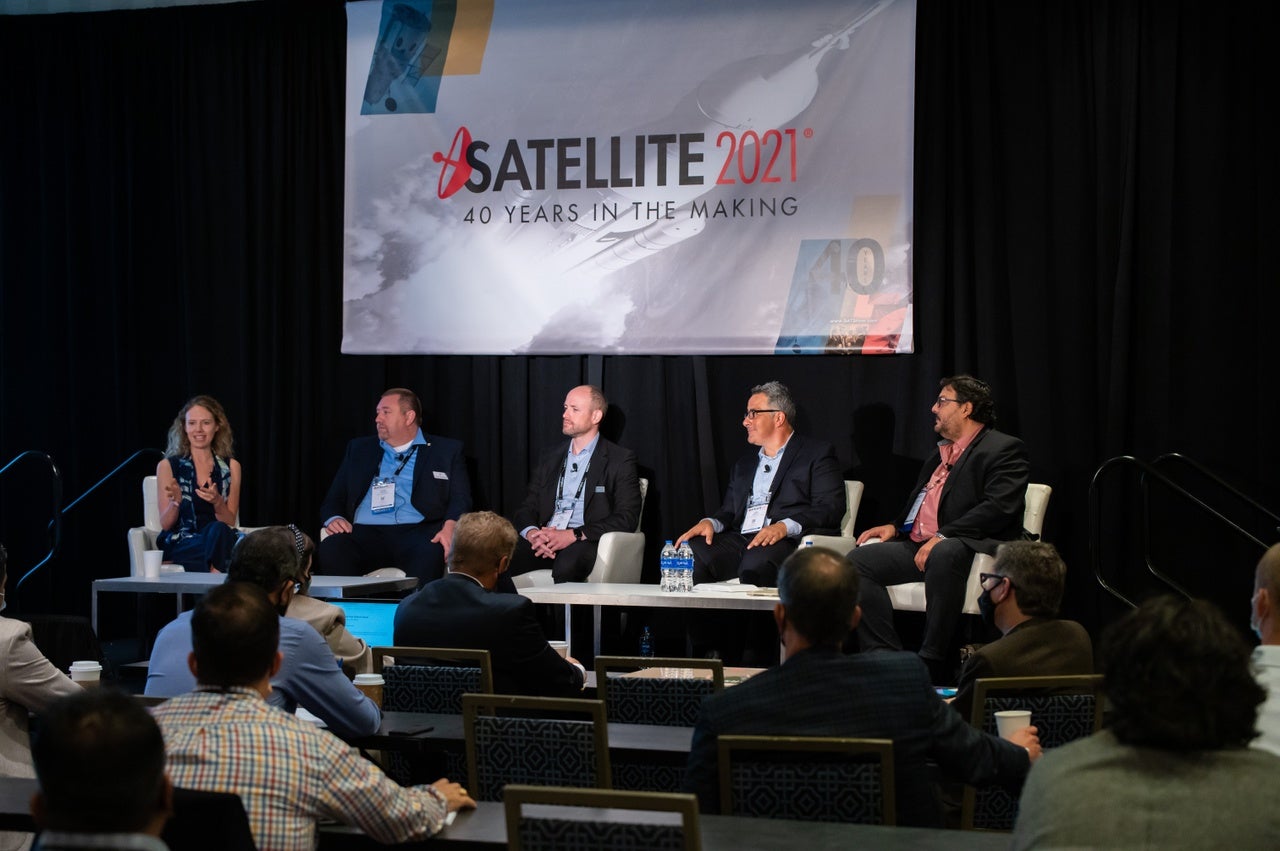
The satellite industry is on a quest for the perfect, low-cost antenna as managed networks grow. The research and trials on antenna technology require a deeper dive into specific uses: what users need and expect, and what obstacles need to be addressed. Executives from four antenna development companies weighed in on these issues during a panel at the SATELLITE 2021 conference on Thursday, Sept. 9.
The industry is working on a simple antenna, according to Ryan Jennings, senior manager for Satcom Strategy and Products for Ball Aerospace. It comes down to the use case and how the technology is applied, which means that the perfect antenna could actually be fairly complex in design so it can be simple to use.
“It needs to be simple to manufacture, simple to calibrate and optimize,” Jennings said. “When put in the field, it needs to be simple for people to use it and configure.”
Manufacturers need to make sure they know how to serve the needs of the user, but with an eye on how the user can or will expand that usage. That was the view of Paul Klassen, vice president of Engineering for Kymeta Corporation. His company is focused on mobility because there are specific challenges in moving vehicles.
“We are focused on solving the problems of the U.S. Department of Defense today,” he said. “The consumer will come in the future, like in the automotive space. We have talked about that in the past, and we will get there.”
Working Through Design Constraints and Integration Challenges
Design constraints have become more important issues that antenna developers must work through, in tandem with terminal designers. “Design constraints are very intertwined with almost every aspect of perfect and low cost,” Klassen said. “Some of the design constraints that we see are really around the compatibility. The L-band, the interfaces, the modem — they drive a lot of costs in the overall design of the terminal,” he said, adding that the antenna side is something he believes Kymeta has solved. The real focus for Kymeta is now on the terminal, he said.
Understanding the broader picture of antenna utilization is part of design constraints, Novello said. “When we think of design constraints, we think of actually designing with a system in mind,” he said. “That means integration with other stuff, like connectors. You know what serious impact connectors have on the cost of a PCB [printed circuit board]? It’s ridiculous. These are the unfortunate outcomes of not thinking of things as entire systems.”
Dedi David Haziza, CEO and founder of NexTenna, added that they have fundamental issues on materials and components. “There are basic constraints that we have to deal with, from the element to the connector integration and all the way down to the modem, because they are all interconnected.”
Jennings followed up about integration, and the challenges that creates, which point to giving the antenna terminal increased flexibility. “The antenna terminal is not just by itself,” he said. “It is a network now. It’s not just a point-to-point link. It’s much more complicated now with these managed network services. The network is constantly changing. Your antenna terminal has to function in that network, and the differences in that network are significant.”
Interoperability is Key
Antenna manufacturers need to have incentives to help build the interoperability that is needed today. “Interoperability becomes a marketing term,” Novello said. “There is no incumbency in our area, there is no market share leader out there. So, there is a financial incentive to play nice. That does not exist in other areas of the industry We got to be able to bite off what we chew.”
Stepping back to offer a broader overview of the work antenna makers are doing, Novello said that they are all involved in a moment of wonder. “You are taking a physically insignificant piece of real estate on the ground, on planet Earth, and communicating to something in space. Wow. What a literally awesome thing we are doing. I wish that ‘wow’ was better communicated to the users.” VS