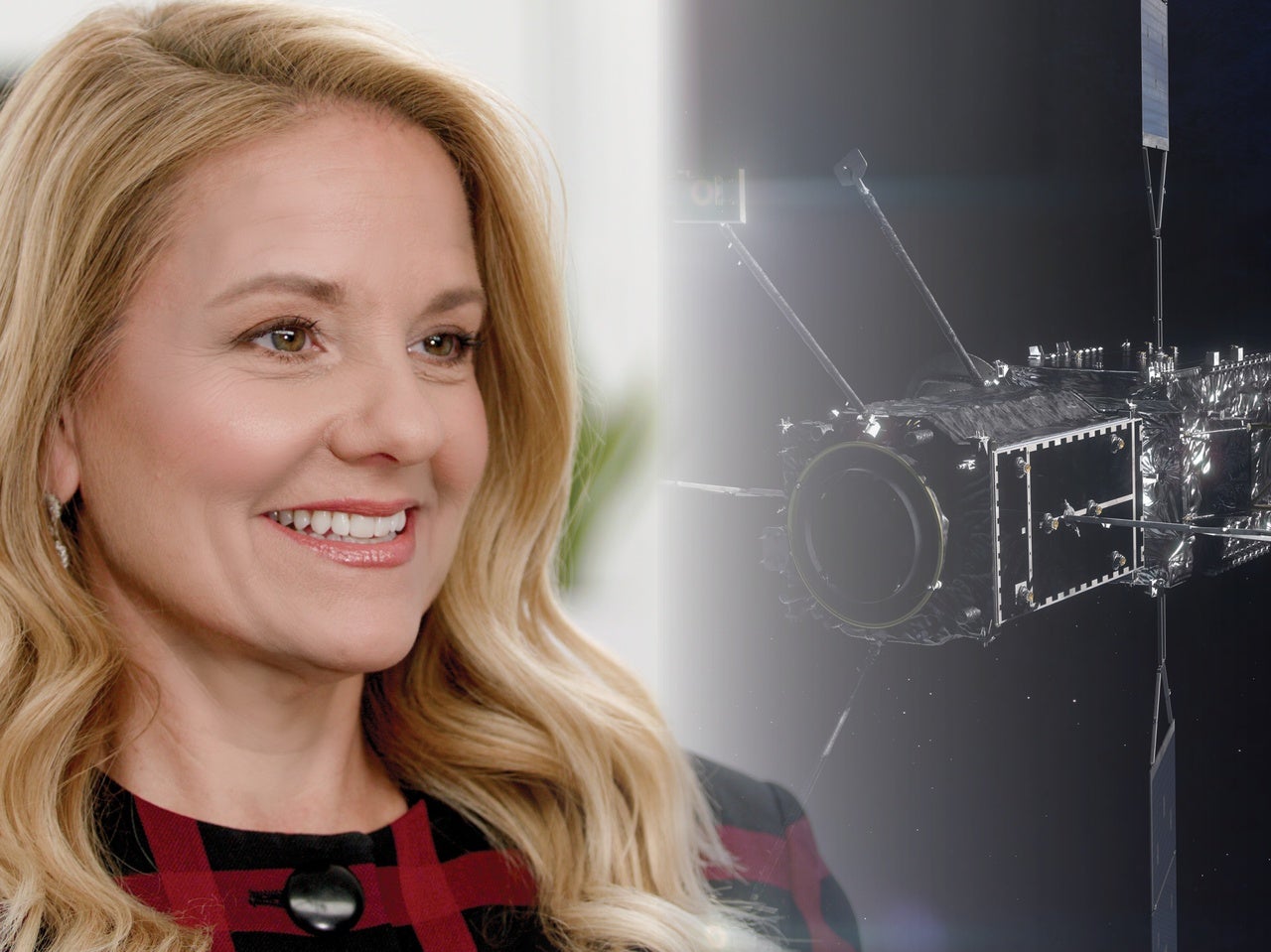

Via Satellite’s Executive and Technology of the Year awards are two of the industry’s highest honors, highlighting outstanding success in leadership and technological achievement. In a normal year, the winners chosen by Via Satellite’s readers and editorial team would be announced in-person during the awards luncheon at the SATELLITE show, but so little has been normal in 2021.
This year, Via Satellite instead announced the 2020 SEOTY and STOTY winners — SpaceX President and COO Gwynne Shotwell and Northrop Grumman’s Mission Extension Vehicle-1 — in April during the LEO Digital Forum, an online event.

Explore the Show Daily 2021 Day 1 Issue
Check out more from this issue and find your next story to read.
SpaceX COO Gwynne Shotwell
Shotwell is now a two-time winner, and she was recognized for SpaceX’s blockbuster year in 2020. She led the group of nominees that included Nobu Okada, founder and CEO of Astroscale; Masood M. Sharif Mahmood, former CEO of Yahsat; Mauricio Segovia, CEO of AXESS Networks; Blake Larson, president of Northrop Grumman Space Systems; Vytenis Buzas, founder and CEO of NanoAvionics.
Shotwell first won the award in 2017 for leading SpaceX through industry-changing milestones in rocket reusability. Now, she is being recognized for a year during which SpaceX not only returned human spaceflight to the United States with the Commercial Crew Demo-2 mission, but also maintained the world’s most active launch business, and built Starlink into the world’s largest satellite fleet.
“2020 — what a weird, and I would normally say, terrible year,” Shotwell said, accepting the award in April. “The global community tried to figure out how to function and survive during a global pandemic. And yet, SpaceX was able to operate and do extraordinary things last year. I’m going to accept this award, again in 2020 — not for myself — but for the extraordinary people at SpaceX that did such extraordinary things in such a weirdo year.”
Shotwell spoke with Via Satellite for the May edition. On the topic of SpaceX’s industry dominance, Shotwell said giant goals keep the company from growing complacent, and she doesn’t see the company as the establishment.
“We never intended to be a disruptor. We really just intended to do the work that Elon laid out for us. I hope we are not considered the establishment, because that sounds very boring,” Shotwell said. “I think that drive for change and being better is why we were able to accomplish what we have to date, and that seems counter to being establishment. Establishment sounds like it’s settled down. But, we have to keep doing better than what we were doing.”
And Shotwell addressed the growing Starlink constellation, which has added more satellites since the interview — launching four missions in May of this year alone. Starlink is still in beta service, but SpaceX recently told the FCC that it has 90,000 Starlink users in 12 countries. SpaceX also recently made news in August by acquiring startup Swarm Technologies, which provides IoT connectivity via tiny, sandwich-sized satellites. It remains to be seen how Swarm connectivity could work together with Starlink, but it was an interesting move for SpaceX’s first public satellite company acquisition.
“Starlink is best set up to serve rural villages and the rural population. We can do work in the city, but you can’t put enough bandwidth down in a city to cover any sort of percentage of consumers in that cell. Starlink is very complimentary to the large ISP, and especially fiber-based systems,” Shotwell said. “It’s just too expensive to take fiber to every house in rural locations. But, Starlink satellites fly over every part of the globe every day, so it’s no more expensive to serve someone in a rural community than it is to serve someone in a city.”
One of the major takeaways from the conversation was insight into SpaceX’s ambition to take Starlink onto mobile platforms like ships and planes. Shotwell said in three to five years, Starlink service will be available on commercial planes.
Taking a wide view of her career, Shotwell was honest and said she wishes to do more in encouraging underrepresented minorities in space. She wants to see everyone be able to participate in the technological revolution underway.
“The best I’ve been able to do is make sure I’m doing my best work every day and that SpaceX is doing great things. As things slow down at SpaceX — and they never have, but as they do — hopefully I have more time to connect with people more closely, and talk about my story. How I got to where I am, and maybe give some advice to folks that have questions,” Shotwell said.
Shotwell will be speaking at the SATELLITE general session on Wednesday, Sept. 8: “The Future of Global Satellite Connectivity.”
Northrop Grumman’s Mission Extension Vehicle-1
In the past year and a half, Northrop Grumman has made in-orbit satellite servicing a commercial reality, and not just an exciting concept of the future. In fact, the same week that Northrop Grumman won the 2020 Satellite Technology of the Year (STOTY) award for its pioneering work with Mission Extension Vehicle-1 (MEV-1), the company successfully docked MEV-2 to the Intelsat 10-02 satellite to deliver life-extension services.
The technology won over these other nominees: hiSky Smartellite network; Kymeta u8 terminal; Lockheed Martin Natural Feature Tracking technology; and Iridium Global Maritime Distress and Safety System.
Northrop Grumman has now twice demonstrated docking two commercial satellites in orbit. In the second demonstration, the Intelsat satellite it docked with was operational. This service allows satellite operators to extend the life of their in-orbit assets by years and defer the cost of a replacement satellite.
Speaking with Via Satellite for the May edition, Joe Anderson, senior director of Business Development for Northrop Grumman and vice president of SpaceLogistics, said the market for in-orbit satellite servicing is rapidly emerging and evolving. Now that the company has proven technical and commercial viability, he expects to sign a handful of deals this year and work with servicing missions for government customers.
“It just makes economic sense to use your assets to their full potential,” Anderson said. “But because of the risk-averse nature of our industry, it really prevented customers from saying ‘Yes’ to an unproven technology. Now that is changing very rapidly. We have really overcome that hurdle with the technology.”
The next generation of this technology involves Mission Robotic Vehicle (MRV), which will install Mission Extension Pods onto existing satellites that are already in-orbit, but not designed to be serviced. These pods are small propulsion augmentation devices that can extend a typical Geostationary Orbit (GEO) satellite life for about six years. This system is expected to launch in 2024.
While so much of the industry buzz is around smaller satellites in Low-Earth Orbit (LEO), Northrop Grumman sees substantial market opportunity in serving GEO assets, and future iterations of this technology.
“The government and commercial industry continues to launch and operate satellites in GEO, and we don’t see that changing,” said Tom Wilson, vice president and general manager for Northrop Grumman and president of SpaceLogistics LLC. “We see a diversity in demand for different missions still being there. There is an entrenched market for us for decades to come. In addition, it is not just about communications satellites or LEO versus GEO. We will not only leverage this technology to service commercial GEO technology, but we will also look to see if there is a market in servicing the LEO satellites, and if there is, we can go there.” VS