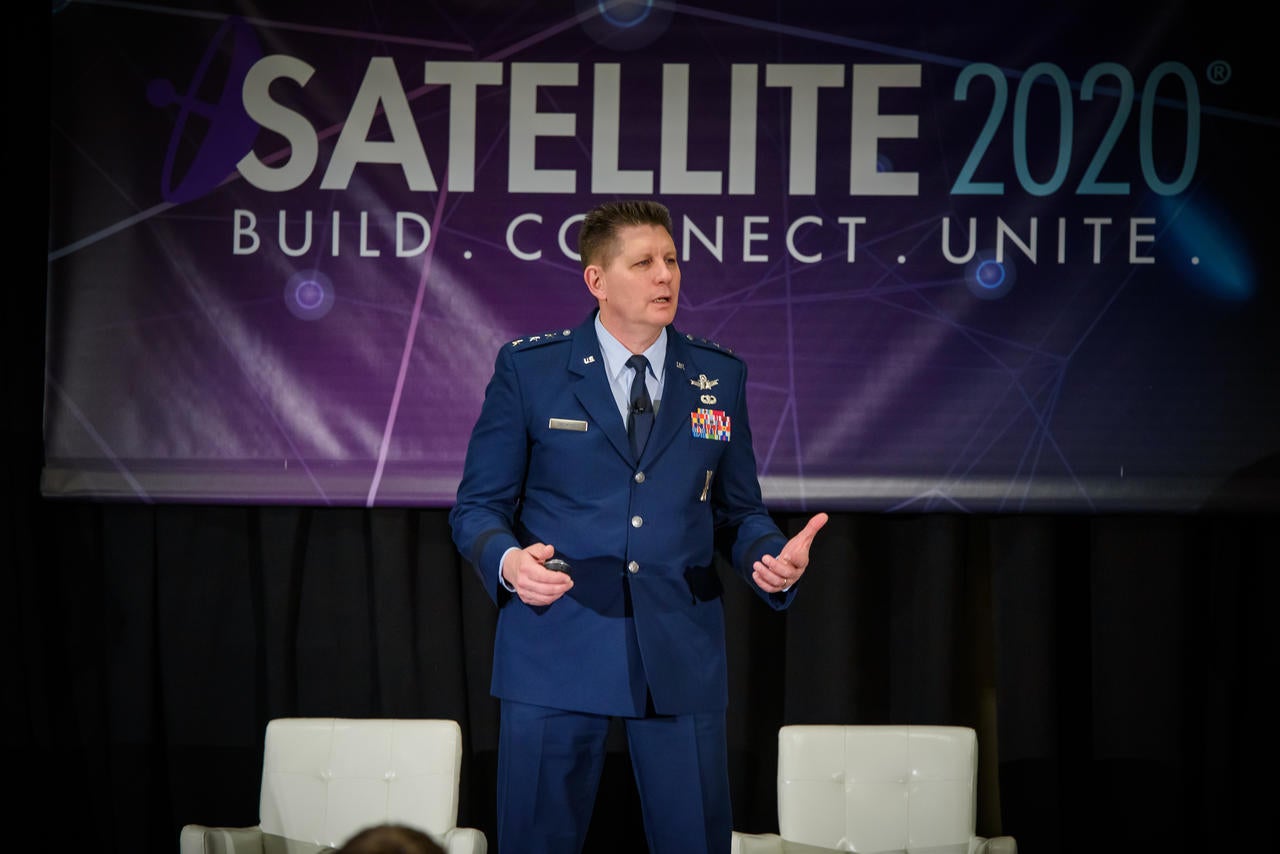

The United States Armed Forces have leveraged space-based assets for decades to provide a warfighting advantage, but the evolution of in-orbit operations by adversaries has highlighted the need for the U.S. Space Force and how much work remains to be done, a top military official said.
“The driving reason for the Space Force is to continue to do [space] well,” Space Force Vice Commander Lt. Gen. David Thompson told an audience during the Government and Military Keynote of SATELLITE 2020. “It’s about aggressive and hostile behavior and activities in the space domain. That’s the major reason for the Space Force today. In order to do everything that space needs to do for our nation, for our national security, for our forces, and perhaps ultimately for civil and economic benefit, we now have to be prepared to do that in the face of threats and adversaries that desire to take that capability away from us.”
Explore the Show Daily 2020 Day 4 Issue
Check out more from this issue and find your next story to read.
The need to protect space assets is growing rapidly, he said. While they are a critical piece of U.S. military operations, they are also just as integral to the economy and the everyday life of U.S. citizens – though few realize it.
“The challenge we really do face is that not enough of the American people understand just how much they depend on space and space capabilities every single day,” he said. “Since they don’t understand that, they don’t understand what it means in terms of the armed forces of the Unites States and our allies. … They don’t understand how all of that is so radically depending on space, and how space has radically changed the way the American military conducts warfare.”
Space operations are evolving as space becomes a warfighting domain, and space needs standards for operations — similar to what exists on land, air and sea — that define acceptable behavior. Thompson cited the current operations of a Russian satellite, known as Kosmos 2542, as the primary example of how things are changing in orbit. The satellite, launched in November 2019, is designed to inspect other satellites in orbit. Earlier this year, it maneuvered to a position near a satellite operated by the U.S. National Reconnaissance Office (NRO).
“The behavior of the Russian satellite, that’s threatening and dangerous. That’s why we need a separate force organized and trained to deal with that,” he said.
And while the organization of the Space Force continues at a rapid pace, Thompson highlighted some of the next steps that are needed. “What we really need most are elements of a warfighting domain and military service that have been lacking over the years. We need our own core intelligence capabilities. We need a national intelligence center. We need uniformed members of the Space Force who understand deeply space intelligence. We probably need to grow the overall intelligence enterprise focused on space. There are organizations with tremendous technical capabilities and dollars today, but they probably are too small for the task in front of it.”
Thompson also argued the Space Force needs to increase its capabilities to test how space assets will stand up to threats, survive threats, and the potential impact the loss of assets will have on operations. “We’ve been building space assets and using them for 20 years. Now we need the ability to fight,” he said.
To realize these goals as quickly as possible, Thompson emphasized the need for greater cooperation with the “burgeoning and blossoming” commercial space sector. Much like the aerospace and IT sectors before it, space R&D is shifting from being primarily driven by government needs to being driven by commercial opportunities. While there will always be areas that are the sole responsibility of the government, such as missile warning, areas like commercial satcom, remote sensing, and launch are experiencing commercial development that the Space Force should leverage.
“This is an opportunity and a challenge, and we have to deliver,” he said. “I believe we are in truly epic, historic, exciting times. The only question is in 70 years — What will our successors say?” VS