
High Throughput Satellites (HTS) have breathed new life into a number of traditional satellite verticals — but the additional bandwidth still isn’t enough to satisfy the connectivity demands of cruise and passenger ship operators. During a Tuesday afternoon panel at the SATELLITE 2018 Conference & Exhibition, a panel of maritime executives said they felt constrained by the slow evolution of ground hardware, and noted too that Low Earth Orbit (LEO) constellations may not be the panacea some expect them to be.
Demand for connectivity is exploding in all mobility markets, and passenger ships are no exception. “In 2000, the amount of bandwidth we were providing for our entire fleet of ships is the amount of bandwidth we are providing to a single user in our larger ships today,” said Guillermo Muniz, director of satellite and network engineering for Royal Caribbean Cruises. ”We’re seeing a doubling of capacity consumption about every three years.”

Explore the Show Daily 2018 Day 4 Issue
Check out more from this issue and find your next story to read.
And because cruises are marketed as luxury vacations, the presumption is that the internet on board will be comparable to speeds at home. This is a marked change from just a few years ago, when passengers were “relatively comfortable having poor connectivity,” said Speedcast Chief Executive Officer (CEO) Pierre-Jean Beylier. Now, however, the landscape is changing faster than ship operators can upgrade their connectivity options. “Today, [passengers] want to be able to post to Instagram and Facebook, and have access to what has become their usual entertainment at home. The networks that have been built to serve cruise ships were not built for that type of usage,” Beylier said.
Carnival and SES recently broke a world record for the most bandwidth ever delivered to a mobile platform at 2.25 Gbps. While that’s sufficient for many use cases, it’s difficult to avoid the inefficiencies that come along with dividing that bandwidth between hundreds or thousands of passengers, said Bertrand Hartman, Chief Executive Officer (CEO) of OmniAccess.
According to the panelists, one of the biggest issues is that downstream hardware has not kept pace with satellite technology as it has evolved, including HTS. Cruise ships still leveraging legacy systems may not even be able to take advantage of HTS beams due to their aged hardware. “There are ships that could not make use of 1 GB of satellite capacity because the on-board infrastructure cannot handle it,” Beylier said.
“In the ground segment, we need to make sure there’s a seamless process for beam switching in an HTS environment. We still haven’t completely solved that issue,” added Reza Rasoulian, vice president of global connectivity and shipboard technology operations for Carnival.
With multiple LEO constellations gearing up to introduce even more capacity, it’s more important than ever to deploy state-of-the-art antennas, the panelists agreed. Thus far, ship operators have been largely disappointed with the mechanically steered antennas on their ships, which are prone to break or malfunction. “There’s a lot of work to be done on flat panel antennas in particular, and I think the industry needs to accelerate that work,” Beylier said.
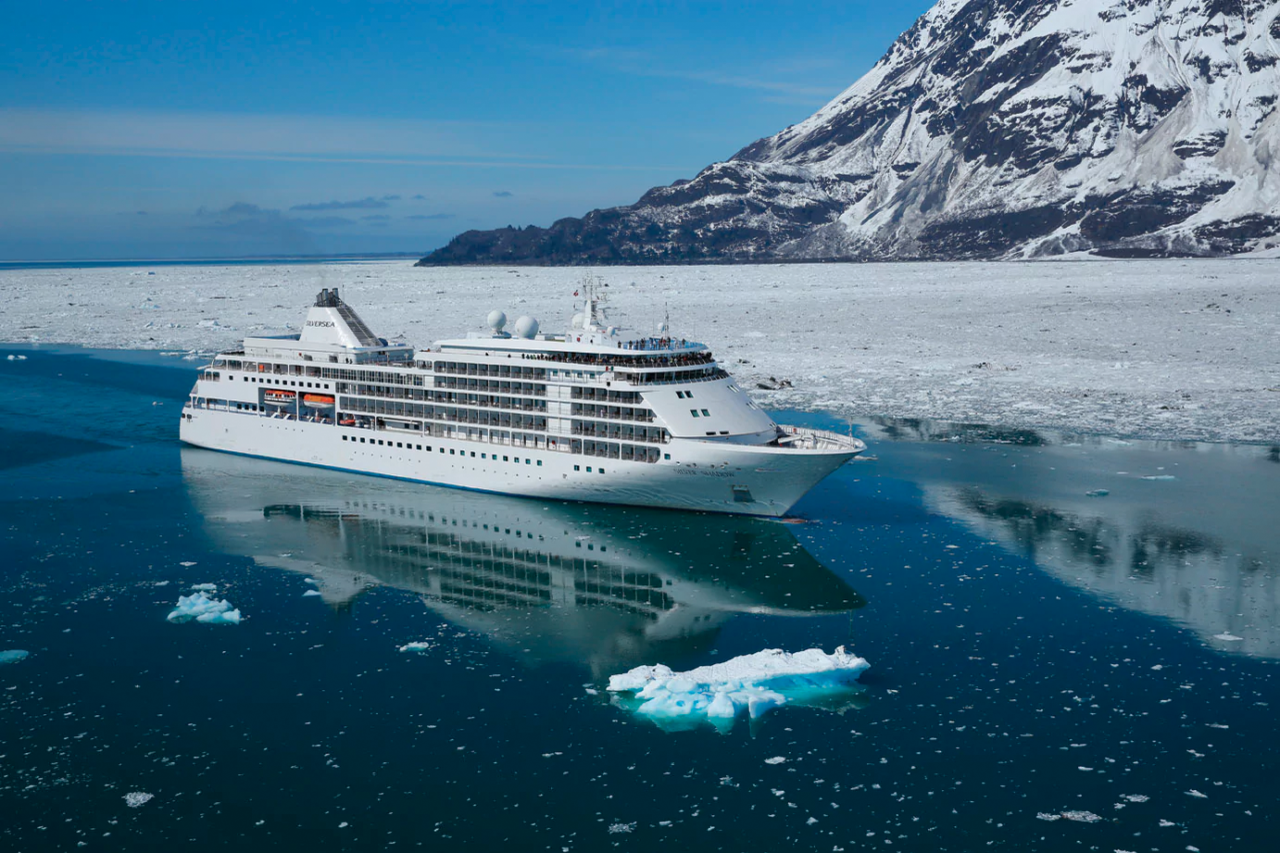
Fabio Agostini, Chief Information Officer (CIO) for Silversea Cruises, also said he hopes to see more end-to-end management from service providers. “We don’t want to have our own expertise,” he said. “We sell emotion and entertainment — we don’t sell technology to our guests.”
Another pain point for Silversea and other ship lines is the lack of global coverage, Agostini said. Satellite operators only deploy HTS beams in regions with enough traffic to justify the bandwidth, such as the Caribbean or the Mediterranean. Even SES’ O3b constellation in Medium Earth Orbit (MEO) — which Carnival uses for its connectivity — can’t cover the entire Earth. “So the bandwidth situation is not homogenous,” Beylier said. “The challenge here is the cruise operator doesn’t want to have 500 Mbps available to passengers in the Mediterranean, and then 50 Mbps if they go to a place where there is no HTS.”
Upcoming LEO constellations with polar orbits could provide full global coverage. But whether they will also solve the other challenges that come along with maritime connectivity — namely, cost — remains a question mark. Agostini in particular still has doubts. “The one advantage LEO has is low latency, but latency is not the biggest issue on board. It will be more about price per megabit and total cost of ownership. Unless the technology will be more reliable or less expensive I don’t see it as that big of a change,” he said.
Still, Agostini described himself as a “big believer” in hybrid communications solutions, meaning there is a possibility Silversea will leverage bandwidth from multiple satellite providers in multiple orbits in addition to the terrestrial connectivity its ships use while stationed at port.
For Beylier, the fact that ship operators are so keenly focused on providing better connectivity for their passengers is promising in itself. “There are many hotels whose internet access is very far from what we get at home, and in many cases we pay for it. If we do this right, it is one more factor contributing to make cruises a better vacation experience,” he said. VS