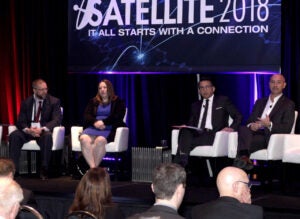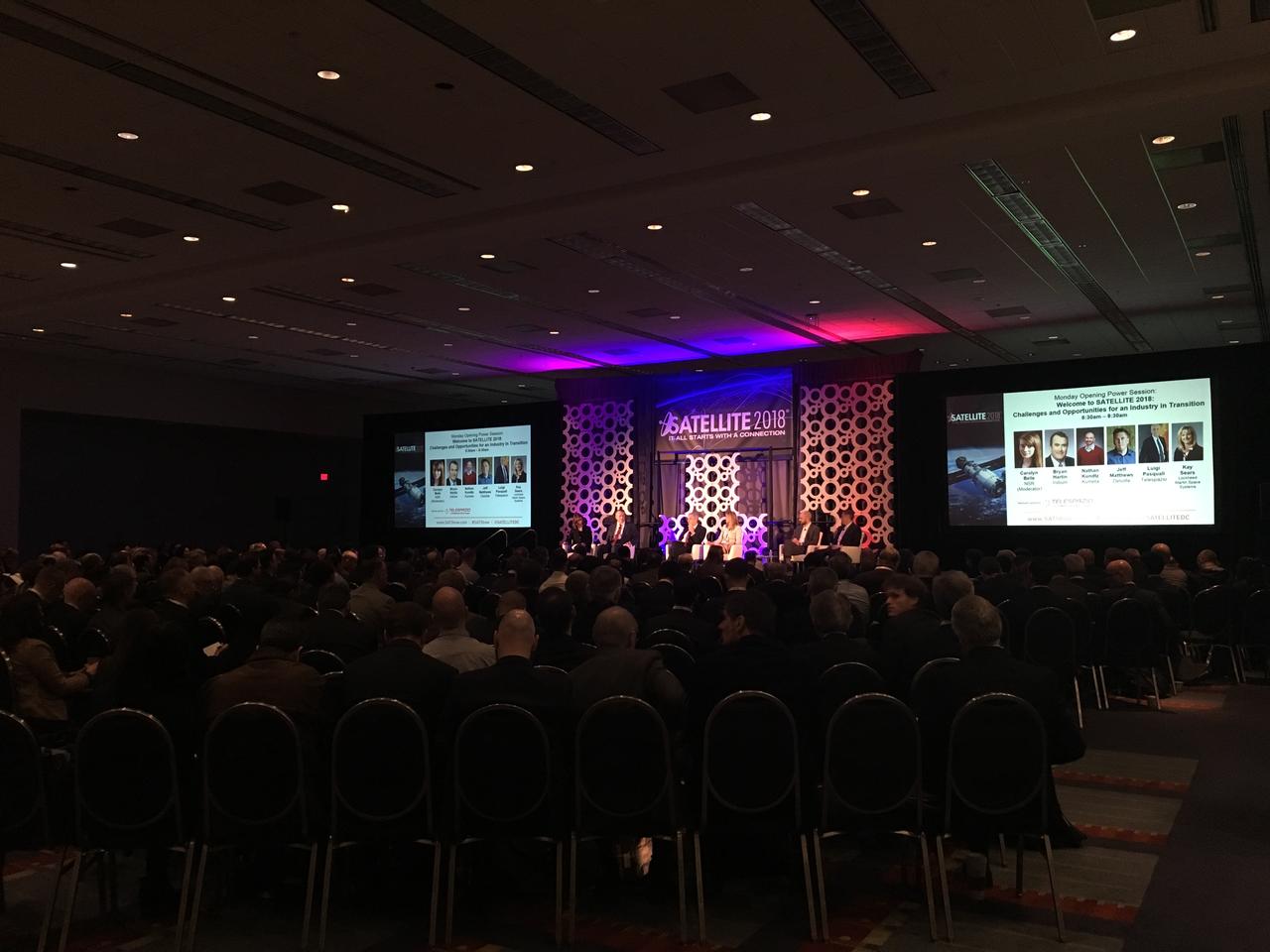
SATELLITE 2018 kicked off with a lively panel “SATELLITE 2018: Challenges and Opportunities for an Industry in Transition” where a number of industry figures talked about everything from LEO systems, ground-based services to what the industry must do to stay relevant in the future. One of the major talking points of the panel was the role and impact of next generation LEO systems, and whether the market could sustain a number of new players.
Kay Sears, vice president for strategy and business development for space systems at Lockheed Martin said LEO satellite operators face a little bit of an identity. “There is a little bit of a business-case definition [question] for these LEO constellation companies. Are they data companies? Or do they want to be a network operator? Those two models are very different,” she said. “I think business models will change several times before they launch. O3b Networks changed the business model several times over the last few years. Business models will change as they hit roadblocks.”
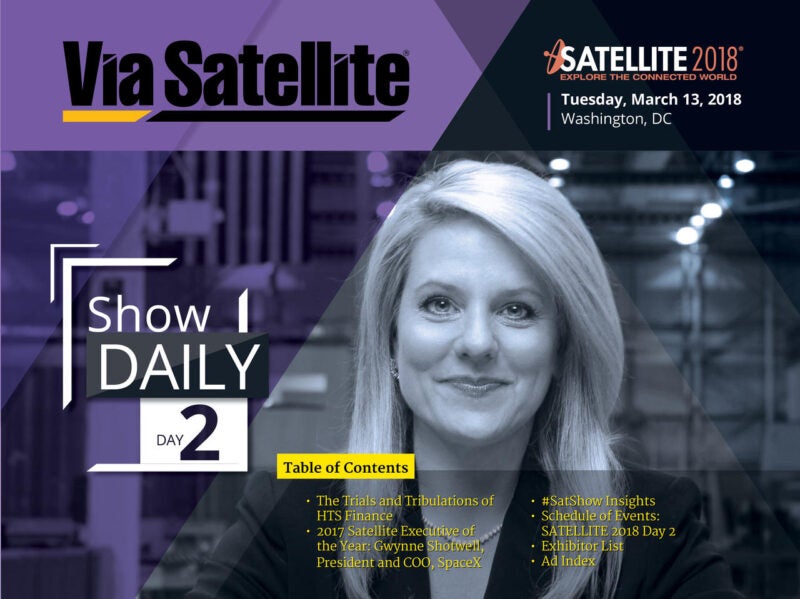
Explore the Show Daily 2018 Day 2 Issue
Check out more from this issue and find your next story to read.
Bryan Hartin, executive vice president at Iridium, made a comparison with the telecoms arena in the late 1990s, and cautioned that not all of these players would find a niche going forward. He said new LEO entrants were good for the industry, as they attracted investment but that they had decisions to make if they are/were going to build the constellations themselves.
“While there are many new entrants, I have seen the Competitive Local Exchange Carriers (CLECs) in the 1990s in telecoms who came in, and only a few made it. There was a lot of excitement. ESPN and Disney were going to come up and show us how it is done. But, they are not there now. The architecture decision is pretty important. To do 600-900 satellites with no cross links is a big effort.”
While Jeff Matthews, specialist leader at Deloitte, was pretty optimistic about new LEO players, he warned that there are “blind spots” that the industry must address. “You can’t do the ‘build it and they will come’ approach. The constant blind spot is the ground segment. Some people/companies are not looking at the entire communications ecosystem. It is still a big concern of mine,” he said.
Industry in Transition
One of the other key themes was that this is an industry very much in transition. With new business models emerging, and a more complex IOT ecosystem taking shape, all of the speakers mentioned how this was an industry on the cusp of significant change. Nathan Kundtz, CEO of Kymeta, highlighted four major trends he sees in the industry right now. First, he said there is now need for industrial always-on connectivity. He said enterprises are demanding constant connectivity, and that applications are becoming business critical. Second, he pointed to the facts of “hybridization” of networks and the use of both satellite and wireless technologies. He expects this trend to continue. Third, and like other speakers, he pointed to a future involving LEO constellations, and the mix of LEO with GEO and cellular. Finally, he spoke about the connected car market as one to watch particularly as it moves to a more autonomous environment. “You need constant software updates to be pushed to vehicles on a global basis. This will be a long-term industry trend,” he said.
Kundtz was optimistic that new constellations could pick up business in the mobile communications market, estimated to be worth around $1 trillion a year. “The mobile market will absorb most of that satellite capacity. The market is there; the question is at what price point,” he said.
Luigi Pasquali, CEO of Telespazio, talked about how the satellite industry could play in broadband markets. He said that, while satellite had previously had difficulties in this area, the emergence of new technologies meant satellite could now become more a part of a broadband access systems. With new High Throughput Satellite (HTS) systems emerging as well as LEO constellations, there is more opportunity for a company like Telespazio to provide services in this ecosystem. He said end users are driving change. “For service providers [like Telespazio], we have to contribute in system definition and architecture on the manufacturing side. This is an evolution — we are focused on the technology,” he said. “Everything starts now with service and applications. We use space as an enabler of economic development; there is a great role for service providers.”
Space-Based Data Services
Matthews was an interesting addition to this panel given Deloitte is a company not necessarily associated with the space industry. He admitted that space is becoming pervasive for Deloitte’s clients.
“How do we take data that you are bringing down from the satellites and bring it into services. For connected cars, smart cities, we have been studying this. So, bringing in knowledge is a play with us. We are intrigued by new use cases for data acquisition,” he said. “How can we push it out? In terms of using space data, how pervasive does that get? [We can start] to tell people that the time is right; that space is here and it is accessible to you and you can use it as a competitive advantage.”
Sears gave some interesting comments from the satellite manufacturing side and how a company like Lockheed can play in this new environment. She said Lockheed Martin was really taking advantage of new technologies such as 3D printing and Artificial Intelligence (AI). She said the company was looking more and more at software-defined payloads and satellites, and how it could produce satellites faster and cheaper. She also spoke about engaging with a new set of clients.
“We are pretty excited about the new space entrants. We are really looking to engage those companies and bring them into the business. We are using our mission knowledge to help them, as they may be targeting a specific market segment,” she said. “We have introduced four different bus platforms, and different size platforms. We want to be responsive to requirements. What do customers value? There is affordability, resiliency? Do we want a 15-year satellite or a seven-year satellite? This is all changing. We need to be as agile as possible. We need to work with customers to see what they value and how they adapt.” VS