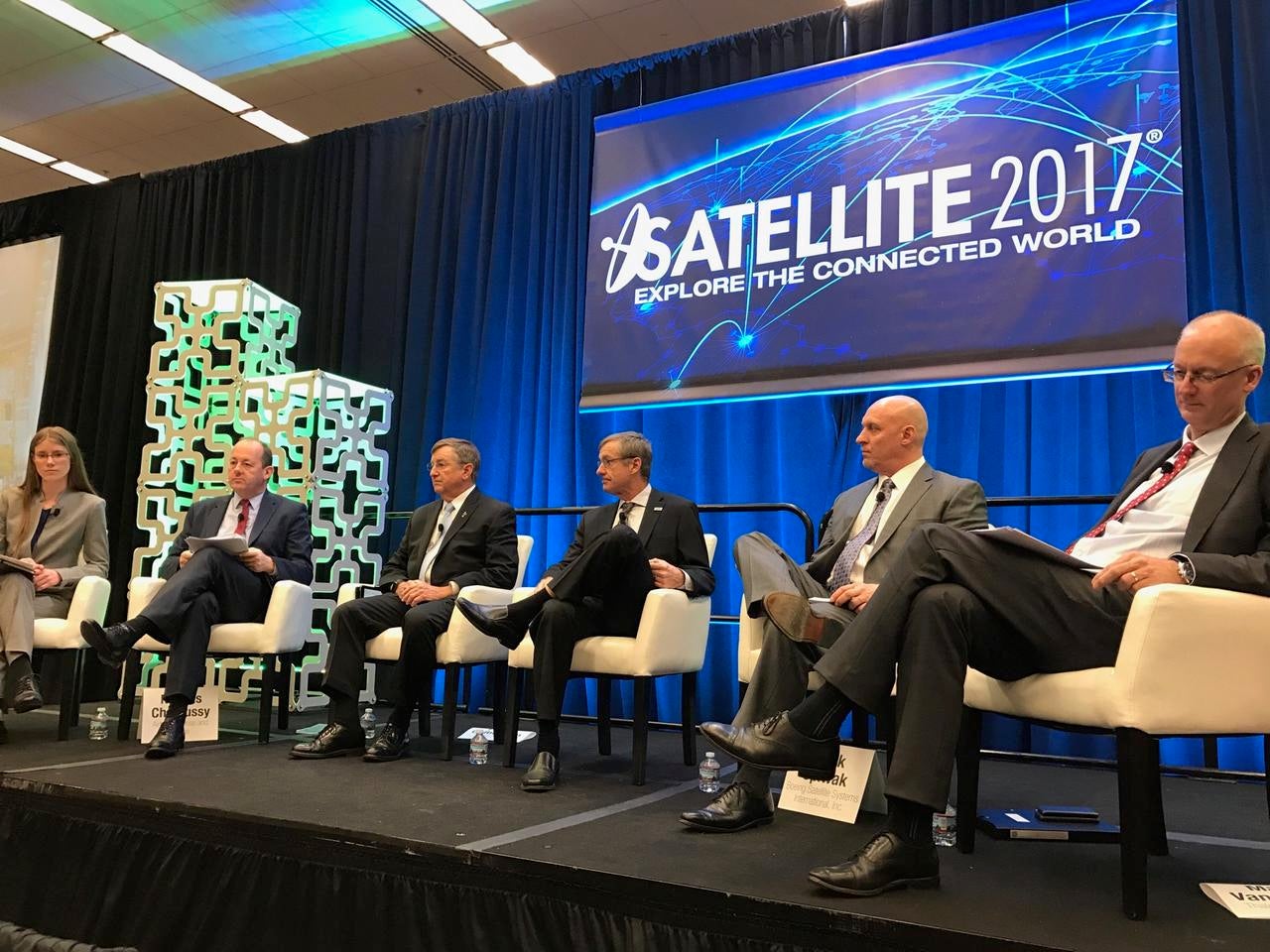

Wednesday’s general opening session was a packed house as attendees gathered to hear a discussion between some of the biggest names in satellite manufacturing. Moderated by NSR Senior Analyst Carolyn Belle, the panel covered a range of topics from launch to satellite servicing — but it seems the biggest takeaway was the need to push for collaboration between satellite manufacturers and their customers.
Martin Van Schaik, vice president of Thales Alenia Space, emphasized that between high competition and disruptive technology, manufacturers’ customers will need a hand to overcome some of the challenges they’re facing today. “One of the most important things we see is that we get a much closer cooperation with our customers to optimize their business plan,” he said. “We have to get more involved and understand the market and the business of our customers. That is a big change for us.”

Explore the Show Daily 2017 Day 4 Issue
Check out more from this issue and find your next story to read.
Boeing Satellite Systems President Mark Spiwak spoke similarly, noting that truly “understanding the business” is the only way to provide the right solution for customers’ needs. “Some customers need the flexibility of a digital payload, others may not,” he said. According to Spiwak, in order to be successful manufacturers must ask themselves, “What is the right solution from a customer standpoint?” Spiwak believes it is important for manufacturers to “speak the language” of their customers. “Whether it’s a follow-on business, a growth business, at [developing] country, a metropolitan area — what is that business model, and how are these technologies advantageous to consumers?” he said.
Nicolas Chamussy, executive vice president of space systems at Airbus, also brought up the point that it’s important to find a balance between standardizing manufacturing techniques and creating customized designs. “Hence the need to interface on a regular basis with the customers,” he said.
Unfortunately, no amount of manufacturer-operator collaboration can provide an easy solution to one of the biggest hurdles in the space industry: launch. “It is a big problem,” said Paul Estey, executive vice president of engineering, manufacturing and test operations at SSL. “The launch vehicle is a bottleneck to getting both the LEO constellations running and GEO back in shape. Long term, I don’t know if there really is a good solution yet.”
Estey also pointed out that the growing popularity of smaller satellites poses its own challenge. “All the guys building LEO constellations darkening the skies are going to suck up all the launch capacity,” he said.
The issue is further magnified by the shortening life span of satellites as the technology continues to mature. “We think the 15-year model is obsolete,” Estey said. “There’s so much change going on in the telecomm business that we’ll have to refresh payloads much faster than 15 years.”
“If we want to use our technology to its full extent, launch cost is still a big limiting factor. We really look forward to more diversified options for launchers … We need a breakthrough in launch capability,” said Van Schaik.
Spiwak also brought up another challenge manufacturers face, which is chasing innovation in order to remain competitive. “It starts with people,” he said. “How do we make sure we’re attracting the right people to the industry? What we don’t want is to be recycling the same people, the same ideas.”
However, Van Schaik said that the struggle is not attracting young engineers; it’s making sure they don’t fall into the same habits and patterns as their predecessors. “How do you ensure that the young engineers are not assimilated in the old culture within two to six months? I think that’s the real challenge. We tend to neglect it and just hire a few hundred of those new engineers … Well, you’ll see very quickly that they are assimilated effectively. That is something our companies do very well,” he joked. According to Van Schaik, one solution is to give young staff tasks where they have the freedom to come up with creative ideas.
Both Chamussy and Frank Culbertson, president of Orbital ATK’s space systems group, mentioned their companies share similar goals of hiring people with less than three years experience. Estey also hopes to use the younger generation to teach the older generation the culture of change. “We developed a rotation program for people working at the company less than five years to make sure they’re not assimilated,” he said. “That fresh blood has been very useful in taking out non-value-added tasks.”
Near the end of the conversation, moderator Carolyn Belle pushed the question of how the new presidential administration could affect the industry in the coming years. The general response from the panel was to pursue caution.
“I think we need to be very careful about how we have the discussion with the administration,” said Culbertson. “Going forward to simplify and buy only American in our business just doesn’t work. We’re too integrated, too reliant on each other. It is a global business.” He highlighted the International Space Station as a testament to the benefits of international cooperation, and said that working together across borders is “the best way to move forward peacefully.”
Spiwak agreed and stated that he feels encouraged that a lot of the discussion seems to be pro-business. Above all else, he said, “we have to stay very connected with Congress and the administration.” VS