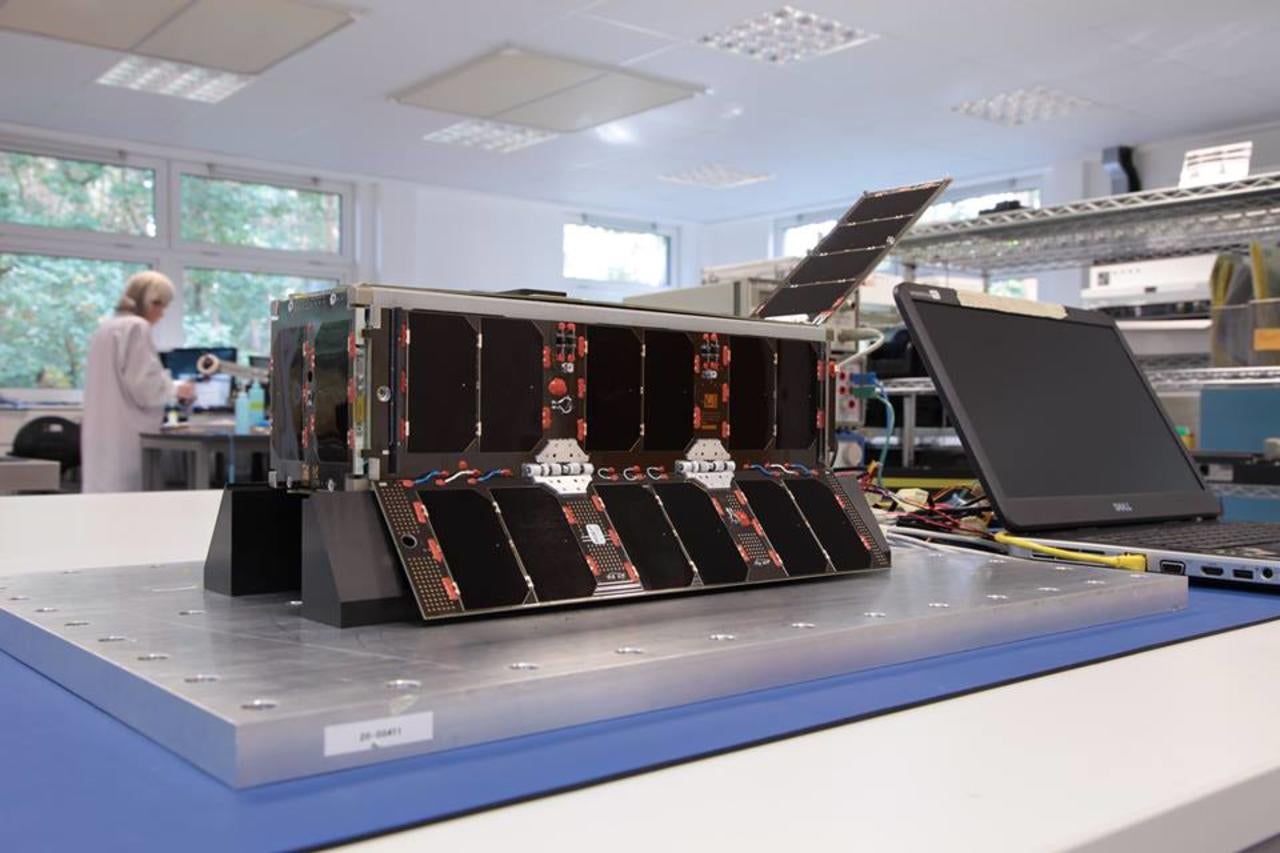

In the last five years or so, the smallsat market has propelled itself to the forefront of the conversation about the future of the satellite industry. Venture capital firms have begun pouring money into what many see as the next big stage of evolution for satellite; but along with those investments come concerns about when some smallsat companies will see profitability. Moderated by Carolyn Belle, senior analyst at Northern Sky Research, a group of industry entrepreneurs gathered to address this question at the “Smallsats: Will They Generate Large Returns?” panel at SATELLITE 2017.
Craig Clark, chief executive officer at Clyde Space, kicked off the discussion by pointing out that it’s still somewhat early to focus primarily on returns. “The market is so young and there is a lot of opportunity. It’s a race to see who’s going to be the dominant player, so for me it’s not necessarily about profit. It’s more about where you position yourself in the market,” he said.

Explore the Show Daily 2017 Day 3 Issue
Check out more from this issue and find your next story to read.
Chad Anderson, CEO at Space Angels Network, also highlighted the relative youth of the smallsat market, but emphasized too the importance of companies working together to figure out what main issues the market needs to address, even as they jostle to figure out the pecking order. “Smallsats are still in their infancy. A lot of parts along the value chain need to be developed,” he said. “Always in new industries you need some level of cooperation among future competitors before there is a market to compete over. We’re still in that early stage.”
“M2M, hyperspectral imaging, AIS ship tracking — someone needs to fuse all of that to provide insights for the customer,” said Jason Andrews, CEO at Spaceflight Industries. Thus, no smallsat company will operate in a vacuum as the technology develops further. “You have to be a bigger part of the ecosystem to generate meaningful returns.”
One of the biggest hurdles to the development of the smallsat market is launch, a challenge that nearly every company in the space industry. The delays the industry saw in 2016 were particularly disruptive, according to Clark. “I do think the launch bottleneck is causing issues in the smallsat market,” he said. Despite the introduction of a number of new launch providers, it’s going to take time before those companies come online properly. “We’re all waiting for that to happen so we can get more spacecraft up,” he said.
“When we get through this next round of launches, more capital will show up,” Andrews added. That additional capital, he believes, will alleviate the problem by diversifying the options available to smallsat operators. “There are a lot of launch companies popping up, and not all will be successful. That’s part of the game. Launch is super hard, and we have to educate the investors that [delays] are something we have to plan for.”
The group agreed that international options coming online will also play a role, exemplified by the record-breaking launch of the Indian PSLV in February. “We had 100 satellites launched all of last year. We had 100 launched by the second month of this year,” Anderson said.
Clark expects that as the launch sector improves, smallsats will start to have a growing role in communications. “If you look at the pie chart of the smallsat market it is mostly dominated by LEO. The space market in general is dominated by GEO communications … but the pace of technology change is so fast it’s allowing more and more applications to come to the forefront,” he said.
Chris Boshuizen, entrepreneur in residence at Data Collective, added that it’s a question of whether technology can keep up with what people want. “Customer demand is outstripping technology and capability in the smallsat realm, which is why big satellites are the domain of a lot of this stuff,” he said. But Andrews doesn’t think that will be the case for long, pointing out that one major advantage smallsats have over standard-sized satellites is manufacturers can take on additional risk. Because they are exponentially cheaper to design and build, “the rate of technology innovation is a lot faster than the bigger satellites,” he said.
As for the future, the panel agreed that the only way smallsats will prove their relevancy in the years to come will be if companies hone in on the specific needs of their end users. “The market is too saturated with companies that are very broad and shallow. I would like to see more specialization,” Boshuizen said. “Know your customers, have the relationships an have a deep understanding of their problem.”
For example, as Anderson pointed out, “If you want to go monitor a specific area it’s a little different than telling me what crop yields this summer are going to look like.” Having the answers to those “intuitive questions” is the crux of what will make or break the smallsat industry. VS