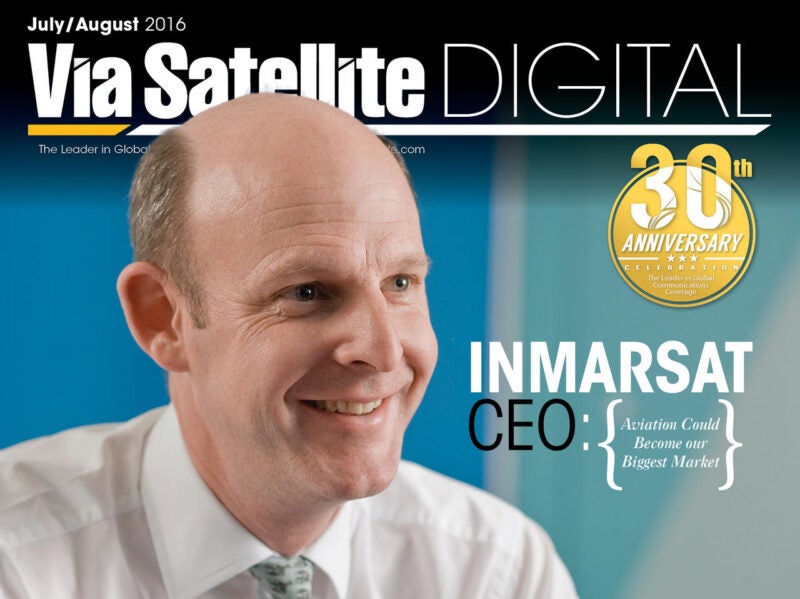

Inmarsat CEO Rupert Pearce sees a big future in connected transportation, so much so that he believes aviation could ultimately usurp maritime as the biggest revenue generator for the operator. Right now, commercial aviation accounts for around 10 percent of Inmarsat’s overall Mobile Satellite Services (MSS) revenues, so it still has some way to go, but Pearce sees many reasons why aeronautical connectivity could become number one.
“Over the next decade there is the potential that aviation could become our largest business, because of the scale of the aviation industry, its sectoral growth dynamics, and because it is almost uniquely an area where mobile satcoms can service the needs of consumers — passengers travelling on commercial airlines. As such, there is the potential for aviation to vie with our maritime business as our largest business segment,” says Pearce.
Explore the July/August 2016 Issue
Check out more from this issue and find your next story to read.
The company is right at the epicenter of these key new data markets for satellite operators. Pearce talks in-depth about the operator’s plans in the aviation market. He sees a number of key contracts up for grabs right now. Pearce says Inmarsat sees very significant levels of activity throughout the world, with airlines looking to implement their connectivity strategy. He describes it as “a very active” market.
“Airlines across the world have gone from thinking about a connectivity strategy to implementing a connectivity strategy. It has gone from something that only the thought leaders have been implementing to something the fast followers are doing as well. More than that, airlines know they not only need a connected aircraft fleet, they need to ensure a very high quality of connectivity so that customer expectations are met, and they need a long-term relationship with their supplier that can ensure that the airline’s connectivity services stay at the cutting edge for many years to come,” he says.
Pearce sees a lot of pent-up demand out there, and reveals that Inmarsat is involved in tenders around the world with both regional airlines and global carriers, from short haul to long haul.
“We will be seeing an inflection point in the creation of this new service segment in the course of the next couple of years,” he adds.
Inmarsat is also funding the development of a unique hybrid satellite-terrestrial network to provide airline passenger connectivity throughout Europe. The operator’s European Aviation Network (EAN) combines satellite communications from Inmarsat and an Air-to-Ground (ATG) network, which will be built and maintained by partner Deutsche Telekom. Pearce says Inmarsat believes that, in certain geographies and for particular applications, such as in-flight passenger connectivity, hybrid capabilities are a much more powerful solution than satellite alone.
Satellite and ATG combo-networks are also unlikely to be just a European play. Pearce says that the operator will look around the world to areas where that makes sense.
“In years to come and after the launch of the EAN, an aircraft will be able to fly to Europe with passengers enjoying reliable high-speed connectivity through Global Xpress, which switches seamlessly to our hybrid European Aviation Network when over Europe, and then switches back to Global Xpress when it exits Europe, utilizing in each case the best technology that is fit for purpose,” says Pearce. “There may also be other regions around the world where high aviation traffic density over land makes a hybrid approach feasible.”
While aviation maybe the most exciting growth segment in Inmarsat’s business over the next few years, maritime continues to be a dynamic market. Pearce jokingly says that his maritime team would likely strongly disagree about aviation being the number one growth vertical over the next few years. In maritime, one of the most significant things Inmarsat did recently was team up with Ericsson on an initiative to offer better connectivity options to its maritime customers. The relationship materialized through happenstance according to Pearce. “It came about because of one happenstance and one market trend. The happenstance is that Ericsson and Inmarsat came into contact with each other in the market, as we both serve Maersk. Maersk is one of our largest and most innovative maritime customers, and Ericsson has an embedded relationship with them, and is delivering tremendous value to them,” he says. “So, we found each other through this important customer relationship. We began our commercial engagement by helping Ericsson to deliver cutting edge services to Maersk. Out of that came the recognition that we could develop a much broader strategic relationship.”
Pearce believes the maritime industry has been gradually embracing connectivity in recent years and that we are now moving into the “smart ship” environment, which is about providing connectivity to all of the systems and sub-systems on a ship; using everything from broadband connectivity to the Internet of Things (IoT), telematics, telemetry and consulting to drive a step change in efficiency, safety and regulatory compliance, and supporting crew welfare and training too. The strategic relationship gives both companies the ability to leverage their respective strengths for the benefit of maritime customers, as they embrace the era of the smart ship.
“It is not just about speeds, reliability or reach. We have done things inside our network that actually support and enhance the ability of Ericsson, and many other Inmarsat partners, to deliver tailored applications and services in new, rich ways, which allows the customer to get better value as well,” he says.
Inmarsat also hopes to expand into the leisure part of the maritime business. It is also targeting the fishing and coastal markets with an ultra-low-cost and ultra-light cut down version of FleetBroadband called FleetOne. The operator believes that if it can get FleetOne down to particular price points at a retail level, there is a big, big appetite it can tap into — up to a million or more vessels around the world. Pearce admits, however, that this is a difficult market to reach, as it is very regional and fragmented Inmarsat is developing a channel to market to do that. This could be another “break-out” opportunity for the company.
Another market the operator may look at going forward is the connected car, which is an area that a number of satellite operators have spoken about in dispatches over the last year. Pearce says this market is right in Inmarsat’s “sweet spot.” He believes there is a need within the car industry to deliver pervasive broadband connectivity to its vehicles, and that this fits very nicely with Inmarsat’s capabilities. Pearce cites the prevalence of cars traveling in urban areas as one of the downsides for satellites, since “urban canyons” can make it difficult to deliver a consistent satellite service, adding that is something the industry has to think about and fix, although it has been done before in other contexts. Interestingly, he reveals Inmarsat is actively involved with a number of car manufacturers around the future of the connected car.
Pearce says one of the things he finds very illuminating is the fact that so much of a car is now in software. He calls the proliferation of software systems in car platforms “incredible,” and believes this creates a “tremendous need” to update and upgrade software, and that satellite can do that very efficiently and effectively. Pearce says Inmarsat is in active discussions with a number of car manufacturers. “Right now, it is an R&D development, so to see that translate into real contracts for installs and services, we are more than a few quarters away. But, one of our ambitions next year is to advance those kinds of discussions meaningfully,” he says.

Pearce admits the operator does not really have capital expenditure holidays anymore, and it has moved past this as a concept. Ten years ago, Inmarsat’s capital expenditure cycles were incredibly intensive, with long intervals between them, as it manufactured and launched generational fleets of satellites, and then entered a period of much lower capex and higher free cash flow thereafter. But this has now changed.
“Because of the phasing of the Inmarsat 4 launches between 2005 and 2013, and the addition of the complementary Inmarsat 5 (Global Xpress) fleet, the game has changed and we can now launch new satellites more gradually but regularly. The world we are living in now is also moving at a different pace and it is more diversified. These factors mean a smoothing of our capex profiles, and we are going to see a much more regular and sustained level of capital expenditure going forward, without the ‘peakiness’ of prior years. We are talking about a very consistent level of R&D expenditure, which you would expect to see in high growth markets and a sector that is moving at the pace of mobile satcoms,” Pearce adds.
Inmarsat is now bringing its Ka-band capabilities to the market on a global basis, and defines global coverage as an inflection point for customers to come on board. Over recent years, the company has seen stable revenues but not a high rate of growth. Its Earnings Before Interest, Taxes, Depreciation and Amortization (EBITDA) is growing at single digit rates.
“To break out to double digit growth, which we feel lies ahead, we have got to bed down Global Xpress as a service offering and deliver it powerfully to the marketplace,” says Pearce.
With new Low Earth Orbit (LEO) constellations launching, and the growing influence of the NewSpace movement, the industry is clearly on the cusp of change. Pearce says the industry is indeed at the beginning of a new era, and that satellite is seen as increasingly relevant to solving communications problems that society has. Pearce also believes we are also at the dawn of a new era for innovation, with HTS beginning to proliferate and Non-Geostationary Orbit (NGSO) ideas, as well as new R&D, coming into the market.
“The pace of innovation has been upped; that is very exciting. But, it is also going to be an era of enormous disruption; incumbents will be ousted, winners will become losers. We could be looking at a very different competitive environment in five to six years than we have today,” he says. “While that is challenging, exciting and exhilarating, it is also unnerving as well because of the profound prospects of change which lie ahead. So, this is a time to remain on the ball, taking intelligent risks, but, above all, investing in innovation and bringing it through very quickly. The demands of our industry are upping all the time.”
However, it is not all good news. Pearce also believes we are beginning to see, in the midst of all this growth, an existential threat to the industry — one that the terrestrial mobile industry encountered more than a decade ago. “While on the one hand it is fantastic to see our customers embrace mobile broadband and aggressively drive data usage upwards, on the other hand it will be very important that the satellite industry is able to continue to deliver attractive Returns on Investment (ROIs) needed to satisfy customer demand,” he explains.
Pearce believes this will require increasingly intelligent innovation, and that the satellite industry cannot afford to turn into an industry with endless high capital expenditure required to merely stand still in terms of profitability. He believes the potential mismatch between data usage growth and Average Revenue Per User (ARPU) growth in the years to come will create new challenges for everyone in this sector.
Change is constant throughout the industry right now. Pearce points to third party expectations for mobile broadband traffic to grow significantly again in 2016, and that this has ramifications for the satellite industry.
“We are at the inflection of the J-curve for mobile broadband growth, and that is pulling through satellite with it,” explains Pearce. “As such, our core business to our traditional customers and markets is growing as our customers embrace the benefits of mobile broadband connectivity, but we are also seeing an expansion of our relevance to new customers who have adopted mobile broadband strategies and now want to extend their coverage, resilience and cyber-resiliency; there, satellite is the enabler. The future does look exceptionally bright for satellite operators that can provide true mobile broadband capabilities at good value.” VS