
As the technology behind In-Flight Connectivity (IFC) continues to improve, bringing better global coverage and more bandwidth, passenger expectations on how they can use Wi-Fi in the sky are soaring. At the same time, airlines are becoming increasingly aware of the operational benefits on offer from a pipe that enables vast amounts of data to be sent to the ground in, or close to, real time.
These two factors are driving the development of a new wave of applications that will take the connected aircraft to the next level, both in terms of operational efficiency and customer satisfaction.

Explore the June 2016 Issue
Check out more from this issue and find your next story to read.
“Over the last two years, demand for connectivity has gone up significantly in almost every single continent, and the technology is improving,” says Aditya Chatterjee, chief technology officer at California-based In-Flight Entertainment and Connectivity (IFEC) provider Global Eagle Entertainment (GEE). “Almost every single component of connectivity is moving up to the next generation, meaning a bigger, faster and more reliable pipe from the aircraft to the ground. And airlines and passengers are taking advantage of it.”
For passengers, this improving technology “translates into more applications they are comfortable with using while flying,” says Chatterjee. Up until recently, airline passengers have mainly used IFC to check email, send text messages and update their social media accounts. But as more bandwidth becomes available, the appetite for higher-bandwidth services involving video streaming is expected to grow. On the horizon, for instance, is increased in-flight use of live-streaming social media applications, such as Periscope and Meerkat.
Chicago-based Gogo, which provides both Air-to-Ground (ATG) and Ku-band satellite-based connectivity services to the airline industry, believes its 2Ku dual-antenna solution will enable it to meet this demand. The company claims its 2Ku service offers more bandwidth at a lower cost and with greater global coverage than other available solutions. This will improve further, says Gogo, when a recently-signed agreement with Intelsat and OneWeb to access their shared high throughput Geosynchronous Earth Orbit (GEO) and planned Low Earth Orbit (LEO) satellites, takes effect and pole-to-pole coverage becomes possible. Passenger demand for connectivity services is no longer limited to the cruising phase of flight. With previous restrictions on the use of Personal Electronic Devices (PEDs) below an altitude of 10,000ft now lifted, airline passengers increasingly expect to be able to surf the Web from the moment they enter the aircraft until the moment they disembark.
Icelandair recently became the first airline in Europe to offer gate-to-gate Wi-Fi connectivity to its passengers through an agreement with GEE. The airline, which has had GEE’s Ku-band satellite-based connectivity system installed across its Boeing 757 fleet since 2014, extended its agreement to include gate-to-gate service in February of this year, as part of its focus on further improving the passenger experience.

“The aim was not to be first; our goal is a pleased customer. Our philosophy is, the more entertainment we give the passenger, the more pleasant the experience,” explains Icelandair project manager for IFE and Connectivity Inga Erlingsdóttir. “We are constantly looking to develop our portals at the same time as providing excellent content to our IFE. Currently, we are focused on enhancing our Wi-Fi portal and providing more material within it, such as newspapers and other information for our passengers. In the future, our passengers will hopefully be able to order meals and services through our IFE.”
Erlingsdóttir agrees that passenger expectations are going up, and says that Icelandair will keep innovating to meet customer demand. “Technology is evolving and we will continue to press on with development [based on] the behavior of our customers,” she says. “As the technology on the ground develops, the demand for the same kind of development in the air follows.”
Running parallel to rising passenger expectations is the growing realization among airlines that the connected pipes they have installed across their fleets are capable of pushing data from the aircraft to the ground. This opens up a whole new realm of operational efficiency opportunities, from real-time aircraft health monitoring to up-to-the-minute weather forecasting to real-time credit card processing. “The pipe doesn’t care what type of data it’s enabling — it’s up to the airline to multi-use that pipe when it’s available,” says Chatterjee.
Applications that would enable airlines to improve their operational efficiency are edging closer to deployment, pushed on by increasing demand from airlines. “We were thinking about these applications in the design or talk phase before, but we are now starting to build them,” adds Chatterjee.
Icelandair, which has so far primarily used its connectivity service for its passengers, is keeping a close eye on developments in this area. “We are already looking toward utilizing connectivity for service factors, such as delivering information between and to crew members,” says Erlingsdóttir. “Icelandair has also been working toward developing e-enablement, with Electronic Flight Bags (EFBs) with full connectivity. The project is intended to ensure real-time information for all systems, such as weather, and to establish system health monitoring and advance notification of faults.”
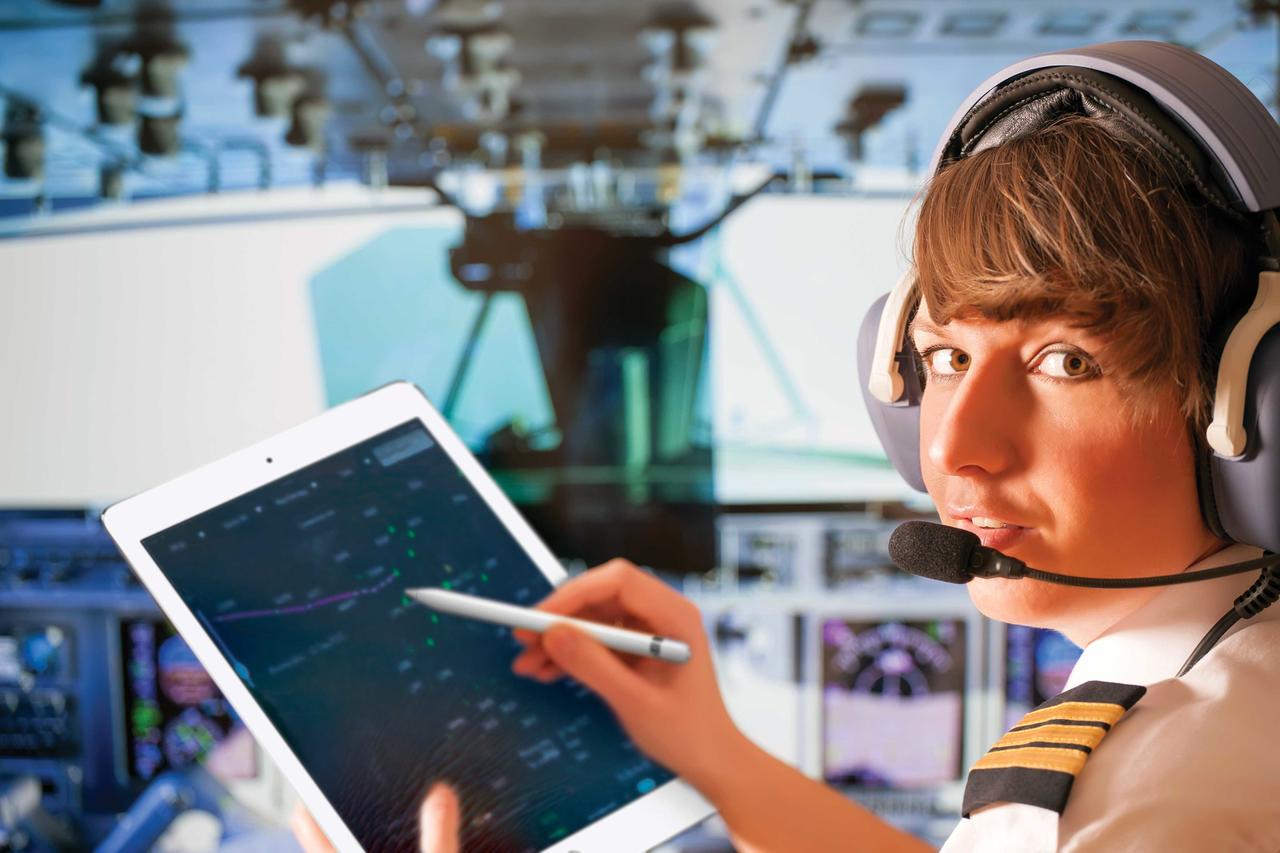
The majority of airline interest in the first phase of the operational efficiency push has centered on the cabin, with a number of airlines arming flight attendants with connected tablets to improve in-flight services (see sidebar). As outlined by Erlingsdóttir, Icelandair is now focused heavily on EFBs, with access for pilots to real-time weather forecasts proving extremely popular. But the next big push — and an area with the potential to save airlines a significant amount of money — will be predictive maintenance.
“As we move along we will see more activity in the cabin, and we are seeing a relatively large push for EFBs. We are now starting to see lots of interest in connecting these [tablet-based EFBs] to our network, particularly for graphical weather data. Having access to live, real and graphical weather for pilots is a very strong payback,” says Andrew Kemmetmueller, vice-president of airline applications at Gogo. “There is a heavy amount of interest in sending data to the ground and processing it relatively close to real time – it doesn’t have to be real time. This allows us to move toward the largest payback opportunity we’ve heard about: predictive maintenance,” he adds.
The ability to send engine and aircraft health data to maintenance teams on the ground in advance enables better preparation and can help reduce the number of unscheduled repairs, which take aircraft out of service and disrupt operations.
Jonathan Kletzel, U.S. airlines and transportation leader at PricewaterhouseCoopers, says the traditional aircraft reporting system, ACARS, has never enabled vast amounts of data to be sent to the ground. But the picture is now changing.
“New Wi-Fi pipes, whether ground- or satellite-based, allow airplanes to send more data through in real time. This will allow airlines to look at parts that might be problematic, and provides an early warning system. Airlines can get ahead of maintenance issues with more intelligent, more frequent data,” says Kletzel. “Airlines are certainly aware of this and they believe there is a business case there … but I’m not aware of any airlines doing it right now.”

Kemmetmueller points out that “20 to 50 percent of airlines have some sort of fairly significant activity around this” going on, and the market is moving “very fast.” But he adds that “airlines view a lot of this technology adoption as a competitive advantage for them and they don’t like us to talk about it specifically.”
SmartSky Networks believes its under-construction 4G broadband Air-to-Ground (ATG) network will give it the upper hand when it comes to providing operational benefits for airlines. The company aims to complete construction of its ATG network across the continental United States and make its service available to the aviation industry in the first half of 2017. “Ours is the first 4G broadband air-to-ground network for aviation in the United States What this means is, for the first time, robust, Internet-like applications will be available to U.S. aviation on an affordable basis,” says SmartSky Networks chief executive Haynes Griffin. “What we think this means is the same kinds of benefits and efficiencies that other industries have benefited from as a result of the Internet, and the connectivity the Internet provides, will now be available to aviation.”
SmartSky Networks is focused on building its U.S. ATG network, but Griffin does not discount the possibility of rolling the service out internationally in the future. “Our technology that we have a portfolio of patents for will work just as well in Europe, Asia and South America,” he says. “We are not actively developing international markets at the moment but we expect to bring some capability to other regions of the world.” While the SmartSky ATG network can be used on a standalone basis, it can also be used in conjunction with satellite-based connectivity services for airlines operating international flights. But for the purposes of video-streaming and transmitting real-time operational data, the company believes its 4G ATG system will be the most reliable and cost-effective option.
In addition to real-time aircraft health monitoring and four-dimensional weather mapping tools — which can help pilots to optimize their flight paths and save fuel — Griffin touches on the next wave of bandwidth-heavy passenger applications that could benefit from a 4G in-flight connection. “One application we think will become more important is gaming, and this can’t be done over links that have latency,” he says. The applications we know about now represent just the tip of the iceberg of what will be possible in the future, and Griffin is keen to ride that wave. Citing as an example online ride-hailing transportation company Uber, which has combined mapping programs, GPS and secure payment technologies to build a multinational, multi-billion dollar business, Griffin says: “The question is: what is the aviation version of Uber? What is the app that hasn’t been thought of today but provides tremendous value to everyone involved?”

Airlines Prescribe Tablets to Improve In-Flight Service
Armed with connected tablets, flight attendants are now able to offer a more personalized service to airline passengers. This not only improves the in-flight experience for the flying public, it can also bring ancillary revenue benefits to airlines and help them operate more efficiently.
As the technology behind ATG and satellite-based IFC continues to improve and more airlines install these systems on their aircraft, flight attendants will be able to make better use of the real-time information at their fingertips to offer a widening range of additional services to the passengers in their care.
“Historically, cabin crew have been the least connected employees in an airline. They work in a paper-heavy, process-rich environment,” says Andrew Kemmetmueller, vice-president of airline applications at Gogo. “If someone requires special service they should receive it without friction — they shouldn’t have to ask four times. But the difficulty is, the information the flight attendant has is often stale and incorrect. For cabin crew, having the most up-to-date information on passengers is really important.”
Gogo last year launched its “Crew Connect” application-based messaging platform, which allows flight crews to communicate with each other and with ground crews by voice or text message while the aircraft is in flight. The idea is that being connected to colleagues in other parts of the airline operation, and being able to access passenger manifest information digitally, will enable flight attendants to provide a more seamless and personalized service. Gogo lists three main applications whereby the connected aircraft can assist with in-flight services, the first being the ability to integrate customer loyalty programs into crew tablets. This provides flight attendants with passenger-specific information, such as meal preferences or allergies.
The second is the opportunity to increase ancillary revenues by, for example, facilitating on board seat upgrades, and to minimize fraud by supporting point-of-sale in-flight credit card transactions in real time. Thirdly, by enabling two-way crew communications with the ground, airlines can prepare in advance for any repair-related delays. Jonathan Kletzel, U.S. airlines and transportation leader at PricewaterhouseCoopers, wonders whether such applications could eventually prompt a re-evaluation of the flight attendant’s remit. “Flight attendants are there for safety first, in-flight service second and everything else after. Now they can help passengers rebook themselves … it will be interesting to see how that evolves. Will airlines rethink the role of the flight attendant?” says Kletzel. VS