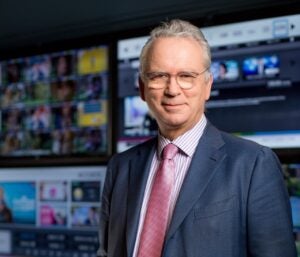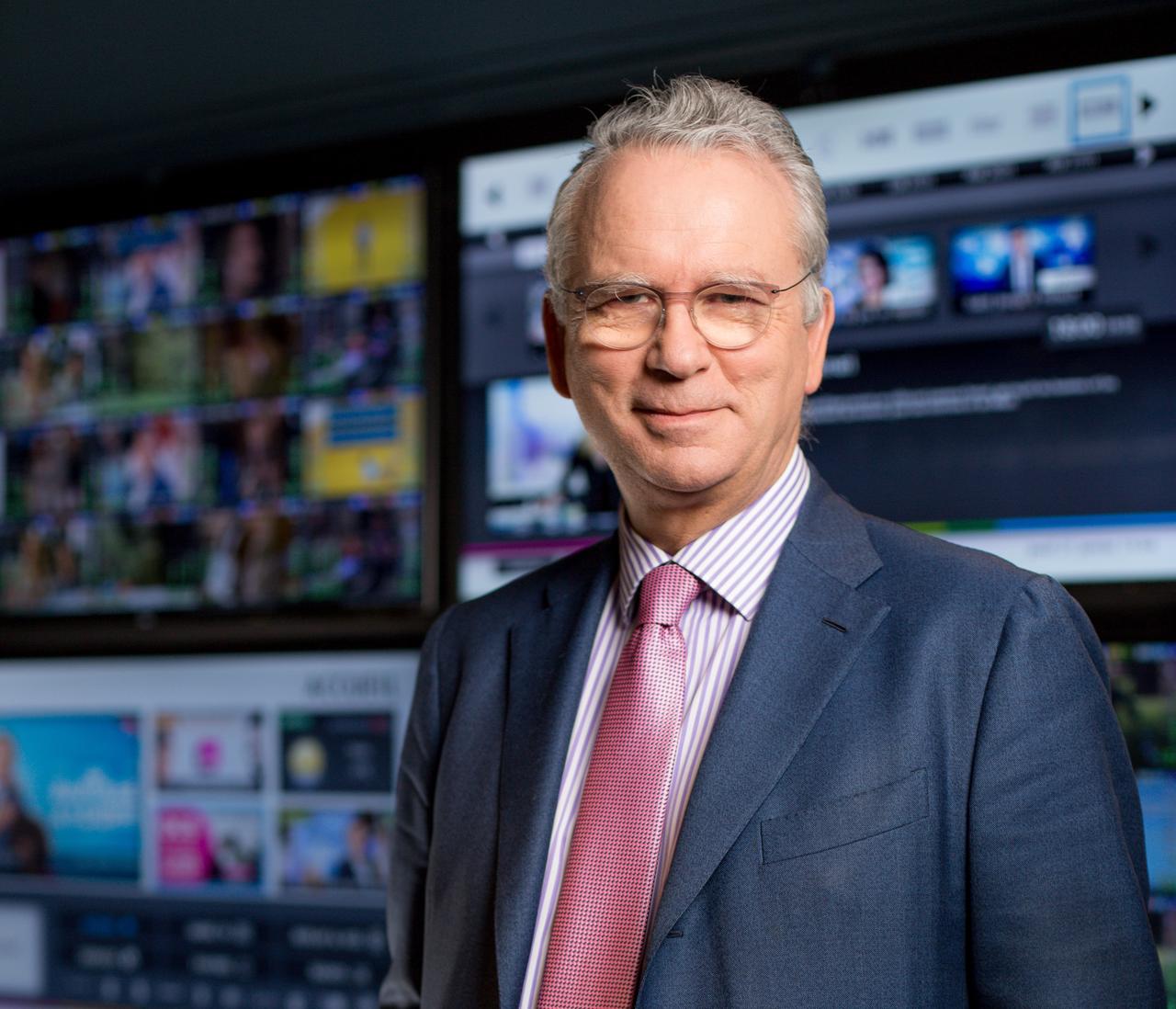
Michel de Rosen in his short time in the satellite industry has been a breath of fresh air. Whether stripping down to his black t-shirt to make a point at SATELLITE or providing amusing anecdotes and stories on various stages around the world, he has been one of the most popular speakers the satellite industry has had in recent years. But, behind the often moments of comic genius, there is a CEO that has quietly and effectively transformed Eutelsat into a global operator and also a technology innovator. Over the course of his six years at Eutelsat, de Rosen has built an impressive legacy for someone who was new to satellite industry back in 2009. Ironically, just as he accepts the most prestigious individual award in our industry, he will be leaving his position at Eutelsat as CEO as Rodolphe Belmer takes the reins ahead of SATELLITE 2016. Here, we catch up with de Rosen to talk about winning the award, highlights and lowlights during his time as CEO, and where he goes next.
He is delighted to accept the award saying his immediate reaction was surprise and “delight” and that he accepts this on behalf of his colleagues of the company who he says are the unsung heroes of a satellite operator. “Most of them are not known by the outside world, especially the members of the technical teams. So, I consider this a recognition of the work done over the years by all my Eutelsat colleagues. I am delighted for them,” he says.

Explore the March 2016 Issue
Check out more from this issue and find your next story to read.
“When I Wake Up”

“When I wake up in the morning, I think about Eutelsat. When I go to sleep, I think of Eutelsat. In my dreams, I think of Eutelsat. I have become Eutelsat.” It is one of many memorable de Rosen quotes as he gets ready to take his final curtain call as the CEO of Eutelsat. It has been a helter-skelter six years for de Rosen, a newcomer to the satellite industry when he joined. During his tenure as CEO, the company has made high profile acquisitions in Asia and Latin America, signed deals with the likes of Facebook, as well as been one of the industry’s most enigmatic spokespeople ahead of WRC-2015.
While he might not be “irreplaceable”, he certainly won’t be an easy act to follow. But, in an interesting moment of self-analysis, de Rosen admits he no longer has the energy he thinks the role deserves, and while his time had undoubtedly been successful, he does not want to wear out his welcome. “You don’t want people to come to you the way they came to Mrs Thatcher and said to her, ‘Prime Minister, it is time for you to go?’. You must anticipate this. You must do it before people think it is time for you to go. In February, I will be 65 years old. What I have observed is that my level of energy is not what it was when I joined the company six years ago or ten years ago. This company has become global,” he says. “This company deserves not just 100 percent of my energy, but 200 percent. We must not be behind the curve, we must be ahead of it. We must not only understand the trends of the world, we must invent it and share it.”
Despite his imminent stepping down as the CEO of Eutelsat, de Rosen will remain chairman of the Board, a role he is keen to continue to play. He admits he “hates the concept” of retirement, and that is keen to do other things. In terms of what they maybe, he says, “I have been approached by a number of Boards. I also want to do something meaningful in the Not for Profit world. I want to choose a course where I can make a difference. Right now, I am busy early morning to late nights with Eutelsat, and will continue that until February; my life will only change in March,” he says.
Asked whether this was a tough decision, de Rosen says it has been “difficult” but in the end a “normal” decision to take. He adds, “I played with this topic day and night. I thought maybe I could wait a year or two years. But, in 2015, I felt the time was right and am delighted to hand over the keys to Rodolphe Belmer who has the talent, energy, creativity, moral compass and ambition to take Eutelsat to the next level.”
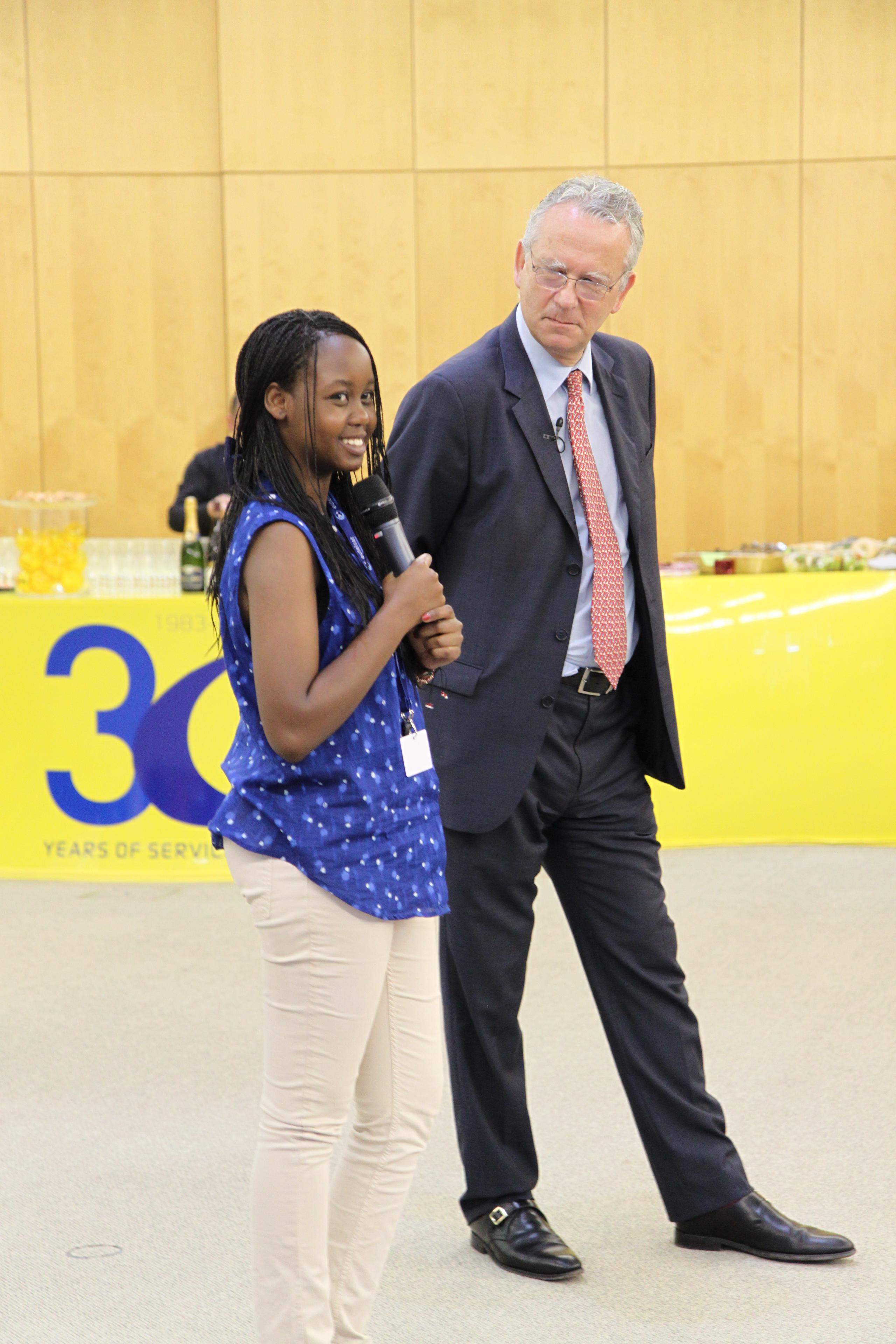
One of de Rosen’s key successes in 2015 reflects his ability to take an industry-wide view. The satellite industry approached WRC-2015 knowing it needed a strong result. De Rosen who had been the chairman of ESOA for two years in the run-up to WRC-2015 played a key role in making sure the satellite industry got the desired outcome this time around. He believes that key reasons for the achievements in Geneva were that the whole industry understood the stakes at WRC-2015 and the agenda of WRC-2019, and was motivated to marshal its energies in defence of spectrum. He says if the satellite industry had not fought, it would have been a poor reflection of its ability to collectively address a threat and defend the interests of its customers. He adds, “It was a conscious decision of the ESOA Board and me to not treat this as business as usual. We had to rise to the challenge. We had to do more than issue press releases and make statements. We had to go out and speak to many decision makers in all parts of the world. We needed to clarify messages that can often be too cryptic and difficult to understand. There was a lot of work done on quantifying and expressing clearly what was at stake, in a way that could be understood by non-industry members. We then had to disseminate those messages to all the people that mattered, and there were thousands of them. There was excellent teamwork at all levels.”
It was undoubtedly a highlight of 2015. “Many observers in the industry thought our chance of prevailing was low because of the appetite, power and wealth of the GSMA companies, The final result is very close to what we recommended because the decision makers of many countries around the world listened, and concluded what we were telling them made sense for them, in particularly what we said about defending C-band for critical satellite services in Africa, Latin America and Asia-Pacific. What was not well understood before ultimately became clear,” he says.

The Major Moves
Eutelsat has certainly not stood still in the last six years. De Rosen identified early in his tenure that the company had “two large holes” which it hoped to fill. The company needed a presence in Latin America and Asia, two high growth markets where Eutelsat was initially absent. Eutelsat was able to do two things in both regions, an organic move, and an inorganic move. In Latin America, its inorganic move was to buy Satmex when it became available, and the organic move was to buy some orbital rights and then to order the Eutelsat 65 West A satellite, which will launch in March of 2016. In Asia, Eutelsat acquired GE-23, which has now become Eutelsat 172A, and secondly it launched Eutelsat 70B. “There was an intent to expand into fast-growing markets and in doing so we achieved global coverage. But, I wanted to do this at a reasonable price that created value for our shareholders,” de Rosen says.
However, a CEO’s tenure is not just about the deals you do, but sometimes the deals you don’t do. “For instance, we decided it was not a priority for Eutelsat to acquire business in North America,” says de Rosen. “There was a time early on in my tenure where there was an opportunity, but we did some homework, and decided not to do this deal.”
Eutelsat also exited from S-band activity with the sale of Solaris together with SES. Secondly, it sold Kabelkiosk to a Dutch company, M7, because it felt that its focus as a service company to the cable industry was more and more dis-connected from Eutelsat’s key priorities. He says, “The perimeter of a company must live. It is never definitively fixed. You sometimes conclude that assets are better off under a different company’s management.”

Over the last few years, two of Eutelsat’s great rivals SES and Intelsat have decided to invest in new systems beyond geostationary. SES made a sizeable investment in O3b, and in 2015 Intelsat decided to take the plunge and invest in OneWeb, although on a much smaller scale, compared to SES. De Rosen says, “Our duty is to always be paranoid, and always look, listen, learn and see what are we missing and what else we can do. We are looking carefully at the LEO world and if we identify a good opportunity that creates value for our shareholders and customers, we will not hesitate to jump in. We were approached to become a shareholder of OneWeb and declined. We considered the level of risk was too high and that we would not be able to create shareholder value.”
De Rosen believes that the geostationary satellite world still brings for the future tonnes of opportunities. He calls geostationary satellites “fantastic” and hails the advances that have been made over the last five years, with a new high water mark in 2015 with the order of the Eutelsat Quantum software-driven satellite. He says with a significantly reduced cost per megabit, satellite operators are going to be able to reach many more users, both with consumer and enterprise profiles. “I think it would be a huge mistake to define “new space” as MEO and LEO, and paint GEO with an “old space” brush. New space IS GEO and LEO and MEO,” he insists.
Facebook and Broadband in Africa
In October 2015 Eutelsat signed one of the most talked about deals of the year, linking up with Facebook to help connect the ‘un-connected’ in Africa. Facebook spoke to many companies before deciding to partner with Eutelsat, de Rosen says, “We worked day and night to present to them a proposal that would be really convincing. We had a very good presence in Africa already, as well as a solid track record in broadband and High Throughput Satellites. When they saw us work day and night, they thought we were almost more Californian than French! Facebook’s decision to include geostationary satellites in their roadmap has given fantastic visibility and credibility to our industry. I hope we will be able to do more together.” He continues, “Who is not impressed by what Mark Zuckerberg has achieved and is doing to make the world more connected and more open? More than one billion people use Facebook every day! He is changing our civilization.

The African broadband market is high on Eutelsat’s list of priorities. De Rosen highlights that 600 million Africans will be connected by 2020. Given the fact, only 160 million people are connected in Africa today, there will be a huge upsurge over the next four years. While satellite can’t serve all of this growth, it will be able to gain significant market share. De Rosen expects broadband to see the fastest growth over the next ten years.
When looking at the demand of broadband more generally, de Rosen talks of demand creating more demand and quotes an example close to home with his 91 year old mother “She got connected three weeks ago, having initially said ‘It is not for me’. She told me the other day what she is discovering she can do with a tablet. She loves it. She is Russian. She is reading about Tolstoy, Chekhov, the Russian revolution, etc. I can tell you she was the most unlikely target person,” he says. “The point is, demand is large, but the potential demand is much larger. Growth in demand creates more growth in demand, as we all lived through with television.
Disappointments
While de Rosen’s time as CEO has seen Eutelsat transform from a semi-regional operator to a global one, there have been the inevitable disappointments along the way. He looks back at 2011 as being a real low point, and a time where he felt personally he could have done much better. “I would say that we collectively and I individually was not good enough at clearly identifying the slowdown in our industry that started in 2011. It did happen, and we saw it happening, but the duty of the CEO is to anticipate. I did not anticipate it well enough; because of that, we did not guide and express objectives that reflected a clear understanding of this slow down. That is a miss, my miss.”
His worst memory was the loss of the Eutelsat W3B satellite in 2010. “I remember how ecstatic we were when the launch went well. I was with two Ukrainian customers, and we had decided if the launch was a success, we would follow a long tradition in French Guiana and dive into the swimming pool. I was at the pool, when I got called by our director of operations who said ‘Are you aware we have a problem?’ I was young in the company and learnt the hard way what the stakes are with a satellite launch,” he says. “Some of our team had worked on it for three years. So, when we celebrate a launch, it is because we know from experience that success is not guaranteed. When it is a failure, it is a big loss for the company and for our users. As such it feels like a tragedy.”

Passing on Hellas-Sat, that was bought by Arabsat, is another example of where he felt he and the company came up short. “This was a goal we had given ourselves. Although it was a small acquisition we did not succeed,” he says.
Like many companies, Eutelsat has had to evolve and change. One of the great challenges when de Rosen joined the company was to engineer a more modern company structure. Here, he believes the company can learn a lot from ‘New Space’ companies in California. De Rosen says he does not believe a modern company in 2016 should be a pyramid, and that it should be more of a network. He adds, “If you look at the most effective companies in California, they don’t work like they have one brain, one guy who gives orders. You need everyone to feel that they are the company. They must feel they have the right and obligation to come up with ideas and participate in the definition of the goals of the company. I believe we have many, many engines of intelligence, creativity. It is much better than if we only had 1, 2 or 3 of these.”
In his six years at the company, de Rosen has seen a number of changes to the industry. He joined the industry in 2009, when every operator was doing well. Eutelsat had just reached a record fill rate. That was also the situation of a number of operators. However, the satellite world would soon change from this ‘Paradise Lost’ situation with a new world being ushered in with operators, including Eutelsat, having to fight harder than ever for customer contracts. “The major challenge for industry is to find a new relevance for satellite, and explain, and show in reality how satellites remain invaluable in 2016, 2020, 2025. So, we need to show why they are indispensable to mankind in the developed world, the emerging world, in broadcast, in broadband, for government services, for new applications like IoT or airline connectivity,” he says.
The satellite industry has a way of bringing people together and once people become a part of this community, it really gets into their souls. While de Rosen has had a varied career and been part of several industries, his appreciation for the people that work in the industry is both genuine and heartfelt. “What struck me when I joined the company, is that this is an extraordinary industry. I have a lot of respect for people who grow green beans or tomatoes, but what we do is elevating and of immense value. The French word, ‘Grandiose’ is what comes to my mind. We invite very important people to our launches and I have not seen one who hasn’t admired what we do. We come closer to God. If God exists, our satellites come closer. The smaller the world is, the more people look to space. It is the new frontier,” he says.

Back to the Future
Ironically, it appears that when de Rosen came into the industry it was the peak of a growth cycle and he leaves as that cycle is about to evolve into another. “A new cycle will see new segments grow faster like mobility, like broadband, like IoT, like broadcast in emerging markets. We must ride this new wave of opportunities and generate growth levels similar to what our industry enjoyed 5-8 years ago,” he says.
I was lucky enough to be the first to interview Michel de Rosen back in late 2009, when he just taken the reins of Eutelsat. I remember his enthusiasm even then to build Eutelsat. Ironically, there was one phrase he used in both interviews about only the paranoid surviving to be successful!! He said back then, “I also believe that only the paranoid survive. The best companies are successful ones that are not sucked into comfortable self-satisfaction but impose continuous improvement on themselves. Business journals are littered with stories of companies that, in the belief they were the greatest, were toppled off their perch by someone else trying harder. I don’t aspire to Eutelsat being the largest satellite operator in the world, but I do aspire to it being the most paranoid, the most driven, the most customer focussed, and thus the best satellite operator in the world.”
Mark Holmes is the editorial director of Via Satellite and Avionics magazines.