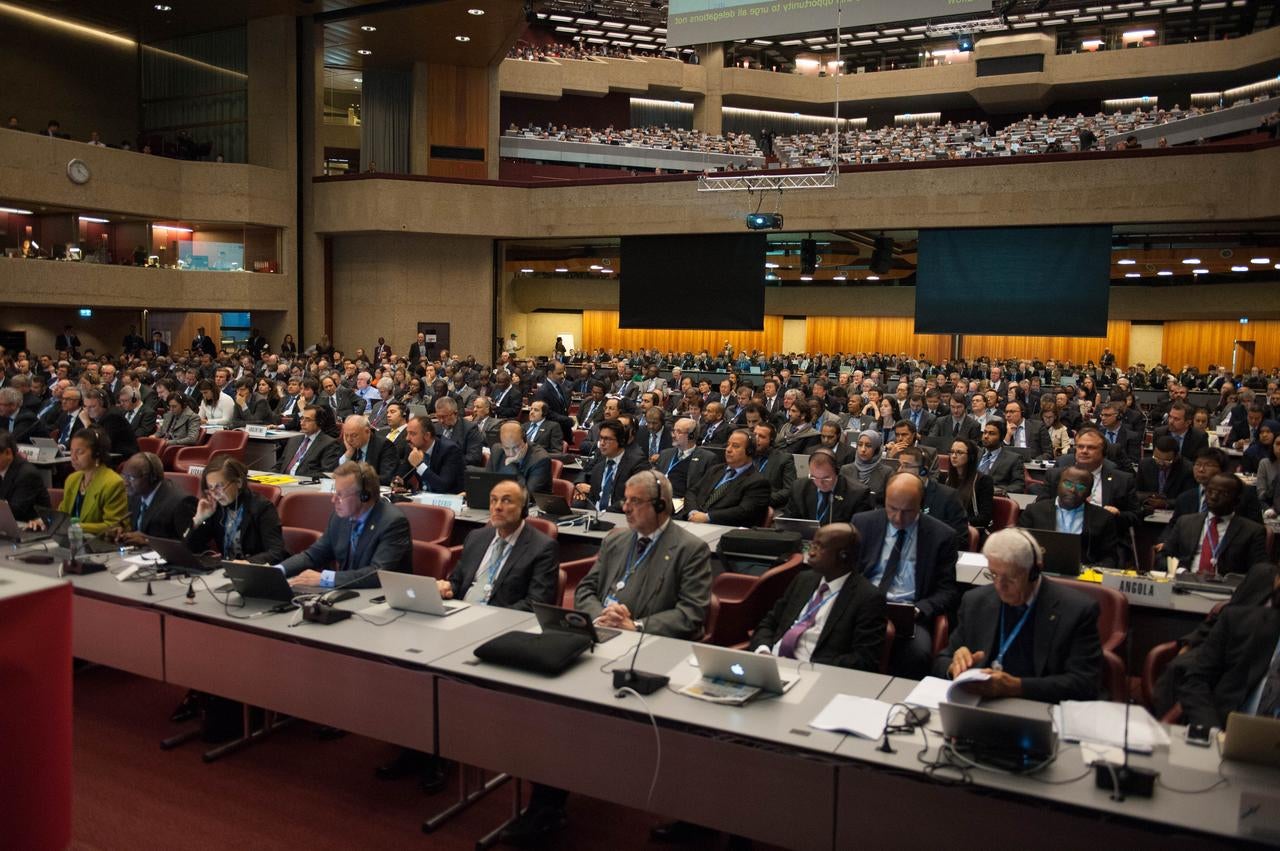

For four weeks, leaders from around the world assembled in Geneva, Switzerland to compile years of research and produce new regulations on how to best use the finite resource that modern telecommunications relies on: spectrum. WRC-15 produced several significant decisions impacting the satellite industry and the Information and Mobile Technology (IMT) industry. Both had different goals, with the crux of their agendas focusing largely on C-band downlink spectrum.
Making the Call
Of the 3.4 to 4.2 GHz of spectrum being considered, the IMT industry gained near-global access to 3.4 to 3.6 GHz, with a minority of countries including 3.6 to 3.7 GHz as well. This compromise, according to Francois Rancy, director of the ITU Radiocommunication Bureau, was one of many tough decisions that ultimately will prove to benefit both satellite and IMT.
Explore the February 2016 Issue
Check out more from this issue and find your next story to read.
“The results of this conference are very well balanced for all parties,” he says. “They offer significant additional spectrum for IMT in a globally harmonized way while maintaining certainty for the current satellite allocations. This protects current and future investments in satellite systems. Reciprocally, satellite services have received new allocations that provide significant growth potential for the future, while protecting the operation and development of terrestrial services.”

The IMT industry gained about 400 MHz of spectrum total, with roughly half coming from C-band. The decision built upon those from WRC-07, which Aarti Holla Maini, secretary general of the EMEA Satellite Operators Association (ESOA), says made the industry aware the band would likely see use by IMT. At WRC-07, there were country-specific footnotes for IMT access to 3.4 to 3.6 GHz. Holla Maini says the fact that IMT already initiated services in certain parts of the world would have been difficult to reverse.
“We are not happy about the loss of this portion of the C-band, which many satellite operators still do make good use of and, more importantly, users rely on, but in terms of a compromise this was as good as it was going to get,” she says.
Yet more of C-band was at stake. A critical data point — the number of unregistered C-band terminals actively in use in many parts of the world remained unknown, right up to and into the conference. Without this information, how reliant many were on C-band could not be conclusively measured. Rancy says WRC-15 essentially took on faith that large quantities of terminals were in use, opting to limit the amount of C-band reallocated so as not to render those terminals unusable.
“The main reason why the issue of C-band has been difficult is the earth stations deployed [are] for receive-only purposes and not registered. This means that many administrations in Asia, Africa and South America do not know where these stations are, and therefore applying the procedures to ensure they are protecting these stations is not going to produce anything because we do not know where they are. This is why people were very reluctant to go beyond 3.6 GHz, because that may have threatened a lot of receive-only stations,” Rancy explains, adding that government administrations need to do better at applying regulations to prevent this lapse of data.

Also influential was the desire to have greater harmonization. Rancy says the footnotes that saw extensive use at the last WRC conference were less favorable now because of the growing importance of ubiquitous access. Without global harmonization, he says the economies of scale needed to develop broadband mobile terminals at affordable prices become difficult. That desire, combined with IMT’s preexisting foothold made 3.4 to 3.6 GHz an extremely viable compromise.
“[3.4 to 36. GHz] had been allocated in 2007 in a rather large number of countries. Mechanically, the number of countries could be expected to increase and become overwhelming. I think it was quite smart to accept that global allocation, but insist that the rest of the band continue to be preserved. This is what happened,” he says.
Reactions and Responses
The GSM Association (GSMA) an organization representing mobile operators around the world, praised the results of WRC-15. Veena Rawat, senior spectrum advisor at GSMA, says the group focused on gains in four candidate bands for the mobile broadband agenda item: C-band, L-band, 700 MHz band, and sub-700MHz band. IMT gained three new globally harmonized spectrum bands at the conference: 200 MHz of the C-band, 1427 to 1518 MHz in L-band, and the expansion of the 700 MHz band from 694 to 790 MHz from a regionally harmonized band to a global one. In this regard, the IMT industry had many successes.
“We welcome the decision at WRC-15 to identify 3.4 to 3.6 GHz for mobile broadband in most of the world as this spectrum will help bring high-speed services to dense urban areas where demand is the greatest,” says Rawat. “Global harmonization will bring the benefits of economies of scale, including lowering cost and accelerating deployment, as countries start to assign the spectrum for mobile use. We were also pleased that some countries in Region 2 identified 3.6 to 3.7 GHz for IMT, which opens the doors for others to join when the time is right for them.”

Specifically, the compromise reached at WRC-15 identifies 3.4 to 3.6 GHz in ITU Region 1, which covers Europe, Africa, the Middle East and Russia; the same spectrum plus some country-specific footnotes for 3.6 to 3.7 GHz in the Americas, which make up Region 2; and 3.4 to 3.6 GHz in a select number of countries in Region 3 — the Asia Pacific. Rancy says there are a number of regulatory provisions to protect receive-only earth stations, such as countries wishing to implement IMT having discussions with adjacent states to prevent interference. He expects IMT use of C-band will grow regionally in areas where it is not used extensively for television, citing Europe and the Middle East as probably first movers.
“Mobile data demand is growing at an astounding pace. The allocation of critical new spectrum for mobile at WRC-15, when coupled with the opportunity to address the need for high-frequency bands for 5G mobile services at WRC-19, will help accommodate existing needs and plan for the long-term growth of the mobile industry and secure the future of the mobile Internet,” says Rawat.
Region 3 had a diverse mix of opinions on C-band. Rancy says Japan, for example, wanted to allocate all 3.4 to 4.2 GHz to IMT. Other nations with greater dependence on C-band for its resistance to attenuation by rain fade had different opinions. John Medeiros, chief policy officer at the Cable and Satellite Broadcasting Association of Asia (CASBAA), calls C-band satellite transmissions “the essential backbone of the Asian broadcasting industry,” adding that, with the ever increasing popularity of video, this will continue to stay true.
“I think the one thing we can foresee for sure is that Asian consumer demand for video content is going to continue to rise sharply. Cisco is projecting that, five years from now, video will make up fully 68 percent of Asian Internet consumption and 63 percent of mobile Internet use,” he says. “Mobile systems, even using IMT technologies, will not be able to provide acceptable viewing experiences for all this video.”

Collaborating for the Future
Between differing claims on actual needs and dueling studies that sometimes directly conflicted with one another, there was noticeable tension between satellite and IMT leading up to WRC-15. Yet industry advocates on both sides express willingness to work together better.
“With the most recent WRC decisions finalized, our industry has already begun reaching out to IMT interests to redouble our focus on the strong synergies that exist between wireless and satellite technologies,” says Dave Hartshorn, secretary general of the Global VSAT Forum (GVF) and chairman of the Satellite Spectrum Initiative (SSI). Satellite backhauling of GSM wireless traffic is a prime example of how those synergies continue to be successfully leveraged, and the development by both industries of new systems — from High Throughput Satellite (HTS) to LTE and small cells — holds tremendous potential for increased delivery of cost-effective services.”
Holla Maini agrees, but cites the need for a level playing field.
“The satellite sector has been accused many times of not being ready to compromise and work together, but when compromise means taking from one and giving to another without anything in return, then it is not really a compromise at all. The fact that so many administrations have now recognized the real use and reliance on C-band spectrum and have been outspoken in their willingness to stay away from studying key parts of Ka-band (the 28 to 29 GHz bands) for sharing for future IMT/5G spectrum should be a clear signal to the IMT community that different technologies have a role to play in the future digital ecosystem,” she says.
Rawat also echoed the need for more communication between industries, saying that the IMT industry was not trying to make the satellite industry keel over in its quest for more spectrum.

“This is not a zero sum game and we were never advocating for satellites to be decommissioned. WRC-15 was about building flexibility into the way spectrum is allocated in the future at a national level. We would welcome closer collaboration between the two industries, recognizing that both fixed and satellite services are an important part of providing backhaul for mobile traffic. Continued communication between the industries will support this process,” she says. “At the national level, there is also an opportunity for governments and regulators to encourage positive dialogue among the industry players within their national preparatory committees.”
All parties are now planning for the next WRC conference four years from now. The satellite industry avoided chagrin at WRC-15, and made many gains, including new spectrum in Ku-band and studies on the use of higher frequency bands. With technology constantly evolving, it will be well before 2019 that these collaborative feelings are put to the test.
The Most Important Outcomes of WRC-15
Veena Rawat, senior spectrum advisor at GSMA
“For the mobile industry, the main objective was to allocate sufficient spectrum in various bands, as well as secure the new agenda item to address high-frequency bands for 5G mobile services at WRC-19, in order to create the flexibility to improve widespread mobile broadband access across the world. WRC-15 was a unique opportunity to secure the future of mobile broadband, and one that wouldn’t have been repeated at WRC-19 or WRC-23.”
David Hartshorn, secretary general at GVF and chairman at the Satellite Spectrum Initiative (SSI)
“In my opinion, and I speak from a satellite communications perspective, the most important outcome was a greater assurance of continued access to the spectrum necessary to deliver ubiquitous and highly reliable satellite connectivity to billions of end users. Likewise, national administrations will be able to more effectively leverage our industry’s offerings to achieve key public-policy objectives, such as improved standards of health, education, public security, disaster preparedness, bridging the ‘Digital Divide,’ and much more.”
Aarti Holla Maini, secretary general at ESOA (speaking specifically about the Europe, Middle East and Africa Region)
“While C-band is extensively used and irreplaceable, it is also saturated. Many satellite operators are now making significant investments into Ka-band and this is clearly a major growth band for the sector — geostationary, non-geostationary, government and military alike. Together, their existing and planned investments amount to over $100 billion. To expose these real-world investments would have caused great uncertainty to an industry which is both innovating and seeing increasing relevance in today’s world.” VS
Caleb Henry is the assistant editor for Via Satellite magazine.