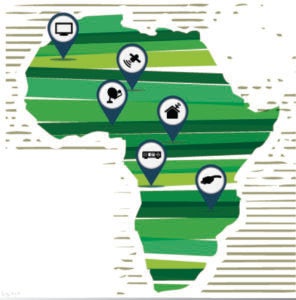

One of the interesting dynamics of the African market is that many players, both regional and global, have looked to grow a presence in the market over the last few years. While there is a danger that an oversupply of capacity situation could develop, operators see the glass as half full rather than half empty.
David Murphy, CCO of Yahsat, says that, with prolific growth of affordable smart devices within the African continent, the demand for data is “unprecedented” and that most operators (GSM/SAT/FTTH) see the African continent as a new frontier for growth. “The advent of Ka satellite services in Africa since 2012/13 has stimulated the VSAT industry across the continent; with Ka band recording double digit growth year on year. This growth is expected to continue for the foreseeable future.”

Explore the Middle East & Africa 2015 Issue
Check out more from this issue and find your next story to read.
He doesn’t believe an oversupply situation will develop in the region. He says the danger of oversupply is a long way off in the real developing countries. He believes the price point will be the key to overall growth and having a sustainable business model. “It is unlikely the African market will reach saturation in the near future given the vast expanse of the continent. There will always be a requirement for new VSAT technologies given the cost of rolling out terrestrial and wireless technologies being prohibitive in areas outside of dense urban areas,” he adds.
Others are optimistic for the future in Africa. Singtel is another operator looking to grow its presence in the region. Lim Kian Soon, CEO of SingTel Satellite, believes the demand for capacity in Africa will continue to grow, especially in regions such as the Democratic Republic of Congo, Kenya, Tanzania and in industries such as banking and oil and gas. However, while he believes communications needs will boost demand for bandwidth as the regions continue to develop, the regulatory situation will need to improve for the region to realize its potential. Better transparency or sound governance practices and bureaucratic processes will improve investors’ appetite and risk tolerance. This effectively affects the development of infrastructure, which in turn affects how communications network can be established, be it terrestrial or satellite. Comparing Africa to other regions, such as Asia, we see stable demand of satellite capacity similar to new markets like Cambodia and established markets like Indonesia and Malaysia,” he says.
Andrey Kirillovich, director of integration and projects at Russian Satellite Communications Company (RSCC), adds that, despite the fact more and more terrestrial networks are being built on the continent, there are still many places outside big cities where terrestrial connection is either impossible or does not provide acceptable quality.
“Even submarine fiber requires back-up due to frequent cuts and maintenance issues. Satellite remains an integral part of African telecom and broadcasting infrastructure because of the size of the continent and huge number of rural communities. The Ka-band rush is slowing down. So traditional C and Ku remain in demand, but with more regional focus. We see increasing demand for good regional coverage, rather than for entire continent, which still have a niche,” Kirillovich adds.
LEO Threat
What has changed in the satellite industry over the years is that other satellite players are trying to get a slice of the pie. While O3b has a long stated aim of serving the African market, the impact of future LEO players on GEO operators is less clear. In terms of the potential threat, Murphy says Africa is still very much a GEO market for two primary reasons. He says that LEO CPEs require tracking capability and regular maintenance whereas GEO CPEs is a fraction of the price and requires little ongoing maintenance. Secondly, Murphy points out that there are not many LEO satellites commercially available over Africa.
Kirillovich believes the advantage of GEO satellites is in the mass production of antennas with no moving parts ensuring low costs. “There is a very recent example in the industry when a new satellite operator had to change its target market from consumers to telco-grade customers. So the issue here is not only in the flat panel antenna as a product itself, but in reaching the pricing level of conventional GEO antennas. Based on the life cycle of any product some time will pass until it becomes a mass product. Moreover, current service providers have already made investments in GEO based equipment. So, in general, I assume these LEO systems may occupy a market niche, after solving all technical, regulatory and business issues, but they will do this by means of obtaining new customers, which in no event could be customers of GEO systems.”
Kian Soon adds, “While O3b’s MEO system has shown limited success, it is a simpler system with much lesser number of satellites as compared to the new LEO systems. Until now, the verdict is still not out on the viability of these new LEO systems considering the complexity of the satellite constellation and ground systems. If they are successful, it will likely have an impact on enterprise network, consumer broadband and mobility.”

Country Markets
There are many hot country markets for operators to try and exploit in the region. Kirillovich highlights a few that RSCC are targeting. “There is the largest economy on the continent – Nigeria with a population of 175 million people. In East Africa (predominantly Kenya and Tanzania), these two countries are becoming leaders in the number of ongoing infrastructure development projects. You have the DRC with its large requirements for cellular backhaul. Angola and Mozambique are rich in oil and gas. Even in the developed markets like South Africa there are certain opportunities for growth,” he says.
Murphy says that the developing countries across the region have potential for growth – but believes this is dependent on the appetite of operators to invest and have a sustainable business model. “With regards to the DTH operators, this boils down to their offering on content and affordability. Operators that lack content — spots, etc. — will always be under pressure to gain market share. They are also facing DTT operators that now have to comply with the digital migration across the regions,” he adds.
Diverse Markets
The cellular backhaul opportunity could certainly be one to watch in the region. Kirillovich is excited about the potential. “It is a well-known fact that many people in Africa may have no bank account but have a mobile phone, which they use for payment and money transferring. And the amount of money sent to sub-Saharan Africa via mobile services is expected to hit $33 billion this year. With population of more than 1 billion people, which will grow further, Frost and Sullivan forecasts 80 percent mobile penetration in Africa by 2020. This means around 800 million people will have mobile devices, most of which will be bandwidth-hungry smartphones,” he says.
Kian Soon agrees saying that mobile operators in the region are looking at satellite as a backup capacity for certain critical segments such as banking, government agencies, NGOs, etc. He also says that government-funded Universal Service Obligation (USO) projects in the deployment of communications services in rural areas will likely come to fruition. He also points out that there is still a significant DTH opportunity for satellite operators.
Globalstar is also hoping to grow its presence in the region, and see some unique opportunities for its technology. Charlie Murray, director of Africa sales at Globalstar, highlights some interesting projects that the operator is getting involved in. “Satellite systems are well suited to marine applications. There are several projects in Africa where small vessel fishing fleets are being monitored by GSM-based systems, but GSM is simply not doing the job well. These systems are being replaced with Globalstar satellite-based systems and we are busy with that at the moment. Then there are other important projects where our solutions are playing a key role. For example, rhino hunting is a real problem in many areas. We are losing a rhino every single day to illegal hunting. Currently, we are working with a company to put satellite-enabled trackers onto rhinos. Some are even being implanted into rhino horns themselves so that conservation groups can monitor those animals over time.”

Case Study: VMD Solutions
One company on the ground in Africa is VMD Solutions, a Tunisia-based services and solutions provider. The company works with Globalstar to provide satellite-enabled solutions to local enterprises. Engineer Jamel Hajji, Sales and Marketing Manager at VMD Solutions, highlights some interesting trends from an end user perspective. He says in Africa, there is growing uptake of smartphones, and usage of applications on those smartphones, with many satellite operators expecting a growing market for satellite phones.
“There is a need to use Internet over satellite. There is a big need in African telecoms markets to use high-speed Internet, particularly in remote areas where mining companies and oil and gas companies are present. There is also a need to have permanent remote monitoring and management of oil and gas tanks, water reservoirs and other dispersed assets. M2M over satellite is required in order to maintain permanent measurement capability, and to reliably transmit the key management data back to head office,” he says.
VMD Solutions is seeing the strongest demand for services where there is unique and challenging geography such as in deserts and forests. Hajji highlights in particular those countries with vast areas of desert such as Kenya, Algeria or Tunisia, as providing significant opportunities for satellite services. “In Chad, Sudan and Egypt, as well as in numerous other territories, there are strong opportunities basically because of a lack of terrestrial communications and inadequate GSM networks,” he adds.
Hajji believes the main commercial prospects for his company over the next few months will be in oil and gas and this sector’s related transportation services. In addition to these players, he reports that African governments need solutions for security, and they are increasingly relying on satellite solutions. “You also have governments investing in projects to protect fishing fleets and monitor for over-extraction of fish, for example. Many countries are investing in geolocation of fishing boats. These are some of the main customer opportunities we see developing in the next few months,” he says.