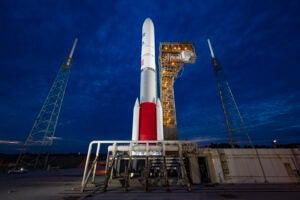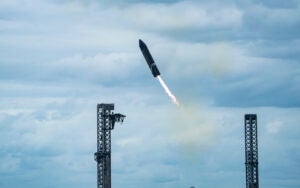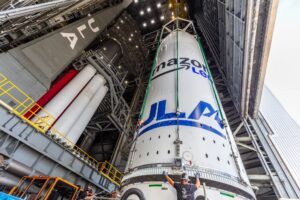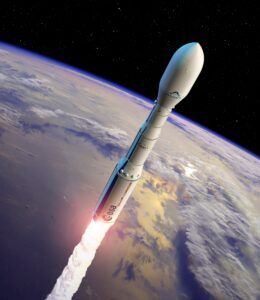

IZMIR, Turkey — Access to space is one of the biggest issues right now in the industry, and the issue is a critical priority for NATO as threats from Russia are on the rise.
At the NATO Edge defense tech event this past week, NATO announced Starlift, a new multinational space initiative to help secure launch of satellites for military purposes. Ten NATO allies, Belgium, Canada, Finland, Germany, Italy, the Netherlands, Norway, Sweden, Turkey, the United Kingdom, along with and the Republic of Korea, committed to financing the initiative, through the NATO Support and Procurement Agency (NSPA).
Daniel Hilgert, head of section for Space Defence Industry in NATO’s Innovation and Armaments division, told Via Satellite that access to launch is a genuine constraint – for both defense users and industry, with more companies seeking greater control over launch within their own supply chains.
“This can improve certainty, but it is not a solution for all companies. We need more launch capacity and reliable access for companies of all sizes across the alliance. This is key for sustaining a diverse and resilient transatlantic space industrial base,” Hilgert said. “Starlift aims to help by bringing military demand together and improving access to commercial launch services. It cannot create additional rockets overnight, but it can help organize demand and give launch providers a clearer basis for investment.”
The NATO official said the goal is to create tangible progress towards a functioning launch brokerage, with coordinated military requirements and tested arrangements for more responsive space operations. Nations will determine the exact timeline for initial operating capability.
“The measure of success for Starlift will be if participating countries can arrange suitable launches more effectively, and if they have more reliable options when circumstances change. That is the outcome Starlift is intended to deliver,” Hilgert said.
Spaceport and Rideshare Options
With NATO looking to take a more proactive approach towards access to space, it opens up a myriad of possibilities for the organization. With Europe looking to develop spaceports, could NATO look to invest in spaceports as part of its strategy in Europe?
Hilgert highlighted the fact that the European Union has an important role in providing finance and supporting investment in Europe’s space industrial base, including its spaceports, and also that NATO could potentially contribute funding in the future through the NATO Security Investment Programme (NSIP).
“[NATO] has historically supported infrastructure and facilities, such as military airfields, fuel pipelines and communications facilities. A similar approach could make sense for spaceports if allies collectively agree that investment is needed to meet NATO military requirements. Starlift brings this topic into the spotlight,” Hilgert said. “It will help build a clearer picture of national military requirements and, working with industry, identify the infrastructure needed to meet them. Any investment would remain subject to the program’s eligibility criteria and allied approval.”
Starlift could potentially encompass rideshare operations as well. “Starlift’s brokerage is the mechanism for aggregating military requirements and connecting them with commercial launch services. Rideshare is one possible option within that approach. It can be cost-effective for planned deployments, while more time-sensitive missions may need different arrangements,” Hilgert said.
A Distributed Launch Network
Starlift will not be limited to European launch options. The initiative aims to develop a wider network, drawing on capabilities in Europe, Canada and partner countries such as the Republic of Korea. Geographical diversity is seen as critical for responsive space operations. A distributed launch network aims to give participating nations more options.
“Resilience means having more than one route to orbit, in particular in a crisis or conflict,” Hilgert said. “But having alternatives is only one part of resilience. Launch sites also need protection and the ability to continue operating through disruption. Their security and availability deserve the same strategic attention we give to military airbases.”
Starlift is a significant move for NATO. At its recent summit in Ankara, Turkey, it launched a “front door” for industry. This approach grew out of NATO’s work with the space industry, including its space industry group Spacenet, and drew on U.S. Space Force models for industry engagement, and has now been broadened to support companies across sectors. It now aims to provide a single-entry point for companies to find opportunities and engage with NATO.
“Defense investments for satellite capabilities have become a key driver for industrial development in this domain. As allies continue to invest in satellite capabilities, access to launch needs to keep pace. Through Starlift, coordinated demand can give launch and spaceport operators a clearer basis for planning and investment. Participating countries will also work with industry to explore establishing standards, where helpful and where it can support fostering a more diverse industrial ecosystem,” Hilgert said.