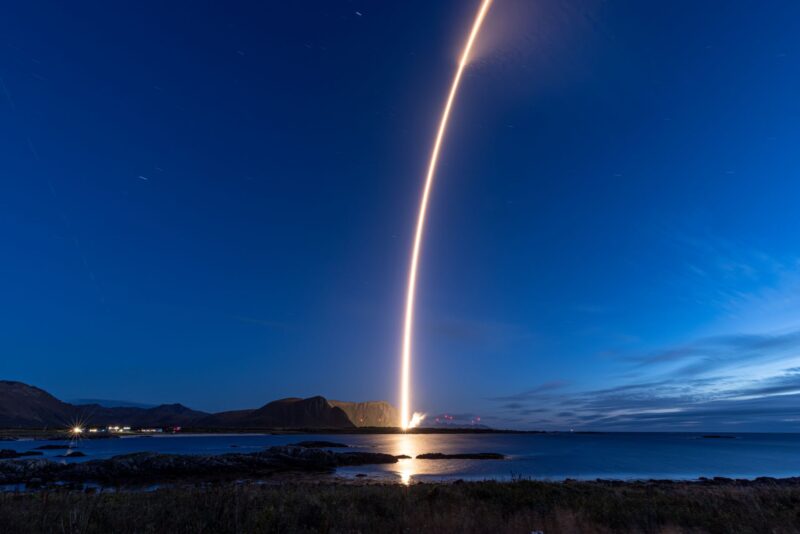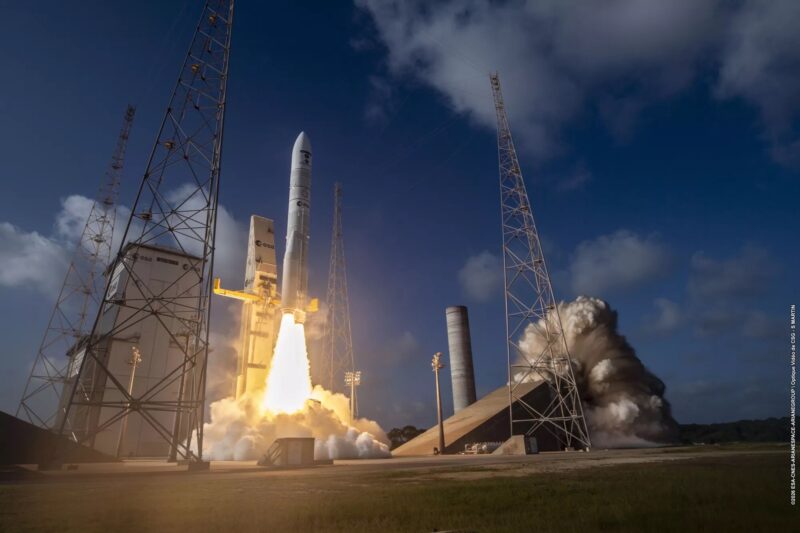
NASA’s Nancy Grace Roman Telescope lifted off on Sunday morning on a SpaceX Falcon Heavy mission. The telescope, named after NASA’s first chief of astronomy, will orbit 1 million miles away at the second Sun-Earth Lagrange point (L2) and provide observations of dark matter, dark energy, exoplanets, and more.
The Roman telescope has been in development since 2016 and the total program to develop, launch, and operate the telescope is approximately $4.3 billion.
The mission launched from Launch Complex 39A at NASA’s Kennedy Space Center in Florida at 7:26 a.m. ET. The Roman telescope, which weighs 18,000 pounds, (8,000 kilograms) deployed about 31 minutes into the mission.
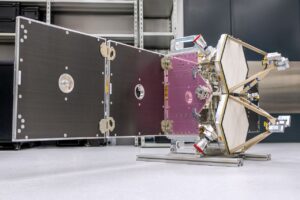
When all components are deployed, the telescope is over 42 feet long and over 14 feet wide.
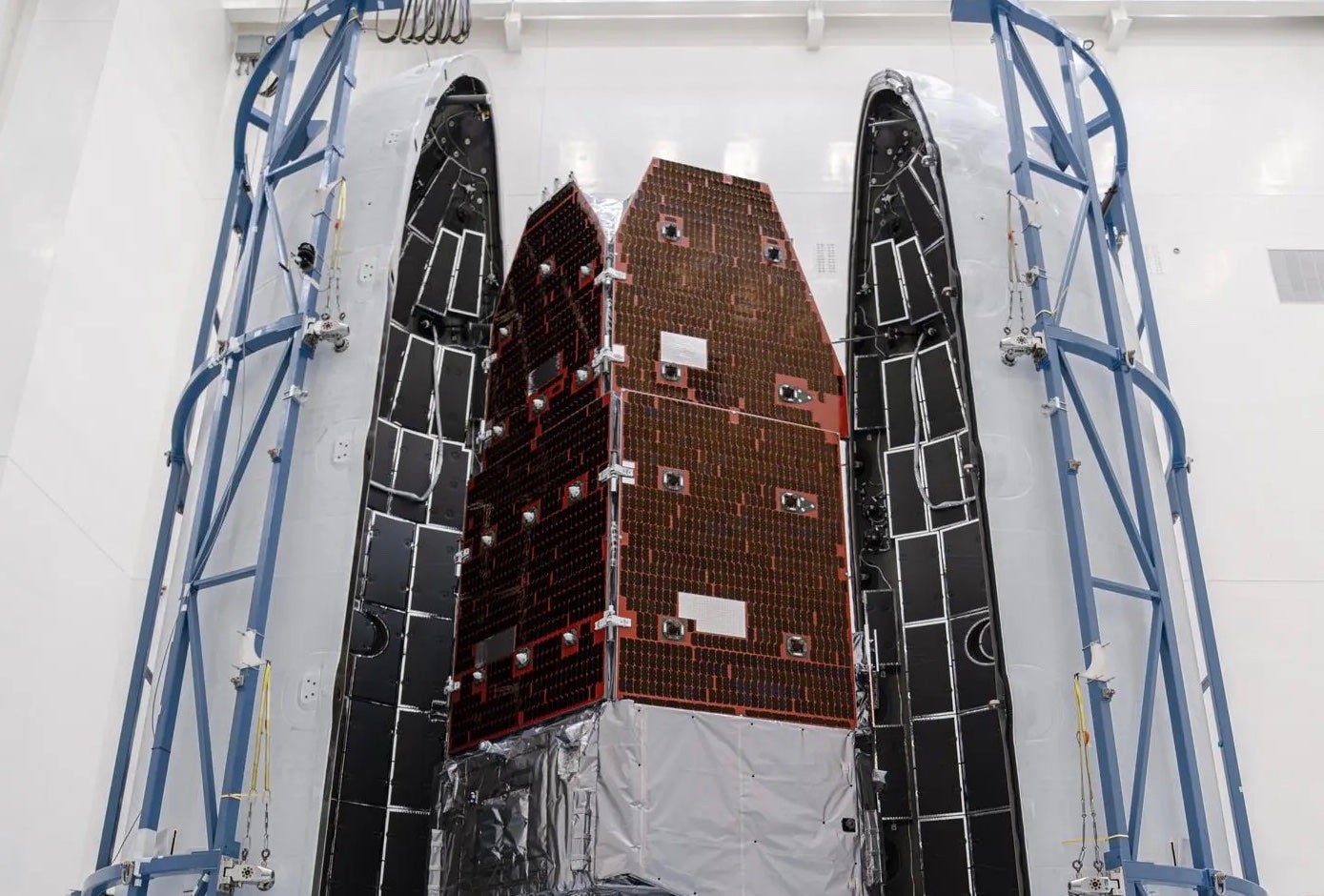
After launch, NASA’s Roman team confirmed successful deployment of the observatory’s solar panels and lower instrument sun shade 1 hour and 23 minutes after launch. The satellite’s antenna and deployable aperture cover will deploy over the following days. NASA expects to release images from the telescope by early 2027.
“We’ve never been able to view the universe with eyes like Roman’s before,” Julie McEnery, Roman’s senior project scientist at NASA Goddard said in a release. “There’s no telling what more we’ll know and have seen by this time next year.”
The telescope will orbit at the same point as the James Webb Space Telescope. However, Roman has a wider view than Webb and will capture a broad view of cosmic ecosystems and pinpoint rare objects. Its Wide Field Instrument infrared camera will have a field of view 100 times larger than the Hubble telescope.
NASA said that with such a large field of view, the mission will “offer practically limitless opportunities for astronomers to conduct a broad range of additional science” like the outer solar system, exploding stars, growing black holes, and billions of galaxies.
Its second sensor, Coronagraph, is a system of optics, masks, self-flexing mirrors, and sensors. NASA said it will demonstrate the most advanced technologies ever flown in space for directly imaging planets around other stars.
Roman is expected to operate for a primary mission lifetime of five years, and can support an additional five-year extended mission.
BAE Systems designed and developed the Wide Field Instrument (WFI) Opto-Mechanical Assembly for the mission.
L3Harris refinished the primary mirror, which was initially constructed for another mission. L3Harris also built hardware to accommodate the WFI instrument and Coronagraph instrument.
Teledyne Scientific & Imaging supplied 18 infrared sensor chip assemblies, to form the largest infrared focal plane ever built for space or ground-based astronomy.
This story was first published on Aug. 28 and updated on Aug. 30 after the launch