Latest News
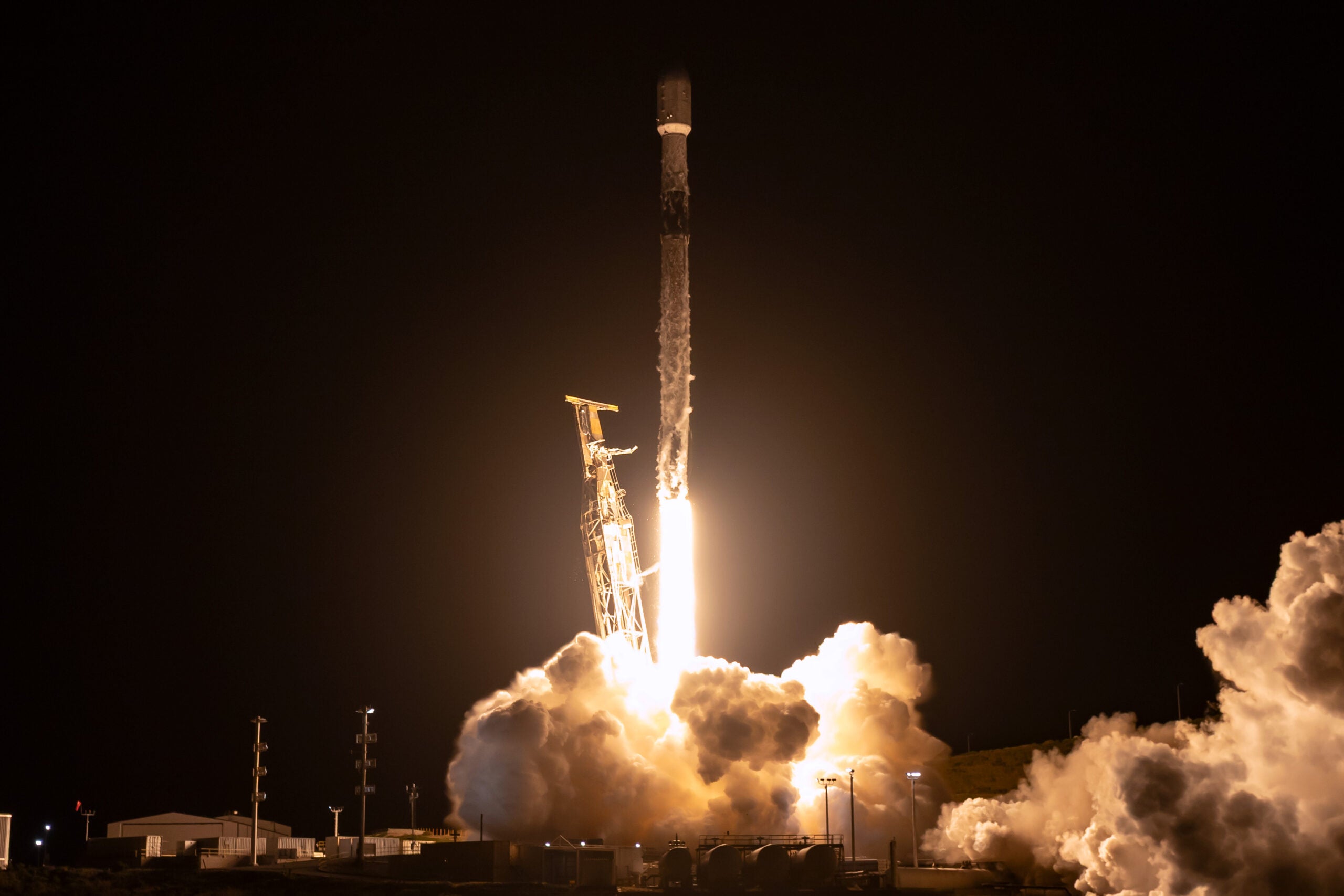
Photo: SpaceX
SpaceX launched 119 payloads into Low-Earth Orbit (LEO) at 4:02 a.m. PT on Transporter-16, a dedicated smallsat rideshare mission, from Vandenberg Space Force Base in California on Monday morning.
The mission was the first stage booster’s 12th flight. It landed vertically on a droneship in the Pacific Ocean after releasing its payloads.
With this mission, SpaceX has orbited over 1,600 payloads in its rideshare program.
A Bumper Crop for Exolaunch
German launch integrator Exolaunch carried 26 microsatellites and 31 cubesats from over 25 clients on the mission, it said in a Monday statement. It used a variety of deployment systems, including CarboNIX microsatellite separation rings for satellites up to 1,000 kg and EXOpod Nova deployers for standard and larger cubesats.
Its list of spacecraft on the mission included:
AAC Clyde Space launched the first two satellites in its VIREON Earth Observation constellation. The company said in a statement that it will test and calibrate their onboard systems before bringing them to operational status in the coming weeks or months.
Three satellites, ERMIS-1, ERMIS-2, and ERMIS-3, were launched in the ERMIS cubesat constellation developed in Greece. OQ Technology subsidiary OQ Technology Hellas built two of the satellites, which will be used in conjunction with the OQ Technology fleet to provide 5G non-terrestrial network (NTN) IoT service and direct-to-device (D2D) emergency broadcast messaging directly to smartphones. The ERMIS constellation is the first phase of the Greek National Small Satellite Programme.
DISCO-2, a climate satellite built by Danish university students in collaboration with Space Inventor to monitor glacier activity and sea temperature change near Greenland, was also aboard the mission. Space Inventor also launched a second satellite for a confidential defense mission, it said in a statement on Friday.
Exolaunch’s statement said it manifested six satellites for Iceye. The General Staff of the Polish Armed Forces said in an X post that Transporter-16 included two ICEYE radar satellites for the Polish military. The satellites will be part of POLSARIS, a sovereign Polish Earth Observation constellation.
Other Exolaunch customers included two Flylab satellites for French research lab ONERA; three satellites for HawkEye 360, three Vindlér radio frequency monitoring satellites for Sierra Nevada Corporation built by Muon Space; and 10 satellites for Spire.
Customers with a single satellite include Aethero Space, Greece’s Aristotle University of Thessaloniki, Indian startup Bellatrix Aerospace, Cosmoworks in South Korea, Endurosat working with the Arquimea Research Center SLU, Satlantis and OHB Sweden, ArkEdge Space, TurkSat, and France’s Unseenlabs.
Exolaunch manifested a number of satellites from customers in Taiwan including TORO3 for Pyras, 8U RIoT-2 for Rapidtek, and T.MicroSat-2 for Tron Future Tech and Taiwan Space Agency.
Exolaunch said it also provided deployment and integration services for: Fergani’s FGN-100-d3 satellite; Muon Space’s PropSat; OHB Sweden’s ADIS satellite; two NewSat satellites for Satellogic, and eight satellites in OHB Italia‘s IRIDE constellation.
Other Customers
Texas-based launch integrator SEOPS prepared 19 customer spacecraft from 13 countries on the mission, including five PocketQubes from Alba Orbital and 14 cubesats of varying sizes. FOSSA Systems, ISISPACE, NearSpace Launch, RIDE!, and Sandia National Laboratories also manifested spacecraft with SEOPS.
D-Orbit supported four payloads for LusoSpace, the QubitCore quantum key distribution (QKD) payload for Qubitrium, and the Camera SpaceMast payload for Germany’s DLR.
SatVu manifested HotSat-2, the second satellite in a constellation for thermal imaging. The constellation uses mid-wave infrared sensing for defense, economic, and climate applications.
K2 Space launched Gravitas, a two-ton satellite capable of generating a remarkable 20 kW of electricity. K2 Space CEO Karan Kunjur told TechCrunch this month that the Gravitas mission will include 12 undisclosed modules from several customers, including the Department of Defense. One of those customers is SES, which confirmed to Via Satellite it has multiple payloads on the mission.
Momentus launched its Vigoride 7 orbital service vehicle to test and demonstrate a series of next-generation capabilities, it said in a Monday press release. It plans to host and operate 10 government and commercial payloads for demonstrations of autonomous rendezvous and proximity operations (RPO), in‑space assembly technologies, communications systems, and onboard computing.
Varda launched samples of thermal protection materials and an autonomous navigation system inside of its W-6 vehicle, as well as thermal and performance sensors for NASA data collection, it said in a Monday statement.
Stay connected and get ahead with the leading source of industry intel!
Subscribe Now