Latest News
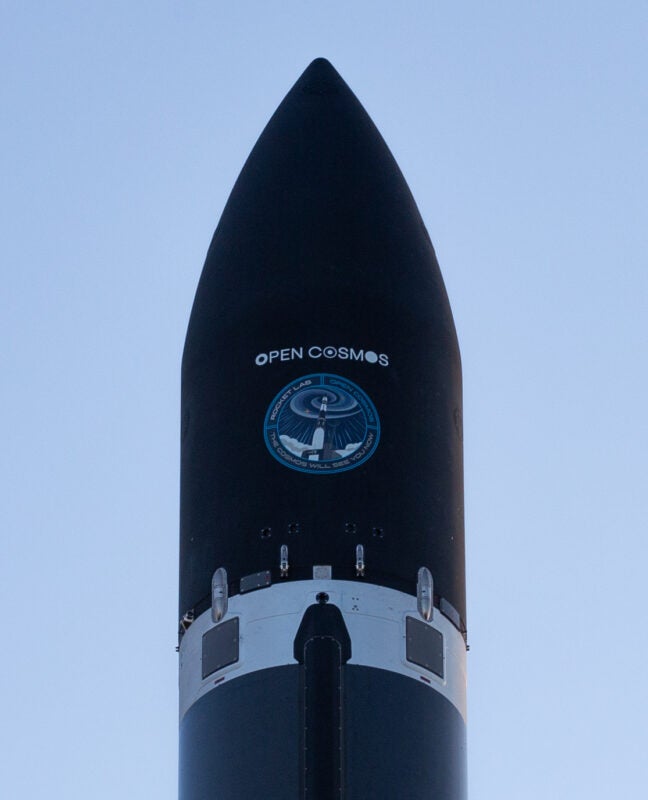
The Electron rocket fairing ahead of the Open Cosmos mission. Photo: Rocket Lab
The first two satellites in Open Cosmos‘ Ka-band satellite constellation have launched, just one week after the company announced it secured Liechtenstein’s high-priority Ka-band spectrum. This represents the first activation phase of Open Cosmos’ satellite network, which is designed to deliver scalable, resilient and coordinated space-based services for Europe and the world.
Rocket Lab launched the satellites from New Zealand on an Electron mission on Jan. 22 at 11:52 p.m. local time. The mission was aptly named ‘The Cosmos Will See You Now.’
The first two satellites are the result of a pan-European effort, with teams across the U.K., Spain, Portugal and Greece contributing to the program. The satellites will operate under Spain’s regulatory framework for satellite registration and operational licensing.
It has been a whirlwind start to the year for Open Cosmos. Last week, the satellite manufacturer announced the government Liechtenstein awarded its high priority Ka-band radio spectrum filings to Open Cosmos, enabling it to build and operate a new sovereign Low-Earth Orbit (LEO) broadband satellite constellation. The spectrum rights, previously held by Rivada Space Networks, are an important geopolitical asset for Europe.
“This launch is a major milestone for Open Cosmos and a critical step in our mission to provide secure, sovereign connectivity for Europe and the world. Moving from spectrum to satellites in-orbit demonstrates not only the maturity of our system, but our ability to turn strategic ambition into operational capability extremely fast. These first satellites lay the groundwork for a resilient network designed to support governments, institutions and commercial partners with dependable space infrastructure when it matters most,” Rafel Jordà Siquier, founder and CEO of Open Cosmos, said in a statement.
Siquier spoke in-depth with Via Satellite about the constellation last week about the importance of the spectrum and future constellation for European sovereignty. “It’s no secret that Europe is strengthening its sovereign capabilities. Being able to communicate securely — not only across the continent, but anywhere in the world — it’s essential,” he said.
Stay connected and get ahead with the leading source of industry intel!
Subscribe Now