Latest News
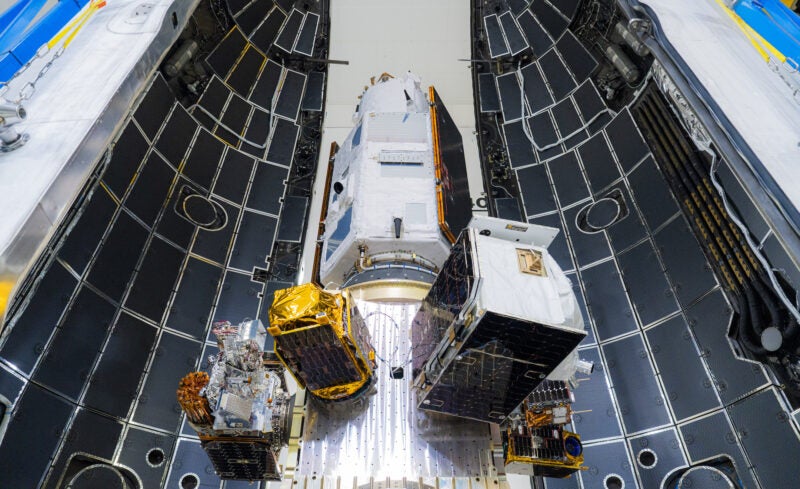
Rideshare customers integrated for the NAOS Falcon 9 mission. Photo: SpaceX
SpaceX launched the NAOS Earth Observation (EO) satellite for Luxembourg on Tuesday, along with satellites for rideshare customers Dhruva Space, Planet, Capella Space, and Pixxel.
SpaceX launched the mission on a Falcon 9 rocket from Vandenberg Space Force Base in California at 11:55 a.m. Pacific Time. The mission lasted around 1 hour and 9 minutes and SpaceX confirmed all payloads were successfully deployed.
Luxembourg’s NAOS, National Advanced Optical System, observation satellite was built by prime contractor OHB Italia. It is equipped with a very high-resolution camera and will operate in Polar Orbit around 450 km to support applications including military operations, security, monitoring disarmament treaties, observing troops in conflict zones, disaster management, and climate change.
Also on the mission were Pelican-3 and Pelican-4, two Planet Planet satellites, part of its next-generation multispectral fleet.
Dhruva Space, based in India, launched its first commercial mission, LEAP-1, with hosted payloads for Australian startup Akula Tech. The Dhruva Space P-30 satellite platform is flying two missions: the Nexus-01 AI module, and a hyperspectral imagery developed by Esper Satellites.
Rideshare integrator Exolaunch manifested four payloads: the Acadia-6 satellite for Capella Space, and three hyperspectral satellites for Pixxel. Acadia is Capella’s class of third generation synthetic aperture radar (SAR) satellites.
With the launch of three new Firefly satellites, Pixxel’s commercial constellation now stands at six operational satellites.
Stay connected and get ahead with the leading source of industry intel!
Subscribe Now