Latest News
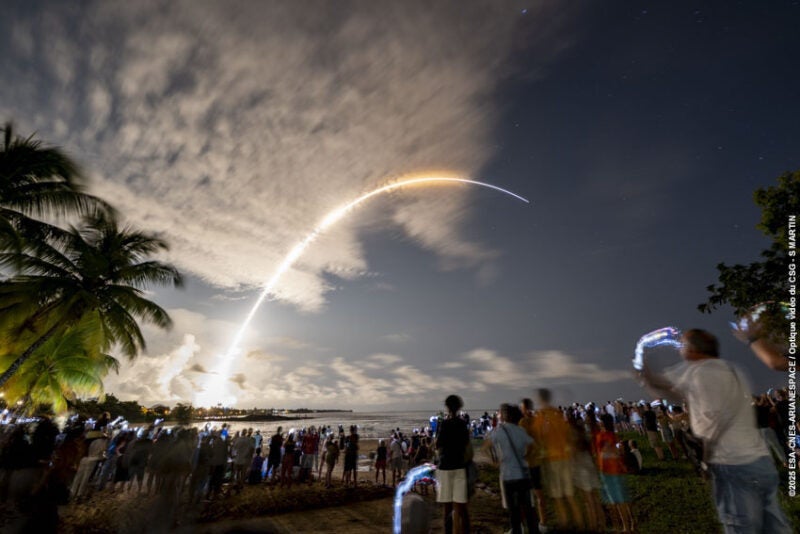
An Arianespace Vega C rocket launches the CO3D mission on July 25, 2025. Photo: Arianespace, ESA, CNES
Arianespace launched the second Vega C mission of 2025 on Friday evening, with Airbus Defence and Space‘s CO3D satellites and the CNES MicroCarb satellite.
The VV27 mission launched from Europe’s Spaceport in French Guiana on July 25 at 11:03 p.m. local time, and lasted 1 hour and 41 minutes.
The Airbus “Constellation Optique 3D,” or CO3D constellation satellites, is made up of four satellites. It is a partnership between Airbus and the French space agency, and will deliver a global high-resolution Digital Surface Model (DSM) service to CNES of 50 cm stereo imagery as well as 2D imagery for government and commercial customers.
CO3D will serve military cartography uses, as well as civil applications such as hydrology, geology, civil security, urban planning and land and resource management.
Also on the mission, the MicroCarb satellite is designed to map CO₂ emissions across urban areas using a dispersive spectrometer instrument. The satellite’s measurements will help verify climate targets and guide net zero strategies. Airbus provided the instrument for the satellite, which was integrated by Thales Alenia Space UK through a partnership with the UK Space Agency.
This was the fifth Vega C launch overall. The previous Vega C launch of this year was in late April for the European Space Agency’s Earth Explorer Biomass satellite.
“VV27 is a great example of what our teams do best: delivering complex missions with precision. Vega C successfully placed five satellites into two different orbits. This mission shows once again how Arianespace contributes to Europe’s autonomous access to space and supports Airbus and the CNES in launching innovative missions furthering our understanding of the Earth,” Arianespace CEO David Cavaillolès commented.
Stay connected and get ahead with the leading source of industry intel!
Subscribe Now