Latest News
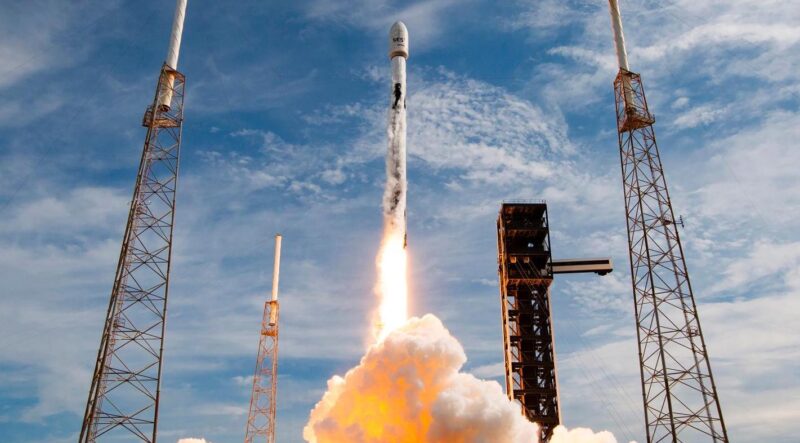
SpaceX launches the ninth and tenth O3b mPOWER satellites on July 22. Photo: SES
SpaceX launched the ninth and tenth satellites in SES’s O3b mPOWER constellation on Tuesday evening. These two satellites will join the first eight satellites already in service, adding capacity to SES’s Medium-Earth Orbit (MEO) constellation.
SpaceX launched the satellites on a Falcon 9 mission on July 22 from Cape Canaveral Space Force Station, lifting off at 5:12 p.m. ET. Manufacturer Boeing confirmed post-launch the satellites are healthy and going through checks.
SES started offering service from the next-gen O3b mPOWER constellation in April of last year, and the seventh and eighth satellites, which launched in December, entered service in June.
Boeing is the manufacturer of the O3b mPOWER constellation, and has three additional satellites in the constellation currently in production, scheduled for launch in 2026. SES said the additional O3b mPOWER satellites will bring up to a threefold increase in available capacity by 2027 when the entire O3b mPOWER constellation is fully deployed.
“Over the past year, our O3b mPOWER services have been transforming industries and empowering our key customers including telco operators, cruise lines, airlines, NATO, the government of Luxembourg, the government of United States and many other allied governments,” said Adel Al-Saleh, CEO of SES. “With this launch we continue adding incremental capacity to our initial O3b mPOWER constellation, strengthening our MEO network and delivering high throughput and predictable low latency services at scale.”
The two satellites launched on Monday as well as the seventh and eight satellites already in service feature redesigned payload power modules. Four of the first O3b mPOWER satellites had issues with their power modules, which led to the redesign with Boeing.
“We designed O3b mPOWER so each additional satellite beyond the first six boosts capacity, performance, and resilience,” said Michelle Parker, vice president, Boeing Space Mission Systems. “This capability stems from our investments in cutting-edge technology and the enhanced production techniques we’ve refined over the course of the program.”
The satellites join SES’s fleet just days after SES closed its acquisition of Intelsat, creating a multi-orbit operator with a combined fleet of approximately 90 Geostationary Orbit (GEO) satellites and 30 MEO satellites.
Stay connected and get ahead with the leading source of industry intel!
Subscribe Now