Latest News
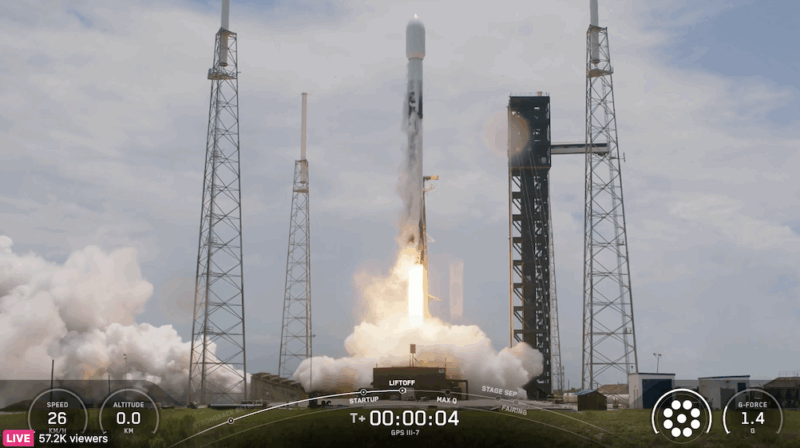
SpaceX launches GPSIII-7 space vehicle 08 mission on a Falcon 9 rocket on May 30. Screenshot via SpaceX
SpaceX launched a GPS III satellite for the U.S. Space Force on Friday afternoon in the second demonstration of accelerating the timeline to launch.
With the accelerated mission, the launch was executed in a timeline of three months, which involved collaboration between the Space Force, prime contractor Lockheed Martin, and SpaceX, including taking the GPS III satellite out of storage, expediting the launch vehicle integration, and preparing for launch.
The GPS III-7, space vehicle 08 mission to Medium-Earth Orbit (MEO) lifted off from Cape Canaveral Space Force Station in Florida on May 30 at 1:39 p.m. ET. The satellite was deployed approximately 1 hour and 30 minutes into the mission.
The GPS III satellites provide global positioning, navigation and timing signals to nearly 6 billion users around the world. The satellite is equipped with M-Code technology, military technology that is more accurate and resistant to jamming.
The Space Force swapped the GPS III-7 mission from a United Launch Alliance (ULA) Vulcan rocket to a Falcon 9 rocket. This is the second time the Space Force made a switch from Vulcan to Falcon. The December 2024 GPS III mission was originally planned to be launched by Vulcan, but Vulcan hadn’t received its national security mission certification yet. Vulcan was later certified in March.
Dr. Walt Lauderdale, Falcon systems and operations chief and mission director for this launch, said this GPS III launch was previously scheduled for later this year. The swap “allows us to get the M-Code up a little bit sooner than what we would have otherwise,” he said in a media roundtable on May 28.
With the change in provider, Space Force also swapped a later GPS IIIF-1 mission from a Falcon Heavy to a Vulcan rocket. There are “no plans” to consider swapping other GPS III missions, Lauderdale said.
The December “Rapid Response Trailblazer” launch was completed in approximately five months from initiation to launch, and Friday’s GPS III-7 mission was completed in just over three months, while the typical timeline is 24 months.
The accelerated timeline allows the Space Force to prove the resilience of the GPS III constellation, Col. Andrew Menschner, Mission Delta 31 commander, explained in the roundtable.
“We’re trying to prove that we can quickly respond to an on orbit failure of a vehicle. But we’re also trying to show the best ways to be resilient. Now that we have the timelines of launch headed to much shorter durations, one form of resilience is having a completed vehicle in the factory and ready to go to respond,” Menschner said. “We don’t always have to have a vehicle on orbit for it to be providing resilience in the constellation.”
Menschner added that for the GPS III constellation, he thinks “we can go faster than the three months” and “we’ll continue to refine our processes and move forward.”
Stay connected and get ahead with the leading source of industry intel!
Subscribe Now