Latest News
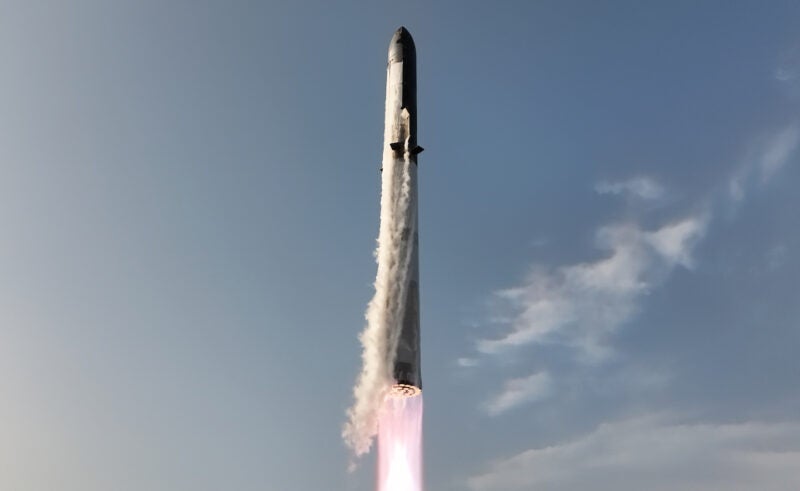
Starship’s 9th test flight resulted in uncontrolled reentry of both the first stage booster and Starship upper stage on May 27. Photo: SpaceX
SpaceX lost attitude control over its Starship rocket during the vehicle’s ninth test flight on Tuesday evening. Overall, the test resulted in uncontrolled reentry of both the first stage booster and Starship upper stage over the Indian Ocean. It marked the third test failure and another setback for the Starship program this year. SpaceX has been working this year to prepare Starship to fulfill NASA contracts to take astronauts to the Moon, and to support the company’s goal to reach Mars.
Starship’s ninth flight test took off from Starbase, Texas, at 6:36 p.m. CT on May 27. The vehicle ascended and went through a successful stage separation where the Super Heavy booster and Starship upper stage separated. This was the first time SpaceX has reused a Super Heavy booster in a Starship test.
But while the Super Heavy booster was headed back for a splashdown in the ocean, at a higher angle of attack than previous tests, SpaceX lost contact with the booster, which broke apart about six minutes into the mission.
The Starship portion made it farther than two previous tests in January and March of this year, which both broke apart over the Caribbean about 8 minutes into the flight. This time, Starship upper stage lit all six of its Raptor engines and was on a suborbital trajectory.
However, when SpaceX attempted to test the payload deployment system to deploy a set of dummy Starlink satellites, the payload bay door did not open.
Then, about 30 minutes into the mission, the vehicle started to spin. SpaceX’s launch broadcast host Dan Huot said the vehicle experienced a leak in a fuel tank system used for attitude control. SpaceX had planned to make a controlled reentry into the Indian Ocean to collect data on reentry.
SpaceX kept the live feed going during the test while the vehicle spun toward reentry, until contact was lost about 46 minutes into the flight. SpaceX explained in a post-launch statement that an “attitude control error resulted in bypassing the Raptor relight and prevented Starship from getting into the intended position for reentry.”
“It’s now coming down in the predetermined hazard area that was cleared ahead of flight, not controlled. We’re not going to get all of that reentry data that we’re still really looking forward to,” Huot said during the broadcast.
“This is a new generation of ship that has different flaps, improved heat shield, a whole lot of things that we are really trying to really put through the wringer,” Huot said toward the end of the broadcast. “There is a whole lot we still need to learn before we get to the next step that we’re hoping for — which is going to be that ship going orbital and eventually coming back here for a catch. Getting through one of these fully is going to be really important. It’s not going to be today.”
SpaceX said in a post-launch statement that all debris was expected to fall within the planned hazard area in the Indian Ocean. The Federal Aviation Administration nearly doubled the aircraft hazard area for Flight 9 after previous two flights sent debris beyond the closed aircraft hazard areas.
The FAA is requiring SpaceX to conduct a mishap investigation for the flight. The mishap investigation is “focused only on the loss of the Starship vehicle which did not complete its launch or reentry as planned. The FAA determined that the loss of the Super Heavy booster is covered by one of the approved test induced damage exceptions requested by SpaceX for certain flight events and system components,” the FAA said in a May 30 statement.
“All Starship vehicle and Super Heavy booster debris landed within the designated hazard areas. There are no reports of public injury or damage to public property,” the FAA said.
This story was updated on May 30 with the FAA’s mishap investigation statement
Stay connected and get ahead with the leading source of industry intel!
Subscribe Now