Latest News
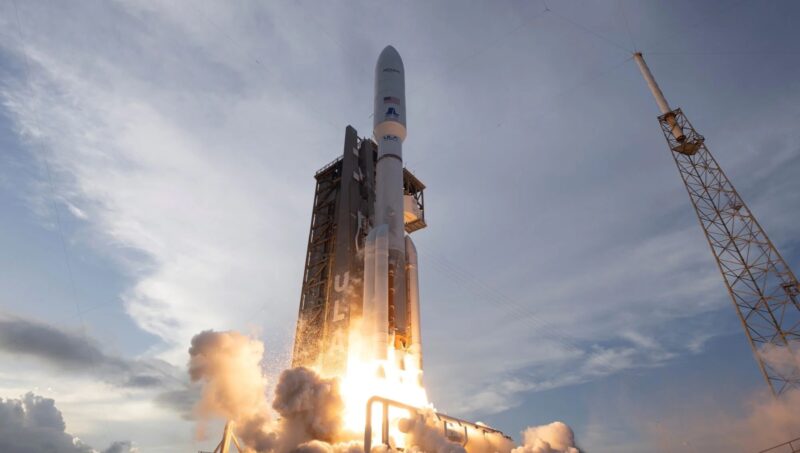
ULA launches the Kuiper 1 mission from Cape Canaveral on April 28, 2025. Photo: ULA
United Launch Alliance (ULA) launched the first full-scale mission for Amazon’s Project Kuiper constellation on Monday evening, starting the deployment phase of Amazon’s competitor to Starlink and OneWeb.
ULA launched 27 satellites in the Kuiper-1 mission on an Atlas V 551 rocket from Cape Canaveral Space Force Station in Florida at 7:01 p.m. EDT. The launch took place on Monday after a scrub earlier this month due to weather.
Amazon previously expected to begin Kuiper launches in 2024, and the company faces an FCC deadline to have half of the 3,232-satellite constellation launched by July 2026.
Project Kuiper is a satellite broadband constellation in Low-Earth Orbit (LEO) designed to provide internet areas with little to no broadband access. With the first 27 satellites, Amazon looks to validate its end-to-end network connectivity including satellites sending data through the internet, ground infrastructure, and user terminals.
In a video about the launch, Amazon said it has already deployed a number of its ground gateway sites around the world, including in Australia and Germany, with more brought online each month. Each site connects to Amazon Web Services (AWS).
ULA previously launched two prototype Kuiper satellites, which demonstrated two-way video calls and data transfers via the onboard optical inter-satellite links. The prototype satellites were deorbited last year.
Amazon said it has rolled out improvements over the prototype satellites, including phased array antennas, processors, solar arrays, propulsion systems, and optical inter-satellite links. Amazon is building its own satellites, and has invested in manufacturing in Washington state and satellite processing facilities in Florida.
“We’ve done extensive testing on the ground to prepare for this first mission, but there are some things you can only learn in flight, and this will be the first time we’ve flown our final satellite design and the first time we’ve deployed so many satellites at once,” commented Rajeev Badyal, vice president of Project Kuiper. “No matter how the mission unfolds, this is just the start of our journey, and we have all the pieces in place to learn and adapt as we prepare to launch again and again over the coming years.”
ULA is set to deploy a majority of the Kuiper constellation and has launch contracts in place for seven more Atlas V launches and 38 Vulcan rockets. Amazon also has launch contracts in place with Arianespace, Blue Origin, and SpaceX.
ULA has been modifying its launch facilities in Cape Canaveral to support the capacity for future Project Kuiper missions, including adding a second launch processing capability.
Ensign-Bickford Aerospace & Defense (EBAD) supported the mission with its NEA-based dispensing mechanisms that deploy the satellites from the launch vehicle. The company supplied a number of technologies for the Atlas V launch vehicle, including modular electronics channels, stage and fairing separation joints, and the flight termination system.
Stay connected and get ahead with the leading source of industry intel!
Subscribe Now