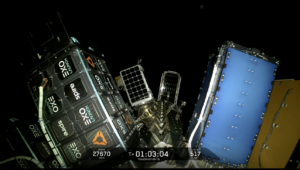

Xona has received FCC approval to deploy its commercial navigation constellation called Pulsar, planned for more than 250 satellites.
Xona announced Monday it has received authorization to broadcast radionavigation signals in L-band spectrum alongside GPS, expanded from its first demonstration satellite Pulsar-0 to the planned full constellation.
The company is preparing to launch its first six production satellites in October and scaling manufacturing in Burlingame, California.
Pulsar is designed to broadcast a proprietary signal in L-band, adjacent to GPS, so that the system can be integrated into many existing GPS receivers. The company claims its signals are up to 100 times stronger than GPS and are protected against spoofing through a dynamic cryptographic watermark. The Pulsar-0 demonstration satellite has completed more than 350 transmission passes and has demonstrated compatibility with existing GNSS.
“From the beginning, we were told that what we wanted to do was impossible,” said Brian Manning, co-founder and CEO of Xona. “A commercial company had never built a system like Pulsar, and no one had been authorized to introduce a new, high-power navigation signal alongside GPS. This decision is the culmination of years of engineering, testing and coordination, clearing the way for a capability the world increasingly needs.”