
DARPA awarded Redwire a $20 million contract to fly a second Very Low Earth Orbit (VLEO) test as part of its Otter program, Redwire announced Thursday.
The new award funds a rapid flight experiment, which will fly ahead of the full Otter VLEO mission, Spence Wise, senior vice president of Space Missions for Redwire, told Via Satellite. It will be a short-duration flight, lasting less than 24 hours, targeted for late 2027.
“This award funds the build and flight of a scaled spacecraft to test critical propulsion technologies sooner. The test will collect data that cannot be fully replicated on the ground and help reduce risk for the full Otter mission,” Wise said.
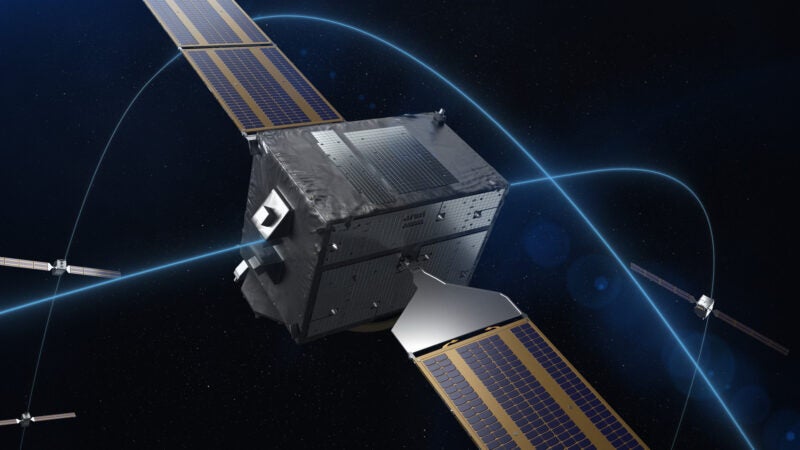
Redwire has been working with DARPA on the Otter program since 2024 and received a $44 million contract last year to build a spacecraft based on its SabreSat platform to advance “air-breathing” propulsion in VLEO.
DARPA describes the “air-breathing” propulsion capability as “harvesting ambient low-density air, and ionizing and accelerating the resultant ion flow, thereby utilizing a virtually unlimited supply of propellant.” DARPA has not publicly announced a date for the full Otter mission, which is intended to operate for more than one year
VLEO — altitudes of 90 to 450 kilometers — offers low latency for spacecraft and can have benefits for image resolution and sensor performance, Wise explains. “Those advantages can support reconnaissance, surveillance and target acquisition, as well as communications, giving operators better information from smaller spacecraft,” he said.
Yet VLEO comes with a higher level of atmospheric drag and spacecraft must compensate for that drag with propulsion. In order to operate in VLEO, spacecraft must minimize drag, provide sufficient electrical power for propulsion, and withstand exposure to atomic oxygen, he added.
Redwire is also working on a VLEO program for Europe, with the European Space Agency’s Skimsat mission. The company stated that these VLEO programs are contributing to develop “a new class of maneuverable, energy‑efficient spacecraft capable of supporting persistent operations in critical orbital regimes.”