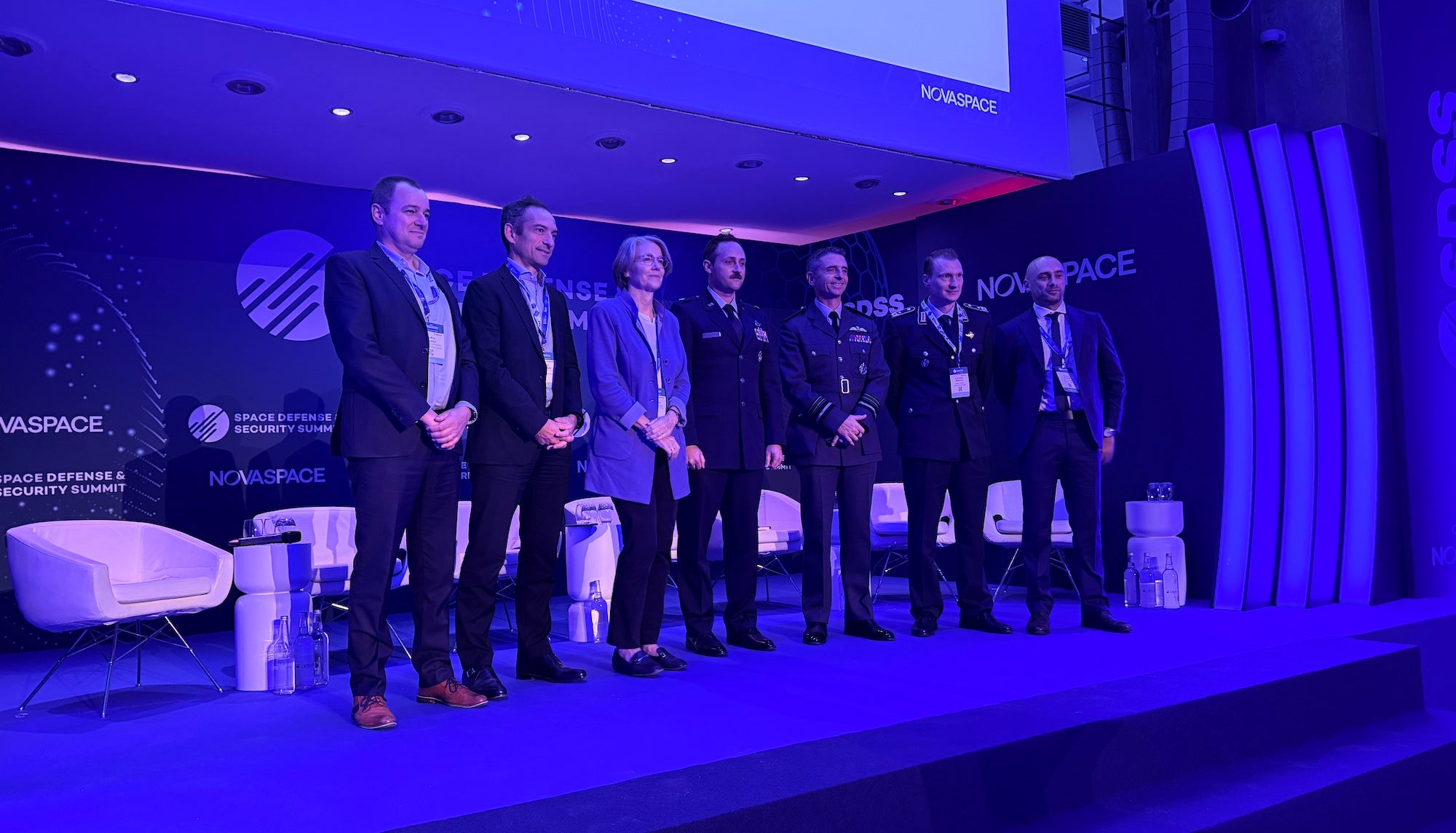
PARIS — Europe needs to embrace risk if it is to benefit more from next generation of space capabilities and keep its space assets secure. This was one of the key takeaways from a discussion on international alliances and cooperation in space security at the Space Defence & Security Summit on Tuesday.
Ahead of the discussion, Eva Portier, space deputy to the Director General for Armaments (DGA) in France admitted that “Space has become a domain of war,” and that we are currently witnessing is a changing nature of the space environment.
“Space is indispensable. It is becoming increasingly congested and contested. We are seeing more hostile activity. Cooperation is a fundamental part of our defense program,” Portier said.
Incentivize Member States
Portier’s keynote provided a backdrop for a panel on international cooperation in space security. European Commission Head of Unit Defence Policy Guillaume de la Brosse said there had been an “ambivalence” towards this cooperation, but it remains a must.
“Cooperation is in the DNA of the European Union. That cooperation is being challenged. There is a need for Europe to do much more, and that means space capabilities. We need to have more cooperation. We want to incentivize member states to invest in space capabilities,” he said.
de la Brosse said there are different pieces of the puzzle that need to be figured out. “Member states are investing heavily in space capabilities. How can we connect the dots between what the EU is doing and what member states are doing? How do we tap into the potential of the private sector? It has to be a very agile architecture to plug and play capabilities. We need space capabilities that are fit for purpose over the coming years. The intelligence itself is for member states. But we are helping member states in developing capabilities. But, how can we have EU based industry provide sovereign services? We need an industry that is fully up to speed and agile. Sovereignty matters.”
Marjolijn van Deelen, special envoy for Space, European External Action Service, said that the EU has expanded the geographic scope of its cooperation, as well as moving from civil cooperation to be much more focused on defense cooperation. “How do we perceive threats? What is our response? These are two high level of questions that we need to discuss with partners. It can get very complicated very quickly. We need to have the engagement at the policy level. For us, the big question is how we square this circle.”
Van Deelen says Europe is having to ponder a lot of existential questions here. “How do we connect the dots of all that is going on in the private sector? How do we do this as Europe, not just the EU. The EU space program is moving more towards defense and security,” she said. “We want to make sure there isn’t duplication. We want to have the freedom to operate in space. We want to have a coherent understanding with our member states. It won’t be a static picture. We see the space domain evolving so fast. Coalitions are evolving fast. It will need to be very adaptive over time.”
Air Marshal Paul Godfrey, assistant chief of Space Operation for Future Concepts and Partnerships, U.S. Space Force highlighted the fact that when NATO made space an operational domain in 2019 it changed the dynamics of the conversation and led to the first space commands outside of the U.S.
“This super-charged collaboration. However, space is inherently dual-use,” Godfrey said. “All of us don’t want to have war fight in space. You want freedom of action in space. You have to ask the question that when you see the increased threats, how is protect and defend being looked at from a European perspective? These are key questions.”
Godfrey also said when looking at space security, governments and the EU need to be more proactive here. He added, “Political buy-in through cooperation is important so we are being proactive through cooperation rather being reactive to an external event,” he said.
Taking Risks
One of the key themes of the panel was the ability for governments, and even Europe, as a whole, to embrace risk to move faster. Lt. Col. Paul Dragnich, chief of staff, International Affairs, for Space Force Space Systems Command, had some interesting views on this. He said when you talk about commercial, rigid military requirements should not define how commercial is developing.
“Commercial is moving faster than military. When we are thinking about trust and security, we need think about it in a different way. We need to take more risk, so we can iterate faster in the future. We need to take the same approach. We don’t have to wait for the perfect solution,” he said.
Dragnich said for an organization like Space Systems Command, its success in the short term will hinge on its ability to understand what cooperation looks like in the long-term.
“If we hesitate or slow down, and don’t accept some risk, we are going to slow down. We need to think about deeper long-term connections,” he said.
Lt. Col. Bjoern Rueckold, deputy director of NATO Space Centre of Excellence, said it all comes down to “information sharing.” He also talked about the importance of standards here. With so many countries looking to develop space capabilities, developing standards where countries can work together here is vital, he said.
Geoffroy Beaudot, head of Space Department, Luxembourg Directorate of Defence added, “We have to better define the requirements in Space. I know NATO is working on it. What are the requirements? If we have a better understanding, it will be easier for us to answer.”
Godfrey also bought up the issue of standards, making an old broadcast analogy. “In the past, we had different TV standards: NTSC and PAL. The EU and the U.S. need to have data standards. We need to be able to do exercises together,” he said.
The overall picture is with all of this extra investment in space, the need for more cooperation, even though individual nations has never been so important. It is clear there is much work to be done here if Europe is to really benefit from these next gen space capabilities and keep space networks and architectures in the future secure.