Latest News
Space Commerce Official Proposes Streamlined Mission Authorization Process for Novel Space Missions
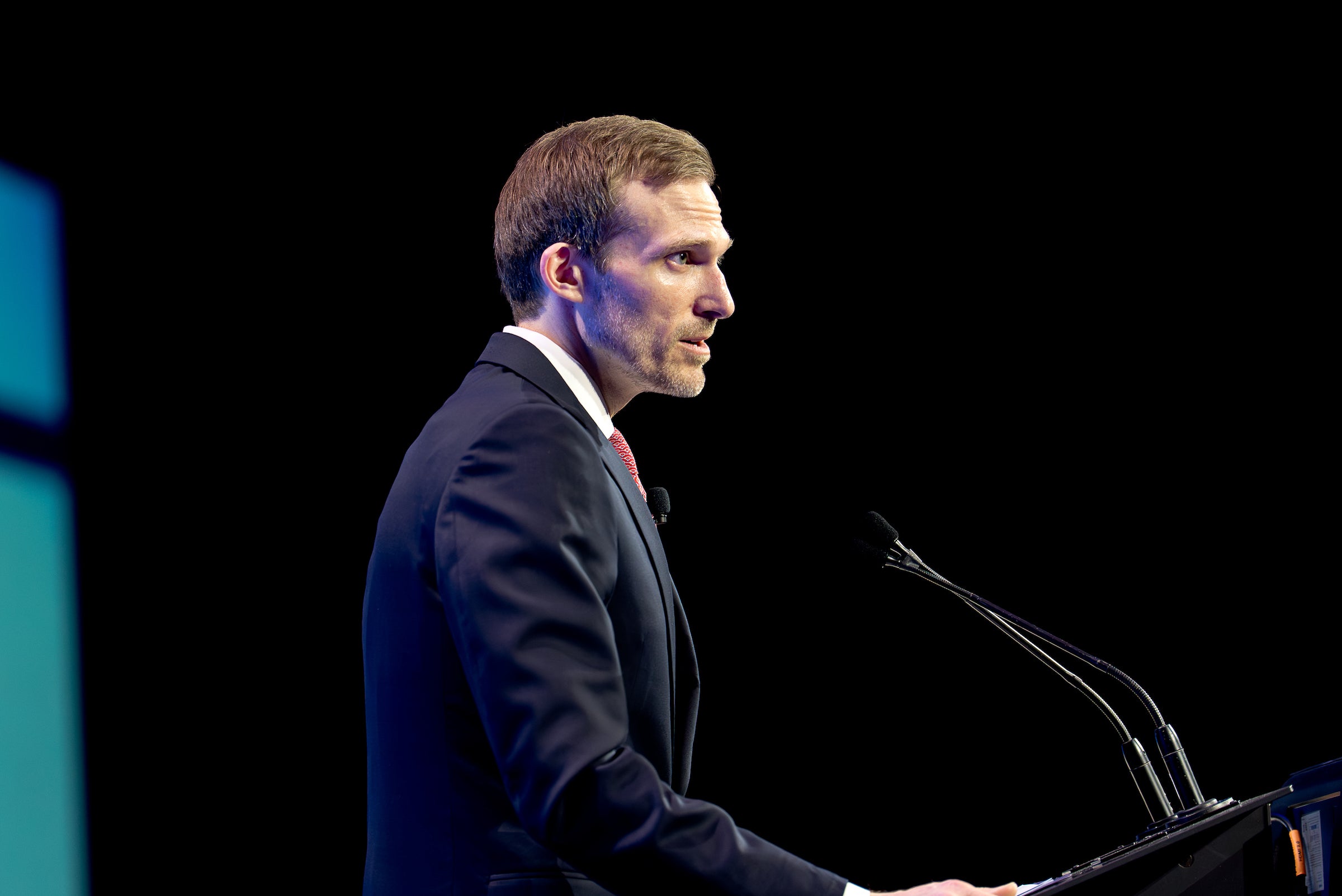
U.S. Office of Space Commerce Director Taylor Jordan. Photo: Brooke Bryand Creative for Access Intelligence
U.S. Office of Space Commerce Director Taylor Jordan announced the office’s proposal of a revamped mission authorization process for novel space activities in a keynote address during SATShow Week on Wednesday morning.
“We’re creating a process for which the Office of Space Commerce can be your belly button for the U.S. government,” Jordan said. “We aim to streamline regulations, have interagency conversations and approvals to ensure that we can, in turn, provide those to the other regulators, such as the FAA [Federal Aviation Administration] and the FCC [Federal Communications Commission].”
In a 15-minute speech, Jordan, who doubles as Assistant Secretary of Commerce for Environmental Observation and Prediction at the National Oceanic and Atmospheric Administration, said OSC is focused on reducing regulatory barriers to launching space missions and discouraging stricter regulations abroad.
Commerce Secretary Howard Lutnick appointed Jordan as director of OSC in December. In his dual role, he said, he helps coordinate the Trump administration’s priorities on civil satellites, data observations, and commercial space.
Jordan said OSC is presidentially mandated to help space missions “get to yes.” He said government often says “no” by default to the use of novel space technologies, due to unclear regulations.
“OSC aims to change that through our mission authorization work,” he said in the keynote. “We are working on a framework that allows the government to say yes to innovative space activities that don’t fit into traditional boxes, such as in-space servicing, assembly and manufacturing, active debris removal.”
To streamline current regulatory processes and comply with President Donald Trump’s Executive Order 14335, “Enabling Competition in the Commercial Space Industry,” Jordan said OSC had released its proposal for a new mission authorization process.
In a Tuesday news release, OSC published a 13-page proposal seeking feedback from the space industry, the public, and all stakeholders. The document suggests making OSC the single point of contact for space operators seeking regulatory approval.
Under the proposal, OSC would specify light-touch requirements for novel space activities. Companies would apply for a permission certification, then OSC would conduct a due-diligence review to ensure compliance while forwarding the application to other regulators such as the FAA and FCC. If no specific concerns are found, companies could proceed with approval within 120 days of submitting their application.
According to the proposal, the current process for payload approval requires separate filings to OSC, FAA, and FCC.
“This is a voluntary program, but it’s going to be fantastic, and we’re going to be able to get to ‘Yes’ for all of these missions that currently don’t have a clear pathway to ‘Yes,’” Jordan said.
Jordan also said OSC is closely monitoring developments in international space regulation, such as the drafted European Union Space Act, to ensure foreign regulations do not put US companies at an unfair disadvantage.
“Our team, in coordination with the whole of government and with our industry partners, have directly communicated our concerns about the implications of the EU Space Act and other foreign anti-competitive regulations that act as a barrier to trade,” Jordan said.
The EU Space Act is a legislative initiative launched last June that would standardize space regulations across the Union. It would require non-EU firms to register with the European Commission before providing services to its member countries.
Earlier this month, FCC Chairman Brendan Carr said in a statement that the U.S. would mirror Europe’s regulatory approach if it restricted the activity of non-EU companies.
“So if you’re part of an organization that might be impacted by changes to foreign market regulations, and I anticipate some of you may, I encourage you to reach out to my team and start a discussion,” Jordan said.
Jordan also said that OSC is deepening relationships with international partners and that it had recently held dialogues with Italy, New Zealand, and Japan.
Jordan did not address the Traffic Coordination System for Space (TraCSS), which provides space situational awareness services to orbital operators, in his address. OSC declined to respond to a request for comment regarding the program.
TraCSS was in the news last summer when President Donald Trump’s administration proposed massive cuts to the service and sparked outcry from space industry leaders.
Stay connected and get ahead with the leading source of industry intel!
Subscribe Now