Latest News
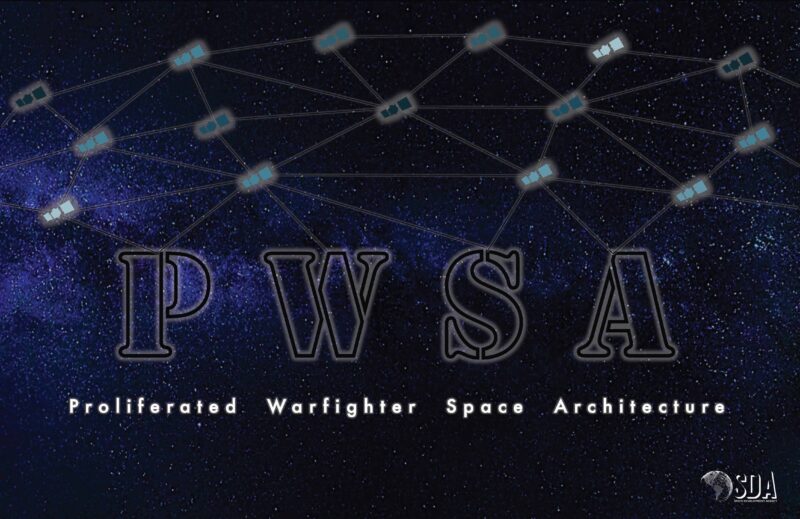
The Space Development Agency (SDA) has renamed its proliferated LEO constellation as the Proliferated Warfighter Space Architecture, or PWSA. Logo: SDA
A new government watchdog report on the Space Development Agency’s (SDA) proliferated constellation says the agency is overestimating the technology readiness of parts of the systems, and warns SDA is at risk of not delivering capabilities on schedule.
The Government Accountability Office (GAO) made six recommendations including that the SDA conduct tailored technology readiness assessment for new critical technology elements, and that it develops an architecture-level networked schedule.
An SDA spokesperson said in a statement to Via Satellite the agency disagrees with the specifics of many of the report’s assertions, yet will work through the recommendations.
The GAO released the report “Space Development Agency Should Be More Realistic and Transparent About Risks to Capability Delivery,” on Jan. 28 about the Proliferated Warfighter Space Architecture (PWSA). The PWSA aims to detect and track potential missile threats in Low-Earth Orbit (LEO).
The report found that the SDA assesses technology maturity at the satellite-level which is under-identifying maturity of enabling technologies like infrared payloads, optical communications terminals, flight software. Last year, GAO released a report on issues PWSA faced with optical terminal capabilities.
“SDA’s strategy to use commercial products in a novel way has led SDA to overestimate the technology maturity of some PWSA-enabling technologies. Furthermore, both space and ground contractors said that they underestimated the complexity of PWSA development and integration,” the report said. “With limited integrated capability demonstrated in [tranche] T0 … and complex integration and interoperability requirements remaining, the risk to delivering MW/MT [missile warning/missile tracking] capabilities in T1 is high.”
GAO reported the SDA faces “significant integration challenges” in Tranche 1 that were not addressed in Tranche 0.
Two batches of Tranche 1 satellites launched last fall, built by Lockheed Martin and York Space Systems. The Space Force has said Tranche 1 will provide an initial warfighting capability through the PWSA beginning in 2027.
The GAO report also reports that three combatant commands said they lack insight into how the SDA forms the requirements for each tranche. SDA works with a Warfighter Council to determine and refine the requirements.
“SDA is not providing combatant commands insight into the prioritization of submitted requirements and combatant commands are unsure when their operational needs will be met,” the GAO said. “As a result, combatant commands told us that, although they have submitted requirements, they are concerned that PWSA will not provide the data or coverage they need. Without collaboration with warfighter participants in identifying, defining, and prioritizing requirements, SDA is at risk of developing an architecture that falls short of warfighter needs.”
The report also found that the SDA has not developed a schedule at the architecture level. GAO also said that although satellites are being acquired “well below” historic DoD prices, “uncertainty remains in the life-cycle cost to deliver the MW/MT capability and SDA does not have a program office cost estimate for the missile warning/missile tracking capability.”
“DoD does not know how much the MW/MT capability will cost because it does not have a reliable cost estimate and SDA is not collecting the data it needs to develop one,” GAO said.
“The SDA planning documents we reviewed, which focus on major milestones such as design review events and launch dates, do not reflect the overall schedule challenges and nuances of moving from design to on-orbit capability for PWSA. In response to our repeated requests to see a government integrated master schedule depicting PWSA as a whole, SDA provided only high-level, static timeline pictures because it had not developed a schedule at the architecture-level,” the GAO report said.
GAO made six recommendations, that the SDA should “assess the technology readiness of new critical technologies; collaborate with warfighters on requirements and deferred capabilities; develop an architecture-level schedule and a reliable, data-informed cost estimate; and include requirements for cost data in new contract awards.”
It reports that the DoD concurred with five of the recommendations and partially with one recommendation.
In a statement to Via Satellite, Jennifer Elzea, SDA director of strategic engagement, said “in general, SDA disagreed with the specifics of many of the report’s assertions; however, the agency will work through the report’s recommendations to determine areas where we might improve our process, transparency, and warfighter capability delivery.”
“SDA’s spiral development model balances technical and programmatic risks in ways that were not previously accepted in space acquisition programs; however, these balanced acquisition risks are likely to result in operational capabilities ultimately delivered more quickly to the warfighter. This approach closely aligns with the Secretary of War’s acquisition reform principles, including: taking a commercial-first approach, accelerating fielded capabilities through reduced bureaucracy, enhancing industrial base capacity, and increasing flexibility,” Elzea said.
Elzea added that SDA works “in close collaboration” with the Warfighter Council.
Stay connected and get ahead with the leading source of industry intel!
Subscribe Now