Latest News
SDA Sees Path Forward to Begin Testing Space-Based Link 16 Connectivity Over the US
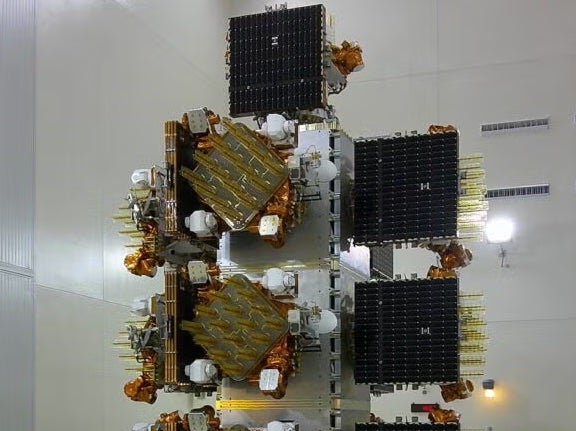
York Space Systems’ T1TL full stack of 21 satellites. Photo: York Space Systems
NATIONAL HARBOR, Md. — Testing last spring on the impact of Link 16 radio signals broadcast from space on the national airspace showed no impact and should clear the road to allow routine testing over the continental U.S., the acting head of the Space Development Agency (SDA) said on Monday.
A report has been delivered to the Defense Department’s Chief Information Office based on the testing at Eglin Air Force Base in Florida in April that showed a “very low signal” from the Link 16 communications aboard the satellite as it passed through the national airspace and “we did not see any signal of any useful strength that could interfere with things,” Gurpartap “GP” Sandhoo said at a media roundtable during the Air Force Association’s Air Space Cyber conference. “They have to go do their due diligence to make sure it does not impact anything.”
“We are really, really close to resolving that,” he said.
Sandhoo did not know the timeline for when approval for this type of Link 16 testing would be given but expects whenever CONUS testing occurs a Notice to Airmen (NOTAM) will be required. The Federal Aviation Administration issues NOTAMs to alert pilots and flight personnel of potential anomalies in the airspace.
Currently, SDA is testing Link 16 communications from space using its Tranche 0 satellites with assets on the surface and in the air over allied airspace. The links enable the transfer of data between various systems and platforms.
SDA’s evolving Proliferated Warfighter Space Architecture (PWSA) will include spacecraft that provide missile warning and tracking capabilities and others that deliver communications worldwide.
Earlier this month, SDA launched the first 21 Tranche 1 Transport Layer (T1TL) satellites into orbit. York Space Systems, the prime contractor for these communications spacecraft, still owns the satellites and is responsible for ensuring they are mission ready and transit to their respective orbital planes. The launch occurred on Sept. 10 and two days later York confirmed contact and the health of each spacecraft.
York’s satellites are power positive, thermally safe, and remain “clustered together” as they progress through the checkout phase before the propulsion burns that will put them in their proper orbits, Sandhoo said, citing the latest update from the company to his agency. They also still have to go through a crypto checkout, he said.
Separately on Monday, York said it has successfully demonstrated a space-to-ground optical laser communication link aboard one of its Tranche 0 Transport Layer (T0TL) satellites with an SDA optical ground terminal. The company said more than 1.5 million frames were successfully transmitted, “validating the performance of York’s optical communications integration in partnership with SDA’s PWSA.”
The Transport Layer satellites are designed to provide resilient, low-latency, high-volume connectivity to U.S. and allied warfighters worldwide.
“By demonstrating secure, high-capacity links for missile warning, tracking, and tactical transport, York is demonstrating that these technologies can be fielded rapidly to meet the nation’s evolving mission demands,” Melanie Preisser, vice president and general manager of York, said in a statement.
The T0TL satellites were launched in April 2023 as demonstration and test assets.
Stay connected and get ahead with the leading source of industry intel!
Subscribe Now