Latest News
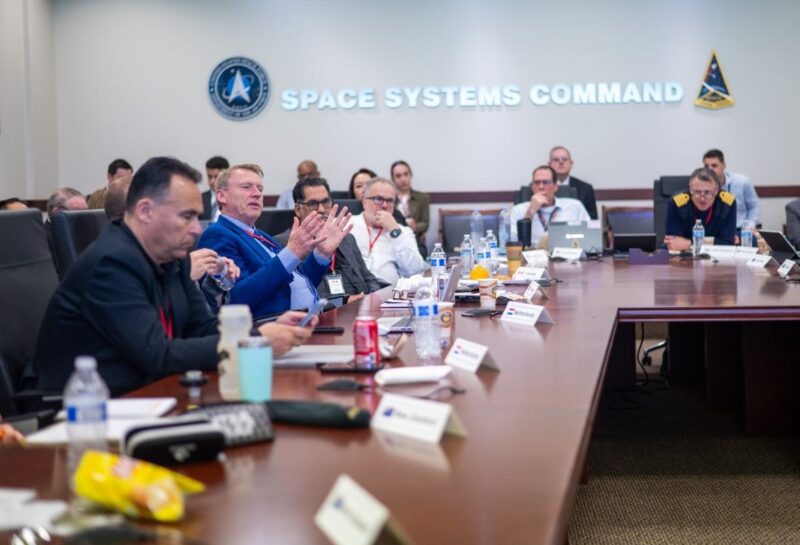
Trond Hermansen, from Norway, comments during the 9th Allied SATCOM Future Architecture Working Group conference on May 5-7 at Space Systems Command in California. U.S. Space Force Photo
The House Armed Services Committee’s (HASC) fiscal 2026 defense bill would require the Chairman of the Joint Chiefs of Staff to establish a Title 10 requirement for the tactical, surveillance, reconnaissance, and tracking (TacSRT) program and would mandate that the Department of the Air Force fund TacSRT as a “program of record.”
Until now, TacSRT has been a pilot program using commercial data analytics for the benefit of the combatant commands (COCOMs). The Department of the Air Force did not budget for TacSRT in fiscal 2024 and fiscal 2025, but Congress funded the program at $40 million in both fiscal 2024 and 2025.
In April, an U.S. Space Force Space Systems Command (SSC) official said that COCOM demand for TacSRT has been high and that COCOMs had POMed money on their own for the program, which the official said has aided U.S. efforts to share space data with allies.
SSC is collaborating with the Defense Innovation Unit to develop a multi-orbit Hybrid Space Architecture of commercial and government systems. Yet, the HASC bill said that the Department of the Air Force needs to step up funding for hybrid terminals on aircraft.
The department’s investment in commercial space “has resulted in the development of multi-orbit software-defined radios and antennas capable of providing resilient communications through access to at least two frequency bands and satellites in three different orbital planes,” HASC said.
“These advancements have the potential to transform long-range communications across the Air Force fleet,” according to the bill. “However, the committee is concerned that the necessary funding to implement these systems on aircraft has not been adequately addressed in the president’s Budget Request. The committee directs the Secretary of the Air Force to submit a briefing to the House Committee on Armed Services not later than December 30, 2025, on the Air Force plan to install resilient Hybrid SATCOM terminals on Air Force platforms and include the timeline for developing requirements, programing funding and installation milestones.”
In May, the National Geospatial-Intelligence Agency (NGA) and Space Force signed a memorandum of agreement on their respective TacSRT roles.
A combat support agency, NGA maintains an extensive collection of tactical imagery from commercial vendors through the Global Enhanced GEOINT Delivery (GEGD) trove to respond to COCOM requests. Maxar Intelligence supports GEGD for NGA.
Stay connected and get ahead with the leading source of industry intel!
Subscribe Now