Latest News
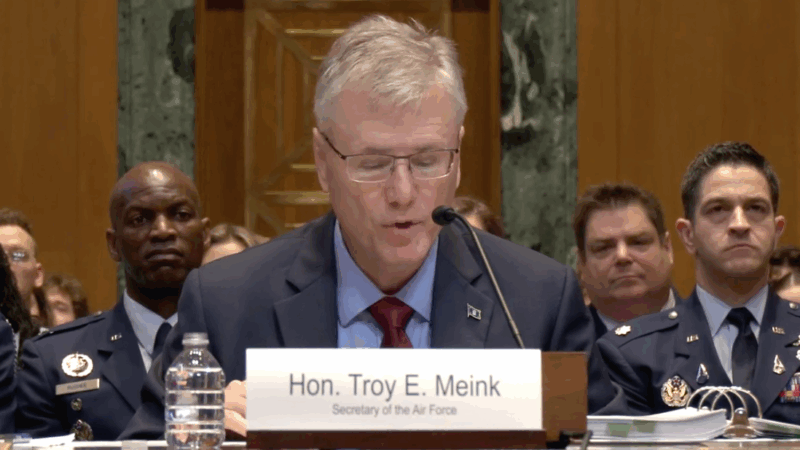
Air Force Secretary Troy Meink during a Senate hearing for the President’s Fiscal Year 2026 Budget Request for the Air Force and Space Force on June 26. Screenshot via Senate.gov
The U.S. Space Force’s fiscal 2026 budget request provides $277 million for the MILNET proliferated Low-Earth Orbit (LEO) constellation and halts funding for the Space Development Agency’s Tranche 3, Transport Layer effort for advanced LEO communications satellites.
The Space Force $277 million request combines two program elements and derives from a National Reconnaissance Office (NRO) classified MILNET effort, based on SpaceX‘s Starshield. The Department of the Air Force, which is conducting an Analysis of Alternatives on future satellite communications, intends MILNET to be a “plug and play” architecture that is not SpaceX-reliant.
“In the FY 26 budget we learned DoD is halting the Space Development Agency’s Tranche 3, Transport Layer and that work which has been going on for several years and had robust competition and open standards has been replaced by something called MILNET, which is being sole sourced to SpaceX,” Sen. Chris Coons (D-Del.), the ranking member of the Senate Appropriations Committee’s defense panel, said at a Thursday hearing on the Department of the Air Force’s fiscal 2026 funding request.
“No competition, no open architecture, no leveraging of dynamic space ecosystem,” Coons said of MILNET.
Coons then asked Air Force Secretary Troy Meink, “Doesn’t handing this to SpaceX make us dependent on their proprietary technology and avoid the very positive benefits of competition and open architecture?
“Tranche 2 is still funded in the budget submission, including the Transport Layer, so we’re looking forward to delivery of that system over the next handful of years,” Meink responded. “As we go forward, MILNET, the term, should not be taken as just a system. How we field that going forward is something that’s still under consideration, and we will look at the acquisition of that.”
Coons then said that he would “deeply appreciate a classified briefing” from Chief of Space Operations Gen. B. Chance Saltzman “on exactly where this [MILNET] is going and why this particular decision was made.”
SDA has extensively publicized the Proliferated Warfighter Space Architecture (PWSA), including the communications and missile warning satellite constellations.
PWSA Tranche 2, Transport Layer contractors include Lockheed Martin, Northrop Grumman, York Space Systems, and Rocket Lab USA.
SDA had been reported to pause releasing an RFP for Tranche 3 Transporter Layer until it recieved budgetary guidance. SDA has already taken industry proposals for Tranche 3 Tracking Layer (T3TRK). The Tracking layer focuses on detecting advanced missile treats, and the Transport Layer is a data transport layer with interconnected optical inter-satellite links.
Meink took office as the 27th secretary of the Air Force last month.
Before Meink’s nomination in January as Air Force secretary, he served, since October 2020, as the NRO’s principal deputy director. There, he spurred acceleration of NRO’s use of fixed price contracts. Some national security analysts have said that Meink has had a close working relationship with SpaceX founder Elon Musk and have expressed conflict of interest concerns because of that relationship.
Meink has said that he favors multiple competitions over defense modernization programs’ lifetimes.
Stay connected and get ahead with the leading source of industry intel!
Subscribe Now