Latest News
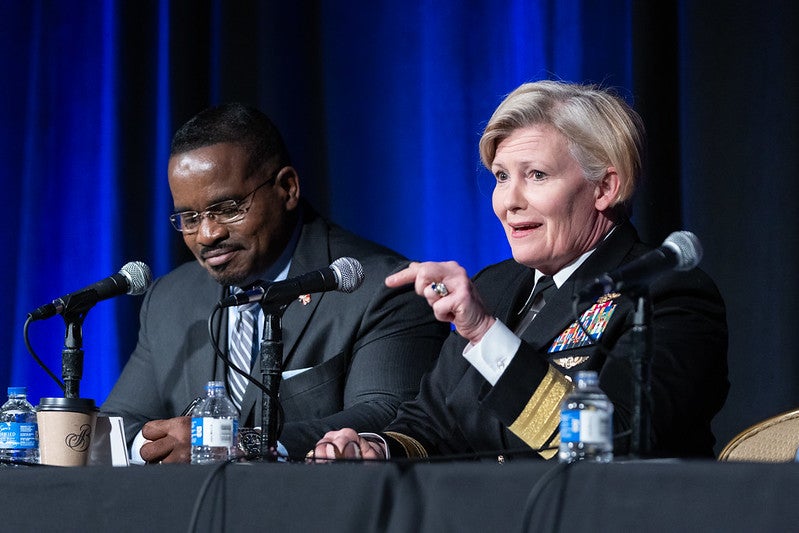
U.S. Navy Rear Adm. Heidi Berg, right, and Ricky Freeman, Kuiper Government Solutions, left. Photo: Space Foundation
COLORADO SPRINGS, Colo. — As the commercial space industry is investing in space communications with satellite constellations, terminals, and networking technologies, the U.S. military is working through how to bring space communications to the tactical edge.
In a Space Symposium panel on April 10, Ricky Freeman, president of Amazon Kuiper Government Solutions, compared it to the U.S. military having a lineup of basketball legends like Michael Jordan, Scottie Pippen, and LeBron James on the same team, but running the risk of losing the game because technical capabilities operate in silos.
“As a country, we are leading the development of space. However, when it comes to integrating space as an operational domain, I think we all agree we are at par with our adversaries,” Freeman said. “We have developed unprecedented capability to capture, analyze, and exploit information — but our ability still to transport that data at speed, particularly to the tactical edge — lags behind what is needed to compete.”
The military needs to enhance its relationship with the commercial sector, and integration is lacking, said U.S. Navy Rear Adm. Heidi Berg, deputy commander Fleet Cyber Command, deputy commander, Navy Space Command. “We don’t have the level of expertise that we need in the Navy or in the Joint Force to be able to truly integrate space capabilities across the board,” she said. “It’s a real risk.”
The Navy has a particular reliance on space operating over the horizon, and needs to have the same level of understanding for the space domain as the undersea, maritime, land, and air domains. This can be done through better integrating space capabilities into troop education at every level from entry level through senior level courses, and improving modeling and simulation, Berg said.
She called for “modeling and simulation capabilities that accurately reflect the capabilities we have both in space and the space domain. To allow us to visualize it, as well as how that interacts with the other domains, and reflect the nuances of cyber capabilities and cyber threats, and EW [electronic warfare], as well as space kinetic maneuver and kinetic effects,” Berg said. “It is that interaction that provides the magic for us to be able to drive to the next level.”
When it comes to integrating space communications at the tactical edge, it needs to be as intuitive as possible for the warfighter, said Thomas Lockhart, director of the Capability and Resource Integration Directorate (J8), Space Command. “Just remember who the tactical edge is and make it as simple as possible.”
Lockhart recalled when he served in Iraq and Afghanistan, the radios he used were complex to deal with. “I have an engineering degree, and in certain cases, I couldn’t figure out how to turn it on and get it connected. We can’t do that. We have to make it simple.”
He wants to see capability that when soldiers or sailors turn it on, they don’t have to worry about how to connect, and security is already built-in, immediately available to them.
One step government can take to incentivize commercial entities to build government capabilities into commercial systems is to be more open to describing the effect the government wants to achieve with a certain capability, said Charlotte Gerhart, deputy program executive officer of the MilComm & PNT Directorate in Space Systems Command.
“If I can tell industry what I would like to do — not how to do it — they have a lot more opportunity and desire to work with us,” Gerhart said.
Different types of systems for communication require different levels of protection and classification. “If I can describe the effects and the benefits, commercial industry would be far more interested in meeting those needs, and I have to communicate that broadly.”
Predictable cash flow from the government is a key part of incentivizing commercial companies to want to work with the government.
“I have no commercial base if there’s not cash flow,” Gerhart said. “If we can set up a case where not only do I get consistent cash flow so that commercial industry can plan for it, but [also] if I can have consistent cash flow in the government, then I can set that to my industry base as well.”
Sam Mehta, president of Communication Systems for L3Harris, argued that in a shift toward hybrid commercial/military partnerships, requirements will have to change. The definition of success might change and stakeholders should not let perfect be the enemy of the good.
“We need to have the stakeholders define and [be] aligned on what’s good enough, and then be open enough to accept some level of failure,” Mehta said. “[We need to be] very, very open to the idea that we might have to change, sometimes significantly, what we’re doing to get there and not call that a failure, not call that a waste of time.”
For example, Mehta pointed out that interoperability comes with trade-offs. A radio programmed with exquisite, DoD-specific waveforms, may not also have the compute capability to also go over waveforms that allies work with.
Optimizing for interoperability, “may mean some trade-offs from time to time. That capability will not necessarily be optimized for one service or one mission in one environment. It’s going to be optimized for interoperability, which means that there might be some trade-offs in the requirements,” Mehta said.
Stay connected and get ahead with the leading source of industry intel!
Subscribe Now