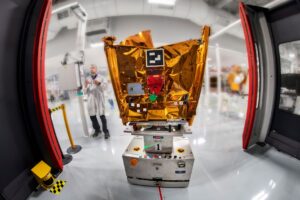

Gilat Satellite Networks lowered its annual outlook as delays to satellite launches and in-flight connectivity (IFC) deliveries impacted the company’s revenue in the third quarter.
Gilat slashed its growth forecast for 2026 from 13% to 3% year-over-year. The new guidance is revenue between $455 million to $475 million, compared to previous guidance of $500 million to $520 million.
Gilat reported Q3 financials on Nov. 10, as revenue of $116 million was essentially flat year-over-year. The Defense business grew 53% year-over-year to about $37 million, but Commercial business declined 4% in the same timeframe to about $70 million.
Management is still bullish on the opportunity in U.S. government business as it goes through approvals for the Comtech acquisition, which is expected to boost its U.S. defense business.
In Q3, the company’s business broke down to 60% Commercial, 32% Defense, and 8% Peru.
CEO Adi Sfadia detailed a number of challenges to the commercial business as one large Low-Earth Orbit (LEO) constellation customer is experiencing delays due to launch availability. That customer has pushed back delivery on Gilat’s solid state power amplifiers (SSPAs).
Sfadia detailed pressures across the commercial environment. “We feel the pressure on almost all commercial subsegments, especially on the enterprise and cellular backhaul. Because there [are] significant delays in GEO satellite launches, there are relatively no new networks that are up for grabs, so that’s delayed orders. There are still several satellites that are expected to be launched in the second half of 2027 and 2028. We do expect to see nice orders probably at the beginning of 2027 onwards,” he said.
IFC Future Still Looks Strong
Gilat also rescheduled IFC deliveries with some installation delays, and is negotiating some of its IFC contracts to have better unit economics on retrofit installations.
On the IFC market trends overall, Sfadia noted that while Starlink is gaining market share, Gilat’s customers continue to win new orders for IFC business. He expects “significant” orders for the Sidewinder antenna in 2027.
“We are providing a unique terminal that allows resiliency between LEO and GEO. There is no such antenna available today in the market,” he said. “If you don’t want to choose Starlink and you want GEO/LEO resiliency, you need to go with … Gilat equipment.”
The Sidewinder terminal is a multi-orbit terminal that operates with the OneWeb Ku-band network. Sfadia also stated that Gilat has begun initial work on a multi-orbit terminal that would be able to connect to Ku-band and Ka-band terminals in LEO.
The Peru segment, which is the smallest portion of Gilat’s business, saw a steep decline of more than 50% during the quarter, which management attributed to a delayed contract award, which pushed revenue to 2027.
Comtech Deal to Boost U.S. Defense Growth
Leadership said the Defense growth in Q3 was driven by increasing demand for multi-band mobile, rapidly deployable satcom solutions, particularly Specifically, the Gilat DataPath $32 million award for multi-band DKET systems supporting U.S. defense network resilience.
Asked about the U.S. midterms, leadership said Gilat remains confident in the outlook for the U.S. defense business, noting that much of Gilat’s defense business is related to the core U.S. defense budget, not the more variable reconciliation budget.
“Political changes can influence budget priorities and timing, but the need for resilience, secure mission-critical communication continues to increase,” Sfadia said. “The acquisition of Comtech Satellite and Space Communication business will strengthen our position in the U.S. and it’ll increase our product portfolio and we’ll be in direct touch with the relevant Department of Defense entities, together with Gilat existing capabilities.”
Sfadia said the Comtech acquisition is awaiting approval from the Committee on Foreign Investment in the United States (CFIUS), which he believes is on track. Gilat, which is based in Israel, received similar approvals for its acquisitions of DataPath and Stellar Blu. The Comtech acquisition is still expected to close this year, he said.
Gilat expects Comtech to add more than $180 million in revenues annually and more than $80 million in adjusted EBITDA.
The Comtech S&S business has its own challenges as Comtech recently reported the S&S business posted a net loss of $17.9 million in Comtech’s fiscal year 2026. This is much improved from a net loss of $136 million in fiscal year 2025.