Latest News
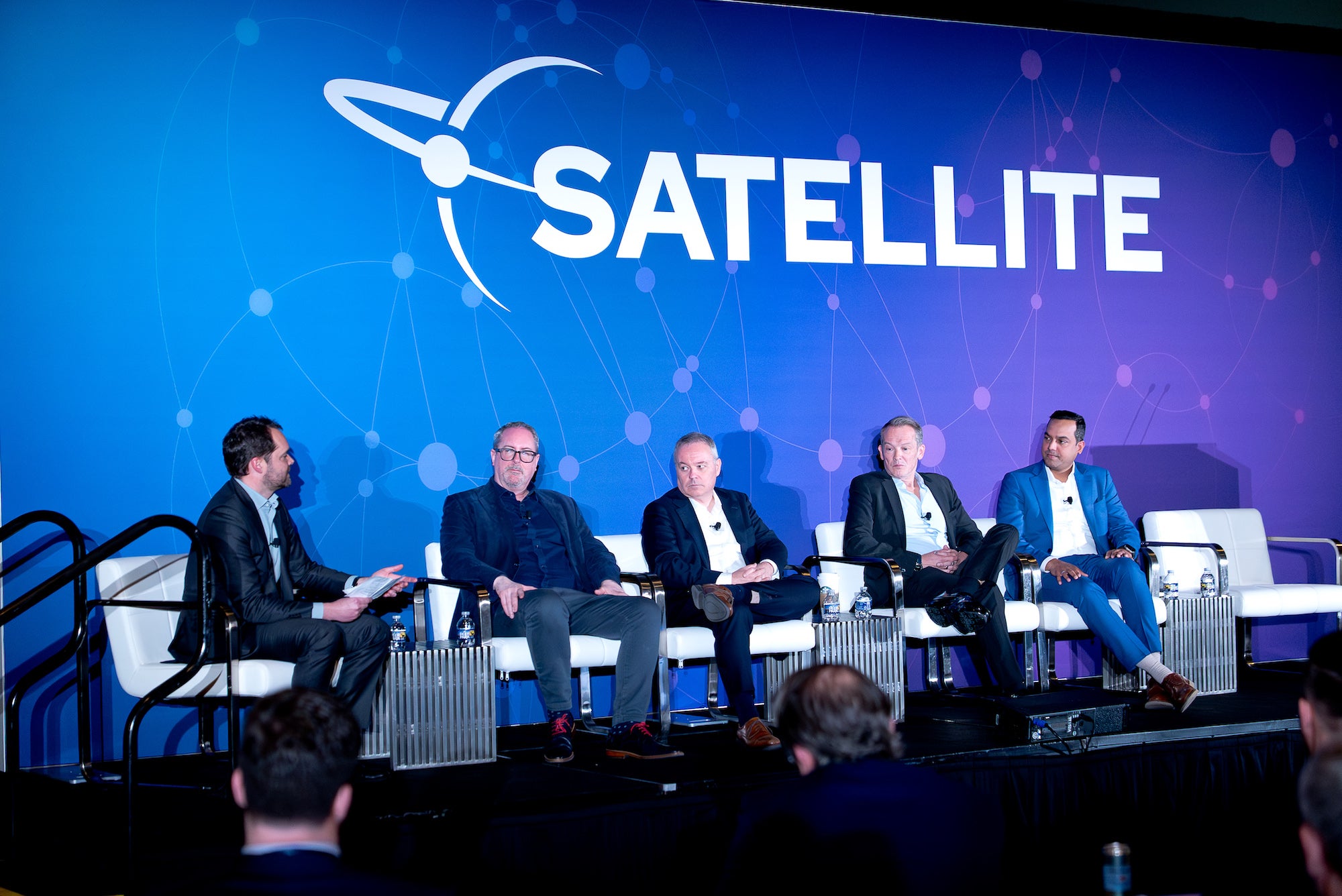
Photo: Brooke Bryand Creative for Access Intelligence
The way the commercial space sector is financed needs to catch up with the huge advances industry has made in its capabilities, venture capitalists at a SATShow business panel said March 24.
From an investment point of view, the space sector is undergoing the first throes of maturation, with the arrival of major players like sovereign wealth funds, infrastructure investment firms, and even traditionally conservative pension funds, said Mark Boggett, CEO of Seraphim Space.
“What we are seeing is that space is now being viewed as a strategic asset class by a much broader range of investors than the past,” he said, adding the new players will “really change the landscape,” creating a new capital base for the space sector that could finance “more audacious opportunities.”
The SpaceX IPO expected later this year, which could value the company at more than $1.5 trillion, will be a tipping point, in terms of bringing new players to the space investment marketplace, said Raphael Roettgen, founding partner of E2MC Ventures.
“In terms of the maturation of the financing ecosystem, it’s going to be a giant catalyst. It’s going to accelerate what’s going on, because any investment banker or analyst who thought they didn’t have to look at the space sector, they have to look at it now or lose their job.” The same would be true for asset managers on the buy side, Roettgen added.
Roettgen applauded the idea of more publicly listed space companies, calling U.S. public equity markets one of the nation’s “biggest strategic assets.” Developing the space economy is a giant undertaking requiring the whole spectrum of financing. The market’s ability to raise “billions, tens of billions, hundreds of billions of dollars over time,” makes them an essential tool.
He added that “from a societal point of view,” public markets are more accessible. Investors in private companies have to be “accredited and qualified” — which typically translates to wealthier investors, Roettgen said. Public companies allow people of more modest means to invest “in the wealth generation that’s going to happen.”
But one panelist, recalling the failures of several space sector special purpose acquisition companies (SPACs) and previous examples of market exuberance, said he is worried about the ability of retail investors to accurately value space companies in the current climate.
“I am a little concerned about public markets investors looking at the space sector and not understanding the level of risk,” said Michael Mealling, a general partner with Starbridge Venture Capital. The SPAC debacles showed that companies without a viable business plan could capitalize on high profile successes to fleece investors.
“The dirty little secret was that most of the SPACs were companies that were rejected by venture capital funds,” Mealling said, “Not every company that goes public is a good company. You have to do your own due diligence.”
Having lived through the first dot com bubble of 2000, he joked, “I like things to be a little bubbly, but I hope we don’t rely on that.”
Companies like SpaceX and Anduril have been successful and dominant enough to make their own reality, Mealling said. They have “the ability to attract enough of the talent to be able to force it to become true,” while being insulated by vertical integration.
“They‘re able to say, ‘I don’t care how it has been done. I’m going to go into the future and drag the alien dreadnought back with me and murder the entire rest of the competition in a redefined market,’” Mealling said.
But such talent is rare. “As an investor, do I invest in a company assuming that the CEO is the next Elon Musk? No. There’s a very limited number of people that can do that. But when you see it happening, don’t bet against it.”
Roettgen, a Wharton graduate, acknowledged that the efficient market hypothesis — the idea that the price of a company’s equity fully and completely represents its value — “is in the same category as Santa Claus or the Tooth Fairy.” Yet he said that public markets are still better than private ones. “For the very simple reason that, in the public market you can bet against the company. You can’t do that in a private market,” he said.
The emergence of new financing tools for the space sector is long overdue, noted the only non-VC on the panel.
Shipping is arguably the one of the oldest industries on the planet, said Praveen Vetrivel, CEO of Space Leasing International, yet it is one of the most sophisticated when it comes to financing and investment products. “There are all kinds of indices and trades and options that you can use to invest in the shipping industry without ever physically dealing with any actual vessel,” he said.
By contrast, three years ago, when SLI first started applying the leasing model used for airliners and shipping to satellites, it found the sector had rather primitive financing arrangements, Vetrivel said.
“The space industry, which is one of the most forward-looking and technologically advanced [sectors], yet you looked at the financial engineering, and it was people turning up with double bags of cash,” he joked. “There was this sort of disconnect.”
Stay connected and get ahead with the leading source of industry intel!
Subscribe Now