Latest News
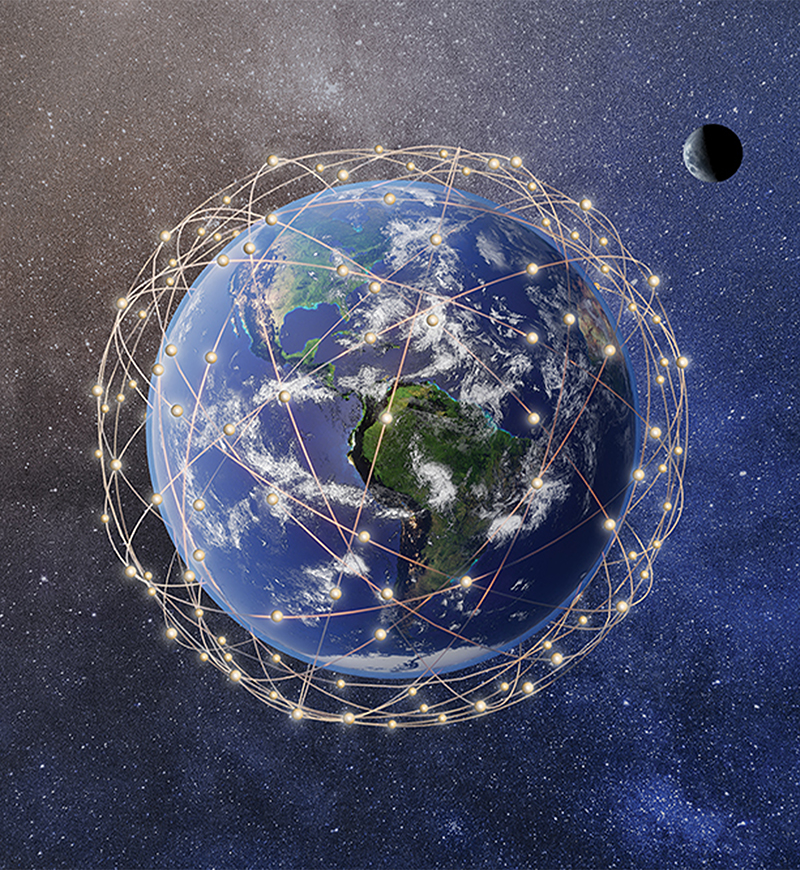
Rendering of Telesat’s Lightspeed LEO constellation. Photo: Telesat
Telesat’s Lightspeed Low-Earth Orbit (LEO) constellation won’t enter service until 2028 due to delays with the ASICs that power the satellites’ onboard processors.
The constellation was targeted to enter service around the end of 2027, but will now enter service around the end of the first quarter of 2028, CEO Dan Goldberg told investors on Tuesday. Telesat announced the schedule slip on Tuesday, along with its full year 2025 financial results.
The change is due to delay with the application-specific integrated circuit (ASIC) supplied by SatixFy. Goldberg said these chips were “one of the key schedule risks” on the program. MDA Space, Telesat’s prime contractor, acquired SatixFy last year.
“We’re tracking the development of these chips pretty forensically,” Goldberg said. “Based on the assurances we’re getting from MDA, we feel good that the chips will be available in time to support the program schedule.”
Goldberg confirmed the first satellites are scheduled to launch at the end of this year, and Telesat has a “heavy launch cadence” planned throughout 2027.
Adding Military Spectrum to Lightspeed
Separately, Telesat plans to add 500 MHz of military Ka-band (Mil-Ka) spectrum to 156 satellites in Lightspeed, to better meet the needs of defense and sovereignty programs.
CEO Dan Goldberg explained to investors that Mil-Ka spectrum is adjacent to the commercial Ka-band spectrum used by Lightspeed, so this change won’t have any adverse schedule impact and will have a “modest” cost impact of around $25 million (U.S. dollars).
Goldberg called this a “massive” increase in bringing Mil-Ka band capacity to market, which has historically been in Geostationary Orbit (GEO) systems like Wideband Global Satcom (WGS) and the U.K.’s Skynet.
“It’s not just the sheer quantum of capacity we’re bringing — the performance characteristics are so much more compelling. It’s high throughput, low latency, distributed, which makes it more resilient. It covers the poles, which [aligns with the] heavy focus on the Arctic right now. We will be able to make that capability available, not just to the government of Canada, but to all of the allied nations, NATO, and other allied governments,” Goldberg said.
Goldberg explained that with Mil-Ka spectrum, Lightspeed will be “better positioned” to meet some of the requirements of Canada’s Enhanced Satellite Communications Project – Polar (ESCP-P). Both Telesat and MDA Space signed a partnership agreement with the government in December for a multi-frequency, Arctic milsatcom capability. Goldberg said that contract is still under negotiation.
2025 Financial Results
Telesat’s revenue declined by 27% in 2025, inline with the midpoint of guidance it gave last year. Telesat reported consolidated revenue of $418 million Canadian dollars ($305 million).
The decrease was attributed to both rate and capacity reductions from North American direct-to-home (DTH) customers and lower revenue from enterprise customers serving rural broadband markets.
Goldberg noted that the GEO business faces “structural challenges,” but beat adjusted EBITDA guidance for 2025. Adjusted EBITDA for the full-year 2025 was CA$213 million ($155 million).
“Within the constraints of what’s essentially a fixed cost business, we’ve optimized our cost structure where we can to maximize the cash flow of that business,” Goldberg said of the GEO business.
At the end of 2025, Telesat’s GEO backlog was CA$800 million ($584 million). Lightspeed backlog was CA$1 billion ($730 million) at the end of the year.
Stay connected and get ahead with the leading source of industry intel!
Subscribe Now