Latest News
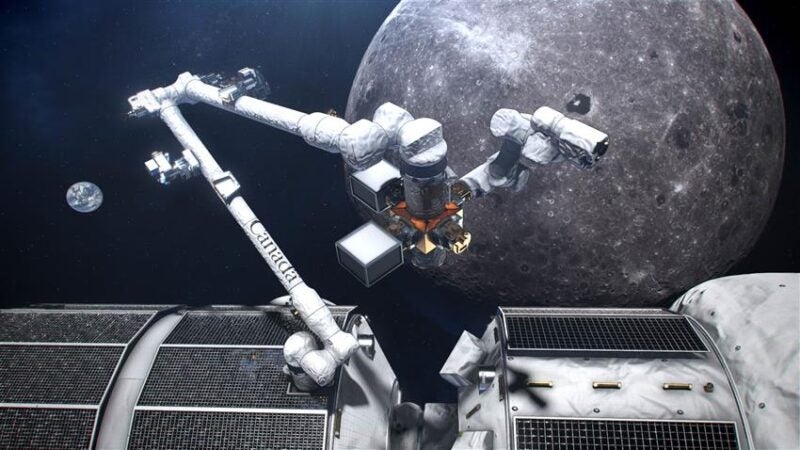
An artist’s concept of Canadarm3’s large arm on the Lunar Gateway. Photo: CSA, NASA
MDA Space grew revenue 68% year-over-year in the first quarter of 2025 as the manufacturer ramps up work on satellite constellation projects for Telesat and Globalstar. CEO Mike Greenley addressed the tariff situation and further constellation opportunities in an investor call on Thursday, while looking to reassure investors about MDA Space’s Canadarm3 contract.
President Trump’s budget proposal for NASA released on May 2 looks to end the Gateway program, which is part of the Artemis program and intended to be a long-term orbit outpost of the Moon. MDA Space is under contract with the Canadian Space Agency to build Canadarm3, the successor to the Canadarm2 robotic arm on the ISS, which will be hosted on the Gateway.
MDA Space’s stock dropped 18% last Friday after the “skinny” budget was released, but has since recovered some of the dip.
Greenley emphasized that MDA’s contract is with the Canadian Space Agency, not NASA, and there has been no change to MDA Space’s contract. He also emphasized this is part of the budget process and not a final budget for NASA. MDA Space is progressing as normal on the program.
“We will continue to work fully through 2025 I would expect, and I would expect there would be significant work beyond that whenever the budget is done,” Greenly said. “I know that all the parties are working on what different purposes on the Moon or commercially, [that] Canadarm3 can service in the future. We are a very, very long way away from talking about any changes to our contract structure.”
He added that MDA Space is also bidding on a number of commercial space stations for similar robotic technologies, and looking at other opportunities like lunar mobility programs, orbit operations, and space exploration opportunities.
Demand for Satellite Programs and Tariff Impact
The company’s Satellite Systems segment more than doubled revenue, with 55% year-over-year growth to $222 million Canadian dollars ($159 million) with the ramp up of the Telesat Lightspeed program and the Globalstar next-generation LEO constellation program.
Meanwhile, the Geointelligence segment revenue was essentially flat at CA$51.7 million ($37 million), and the Robotics & Space Operations segment grew 9.5% to CA$77.3 million ($55.5 million), with the ramp up of the Canadarm3 program.
Greenely addressed demand for satellite systems, saying he is seeing interest in both broadband and direct-to-device, but there is more momentum in direct-to-device constellations.
“We have a very strong pipeline. We’re in a very good position with a number of additional constellations, and all that remains in place,” he said. “I would say all of the premiere constellation projects that are available for competition would probably be talking to MDA Space in one way or another … We are not losing any competitions.”
Tariffs have become a bigger subject in contract negotiations, but Greenley said MDA Space sees the U.S. tariff situation as “very manageable.”
He said a preliminary analysis suggests that most of the products MDA Space exports, including finished satellites, are largely compliant within the United States–Mexico–Canada Agreement.
A large portion of the company’s backlog and supply chain is based outside of the U.S. Greenley said 80% of the company’s backlog is outside of the U.S. A little over 25% of the company’s supply chain for satellite manufacturing is based in the U.S.
Backlog at the end of March was CA$4.8 billion ($3.45 million), an increase of CA$1.5 billion year-over-year, due to the Globalstar order.
MDA Space reaffirmed its full year financial outlook, expecting full year revenues to be CA$1.5 billion to CA$1.65 billion, which would be 45% year-over-year growth at the mid-point.
Stay connected and get ahead with the leading source of industry intel!
Subscribe Now