Latest News
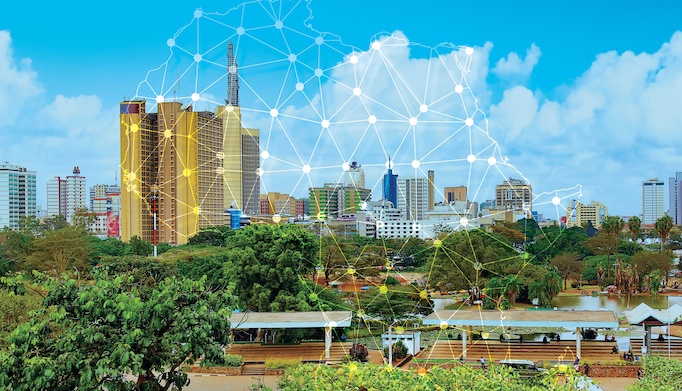
Photo: Via Satellite illustration/Shutterstock
With a large landmass of 11.7 million square miles, Africa has been a challenging place to set up satellite services. But that is changing. As of September, 2025, more than 21 African countries have established space programs and 18 have launched at least one satellite, according to the Africa Center for Strategic Studies. Now the real work of digital inclusion, enterprise application, and national development connecting millions of Africans begins, industry experts shared during SATShow Week.
Africa is one of the fastest growing satellite markets in the world with limited terrestrial infrastructure and growing demand for connectivity. African nations and companies have launched a combined total of 65 satellites, with over 120 additional satellites in development and expected to be launched by 2030.
“Satellite services will be the main product driving the market in Africa in the next five to 10 years,” Jane Nkechi Egerton-Idehen, CEO of Nigerian satellite operator Nigcomsat said. “For a population of over 1 billion, there is less than 50% broadband penetration. There’s still a need to breach that divide. It is still an interesting market with a huge potential, but growth will definitely come from broadband.”
There were about 100,000 terminals in service in Africa about four years ago, according to Anshu Vij, managing director of EMEA, for Hughes Network Systems. They were capacity constrained. They were not going to operate. “Today, there are over half a million subscribers in Africa on satellite product.”
Because of the African terrain, service delivery is sometimes difficult, Vij said. It used to be the case that only one terminal could be installed in a day, but the technology has improved and terminals can be much more quickly deployed.
Vij believes that service distributor partnerships both in government and enterprise are a key driver to grow broadband access in Africa.
Egerton-Idehen agreed that working in partnership with the government is key, adding that many governments in Africa are focused on digital access and digital economy. “In Nigeria, we want to have people have access to government e-services, like ID cards and international passports,” she said. “But the truth is that it’s easier in the urban areas, because that’s where there’s access. In the rural areas, there is no access. Over 70% of the citizens are in the rural areas. So governments are now forced to create access in those areas so citizens can access those services.”
There will be an election in Nigeria later this year, and officials are working toward electronic transfer of the election results. “That means in almost every local government area we need access, but we still don’t have that. So there are development opportunities there,” Egerton-Idehen said.
Governments remain the largest clients of satellite services, she added.
Jean-Phillipe Gillet, president of the Fixed and Maritime vertical of SES, said the mission is to provide satellite as complementary to terrestrial network. “To do that, you need to reform the edge,” he said. “Satellite has always been on the edge when you have absolutely no other solution. It’s expensive, it’s difficult to deploy. You need to rethink being satellite connectivity as part of the edge, part of the core network, really expanding.”
But Egerton-Idehen, a former satellite engineer, questioned why satellite has been expensive to deploy, calling attention to expensive, proprietary terminals.
“One of the reasons is because it’s been a closed off system. I think that has been a weakness. And in Africa, it’s a big issue. Users will buy your terminal. But if anything happens, you have to buy another terminal to use the same service. Why does the terminal have to cost more than $500, when the segment of the market we are trying to serve, the rural areas, is the segment that cannot afford $500 for a terminal?”
Gillet said SES’s main channel to market is to provide services to mobile network operators, citing a specific partnership Africa Mobile Networks, which operates in deep rural areas where less than 2,00o people may live in a village. There’s business to be found in rural areas, Gillet stressed. “When you make money, you can scale it, because that means you’re able to raise more funding in order to deploy,” he said.
While there are challenges to gaining deeper penetration in the African satellite market, Egerton-Idehen sees challenges as opportunities.
“There is a pent-up demand in Africa,” she said. “It’s still a market that’s fully untapped. It’s high risk, high reward. If you do have an appetite for risk, Africa is the market that is calling.”
Stay connected and get ahead with the leading source of industry intel!
Subscribe Now